
Parker-Hannifin Strengthens Position Through Supply Chain Resilience and Credit Facility Expansion
The latest quarterly report highlights Parker-Hannifin’s tactical supply chain management and increased financial flexibility amid ongoing market pressures.
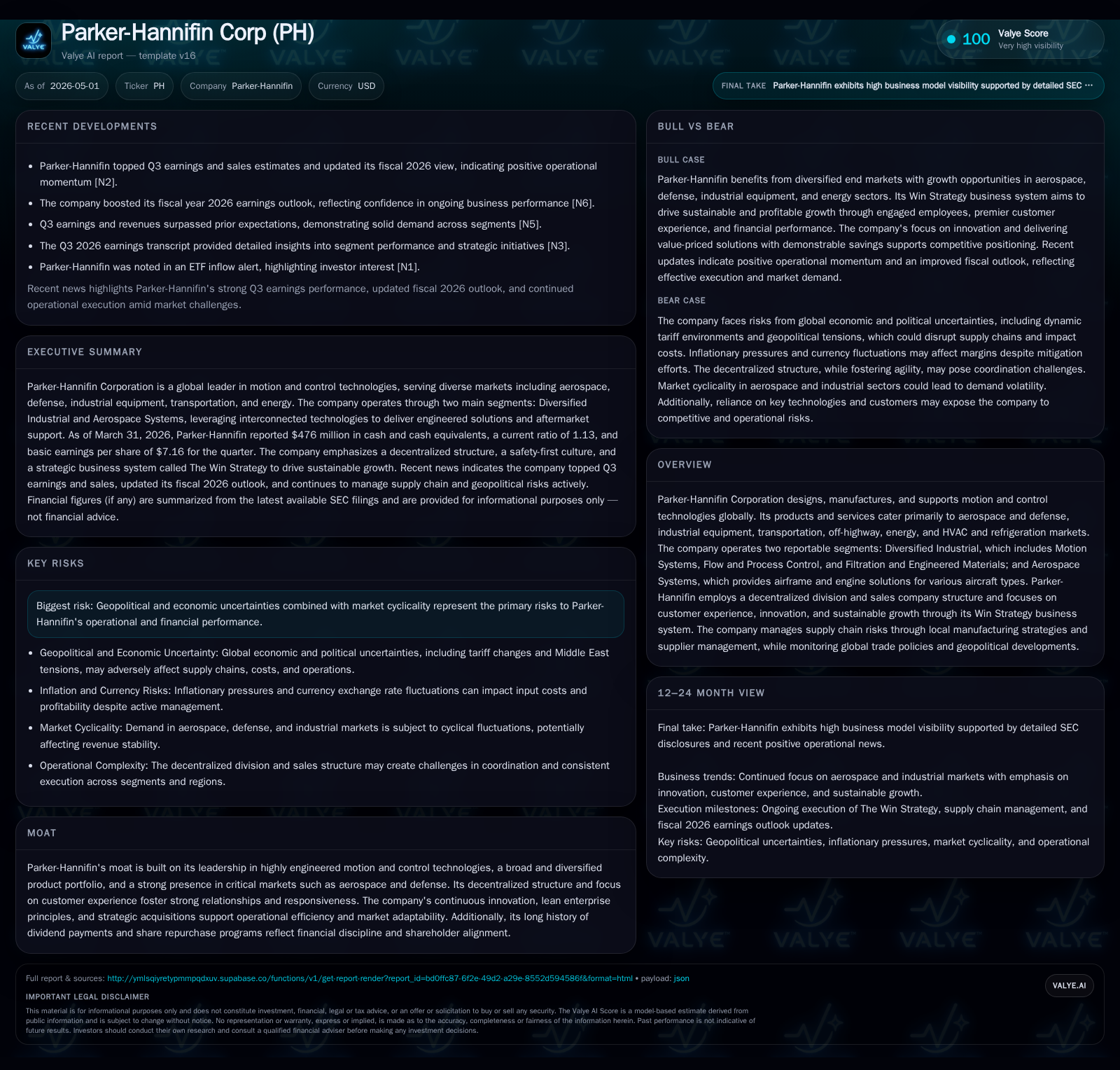
In Q3 2026, Parker-Hannifin reinforced its operational stability by expanding its revolving credit line to $3.75 billion and advancing a 'local for local' manufacturing strategy to buffer supply chain risks. The company manages inflationary pressures through cost and pricing initiatives while continuing lean enterprise improvements. Its diversified industrial and aerospace segments benefit from strong OEM relationships, innovation, and a decentralized sales network, supporting growth despite cyclical headwinds. Focused business realignment in Europe aims to simplify operations and enhance margins going forward.
Q3 2026 Operating Update: Supply Chain and Capital Position
Parker-Hannifin’s latest 10-Q filing dated May 1, 2026 emphasizes strategic moves that fortify operational resilience amid challenging macroeconomic conditions [S2]. Central to this effort is the company’s “local for local” manufacturing approach which prioritizes producing goods close to end-markets. This reduces exposure to transportation disruptions, tariffs, and geopolitical volatility while expanding the supplier base for broader sourcing options.
Moreover, the firm actively monitors global trade policies alongside inflation trends. Management implements cost controls paired with pricing adjustments to offset input cost pressures. These disciplined measures are complemented by continuous improvement programs embracing lean principles and strict workforce plus discretionary spend oversight. Collectively these form a multilayered defense against inflationary erosions.
Financially, Parker-Hannifin enhanced liquidity by amending its revolving credit agreement in August 2025 to increase the total line of credit—and corresponding commercial paper program size—to $3.75 billion [S2]. The facility matures in June 2028 with an option for annual one-year extensions providing structural flexibility. This enlarged credit line underpins short-term funding needs and supports opportunistic investments or acquisitions.
Also notable are ongoing business realignment activities primarily in Europe involving plant closures and organizational simplifications designed to reduce complexity [S2]. Though these actions incurred severance-related charges in fiscal 2026 akin to prior years, management expects positive operational impacts without material liquidity effects.
Business Model: Diversified Industrial and Aerospace Technologies
Parker-Hannifin operates two reportable segments capturing distinct yet complementary industrial domains. The Diversified Industrial segment bundles Motion Systems, Flow and Process Control, Filtration, and Engineered Materials businesses catering to aerospace & defense OEMs, industrial equipment makers, transportation & off-highway vehicle producers, energy sector applications, HVAC/R markets among others.
Engineering sophistication is high across these units with products ranging from precision hydraulic components to filtration solutions integral to complex machinery performance. Customers pay primarily OEMs who depend on Parker’s reliable component integration to meet stringent quality standards.
The Aerospace Systems segment focuses on airframe structures and engine systems supplying commercial transport aircraft manufacturers as well as defense contractors. It serves both original equipment manufacturers (OEM) directly and offers aftermarket support to operators extending component lifecycle value.
The company’s decentralized divisional structure enables tailored regional sales strategies fostering deep customer engagement. This hallmark enhances switching costs—key in industries where downtime is costly—and allows agile responses to specific technological demands or regulatory requirements.
Competitive Positioning and Industry Structure
Within motion and control technology sectors characterized by capital intensity, long product development cycles, and regulatory oversight—especially in aerospace—Parker-Hannifin commands a protective moat. Its breadth of product offerings coupled with engineering rigor creates high barriers to entry.
Continuous innovation fueled by the Win Strategy business system strengthens this positioning by driving product pipeline advancements while improving operational efficiency using lean methods. Strategic acquisitions such as Curtis Instruments augment capabilities in electric motor controls aligning with emergent electrification trends in mobile machinery.
Supplier network expansion combined with localized production mitigates capacity bottlenecks prevalent in global supply chains faced by competitors. Regulatory compliance mandates in aviation maintain strong OEM relationships where reliability is paramount.
Growth Drivers: Innovation, Customer-Centricity, and Market Demand
Key growth vectors for Parker-Hannifin arise from several interconnected factors:
- Innovation pipeline acceleration through the Win Strategy supports differentiated products increasing value capture.
- Lean enterprise initiatives are beginning to yield margin benefits partially visible in reduced realignment charges compared with prior years [S2].
- Recovery trends in commercial aerospace aftermarket parts drive stable revenue streams integral given cyclical new aircraft build rates.
- Electrification of mobile equipment touched upon by the Curtis acquisition opens growing markets requiring advanced motor speed controllers complementing hydraulic solutions.
- Global infrastructure investments support demand for reliable industrial equipment featuring Parker’s fluid handling technologies.
Volume growth pairs with selective pricing initiatives designed to balance inflation pass-through without compromising order intake.
Risks and Headwinds: Geopolitical, Economic Cyclicality, and Operational Complexity
Parker-Hannifin faces multiple risk vectors mixing external macro factors with inherent operational challenges:
- Ongoing geopolitical tensions impact raw material availability along with tariffs influencing input costs necessitating vigilant price-cost management [S2].
- Economic cycles affect capital spending patterns particularly in transportation and off-highway sectors; defense spending fluctuations also impart variability especially on the Aerospace Systems segment.
- Inflationary pressures remain persistent globally requiring adaptive pricing mechanisms but may compress margins if sustainment falters.
- Complexity reduction efforts via European plant closures carry short-term disruption costs though aimed at longer-run profitability gains [S2].
- Foreign currency exchange fluctuations can influence reported earnings given international operations.
Near-Term Watchpoints: Guidance, Capacity Utilization, and Realignment Outcomes
Upcoming milestones that warrant close monitoring include:
- Quarterly guidance updates indicating effectiveness of pricing strategies against inflationary headwinds [N1][N2].
- Execution progress on simplification actions including plant closures impacting operating efficiency metrics within Europe [S2].
- Backlog conversion rates especially from aerospace OEM customers which serve as a leading indicator for revenue visibility.
- New product launches stemming from the Win Strategy measurable through booking increases or EBIT margin improvements highlighted in investor communications.
- Integration results from recent acquisitions reflecting synergy realization without excessive integration drag.
Collectively these will shape near-term confidence levels around sustainable margin expansion potential beyond cyclical noise.
Latest Financial Snapshot
Latest financial snapshot
| Metric | Value | Period |
|---|---|---|
| Cash & equivalents | $476mm | |
| 2026-03-31 | ||
| Total debt | $6.8bn | |
| 2026-03-31 | ||
| Net debt | $6.3bn | |
| 2026-03-31 | ||
| Current assets | $7.6bn | |
| 2026-03-31 | ||
| Current liabilities | $6.7bn | |
| 2026-03-31 | ||
| Current ratio | 1.13x | |
| 2026-03-31 |
Source: SEC companyfacts cache [F1].
| Metric | Amount (USD) |
|---|---|
| Cash & Equivalents | 476 million |
| Total Debt | 6.77 billion |
| Net Debt | 6.29 billion |
| Current Assets | 7.61 billion |
| Current Liabilities | 6.74 billion |
| Current Ratio | 1.13 |
As of March 31, 2026, Parker-Hannifin maintains a moderate leverage profile with net debt of approximately $6.29 billion after factoring cash reserves [F1]. The current ratio of 1.13 reflects adequate near-term liquidity supported by the recently expanded $3.75 billion revolving credit facility expiring mid-2028 [S2]. This solid financial footing underpins both working capital needs related to inventory management amidst supply chain challenges as well as strategic investment flexibility moving forward.
This analysis synthesizes publicly filed SEC disclosures alongside recent market reports without offering investment advice or recommendations. All numeric data adhere strictly to cited official filings within the stated period.
Disclaimer: This is research-only, informational analysis and not investment advice. It may include AI-generated interpretation and general industry context. Always verify important details using primary sources.

Comments