
Genie Energy Expands Solar Portfolio and Navigates Deregulated Market Challenges in 2025
Latest filings reveal Genie Energy’s strategic growth in renewables alongside regulatory headwinds in U.S. retail energy markets.
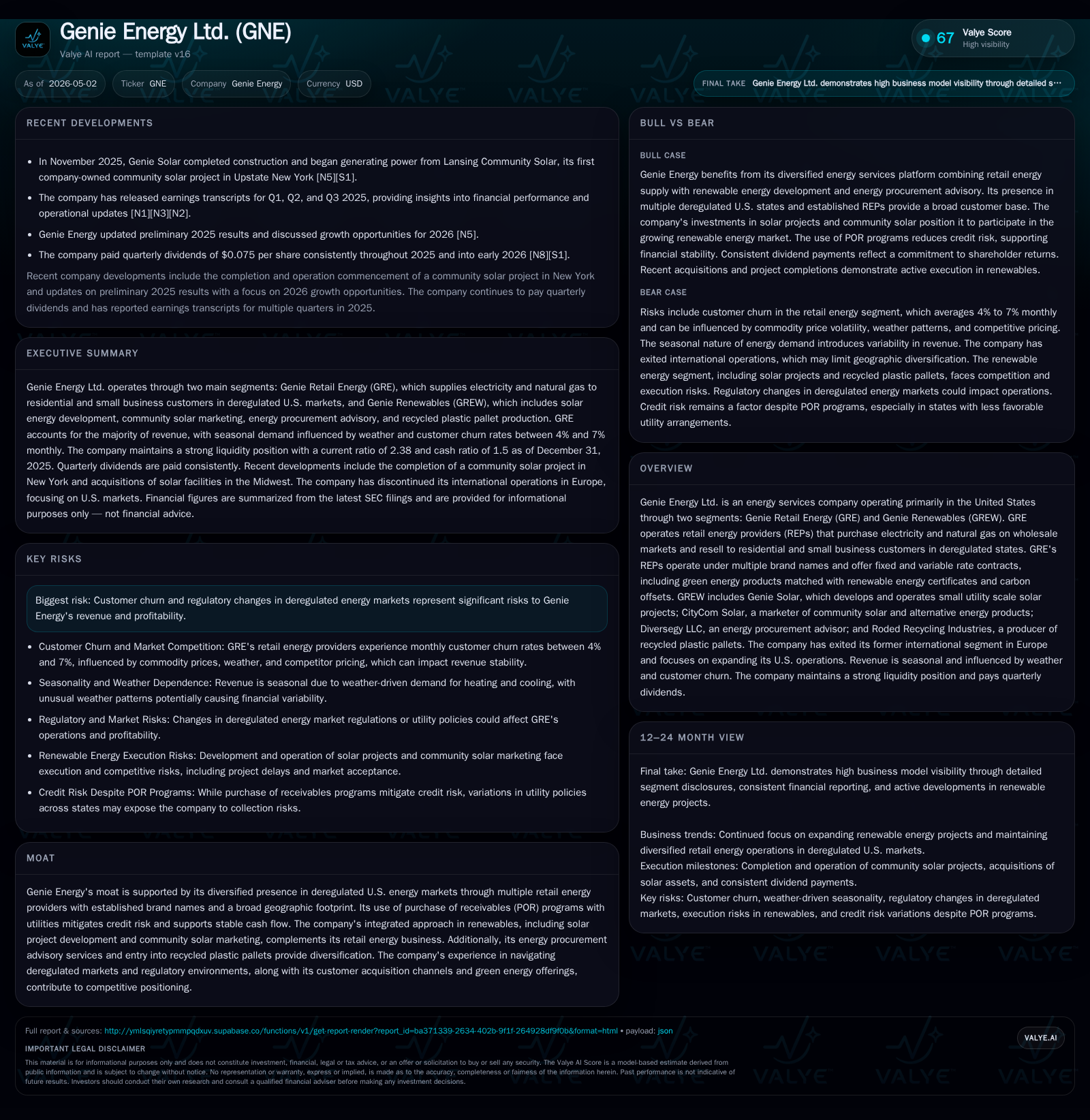
Genie Energy's most recent disclosures show continued expansion of its renewable energy projects, particularly solar, while maintaining a diverse footprint across deregulated U.S. energy markets through multiple retail energy providers (REPs). The company faces ongoing regulatory changes and competitive pressures that challenge customer acquisition and retention. Its integrated model combining retail energy sales, solar project development, community solar marketing, energy procurement advisory, and a novel recycled pallets business offers diversification but also complexity. Financially, Genie maintains a strong liquidity position with minimal debt, supporting its growth initiatives despite operational risks linked to regulation and market competition.
Recent Operating Update
Genie Energy’s latest filings anchor the current operating context around its November 2025 quarterly report (10-Q) [S2] and the April 2026 event filing (8-K) [S3], supplemented by the comprehensive May 2026 annual report (10-K) [S1]. The company continues deploying capital towards its renewables segment while sustaining operations in competitive deregulated retail energy markets.
In late 2025, the company completed construction of its first company-owned community solar project—Lansing Community Solar—in Upstate New York [S17]. This milestone enhances Genie Solar's operational portfolio which includes approximately 9.4 MW across Ohio and Michigan plus additional projects under construction or permit in New York totaling over 16 MW. This establishes Genie as a growing participant in small utility-scale solar generation targeting demand for community solar – an expanding avenue favored by residential customers who lack roof access or seek shared renewables.
Parallelly, General Electric Renewables’ sub-segment CityCom Solar provides complementary marketing capabilities for community solar subscriptions and alternative products. Diversegy LLC continues to function as an energy procurement advisor targeting commercial customers navigating deregulated energy markets with volatile prices.
Additionally noteworthy is Roded Recycling Industries' move towards commercialization of plastic pallets derived from agricultural and industrial plastic wastes [S1]. This pre-revenue venture applies proprietary processes promising cost advantages aided by material sustainability credits available in select jurisdictions.
Business Model
Genie Energy derives revenue from two main segments:
Genie Retail Energy (GRE): Operates multiple retail energy providers purchasing electricity and natural gas wholesale. These REPs resell commodity supply under fixed or variable contracts to mainly residential and small business customers within deregulated U.S. states. Revenue flows primarily from customer subscriptions tied to commodity usage and contract terms. GRE's REP brands include IDT Energy, Residents Energy, Town Square Energy entities, Southern Federal Power, Evergreen Gas & Electric, and Mirabito Natural Gas.
Genie Renewables (GREW): Comprises several businesses centered on renewable energies and sustainability solutions:
Genie Solar: Develops, builds, manages small utility scale solar generation projects including community solar.
CityCom Solar: Provides customer acquisition services around community solar offerings.
Diversegy LLC: Acts as an intermediary helping industrial/commercial clients secure favorable energy procurement terms.
Roded Recycling Industries: Manufactures recycled plastic pallets targeting the logistics/materials handling sector.
Revenue mechanics vary: GRE revenues hinge on volume of electricity/natural gas sold at contracted prices which include embedded margins above wholesale costs; pricing power can be limited due to regulatory constraints and competition. GREW revenues tend to come from project-based sales (solar power generation output or discrete capacity contracts), advisory fees (Diversegy), subscription commissions (CityCom), or product sales (Roded).
Margins are influenced by commodity price volatility affecting GRE’s wholesale purchase costs relative to customer rates. However, adoption of Purchase of Receivables (POR) programs—which allow utilities to pay Genie promptly upon customer billing—helps mitigate receivables risk and stabilize cash flow.
Genie's business model benefits structurally from its multi-brand presence across several geographically diverse deregulated states which diffuses localized regulatory shocks or competitor encroachments. Moreover, expanding ownership stakes in renewable assets build recurring-generation revenue streams less correlated with fossil fuel price cycles.
Industry Structure and Competitive Position
The U.S. retail energy supply industry operates predominantly within deregulated markets where incumbent utilities often remain distributors but competition exists for commodity supply sales to end-users via licensed REPs. Competitive dynamics are intense due to relatively low switching costs for consumers who may prioritize price sensitivity or brand loyalty.
Incumbent utilities retain advantages such as name recognition, established infrastructure relationships, and regulatory influence but generally do not compete aggressively on supply pricing immediately following commodity cost increases due to slower rate adjustments [S1]. Other REPs also challenge market share by offering bundled services or differentiated green-energy products.
Regulation imposes constraints: recent mandates require sales agents registration, compensation disclosures, and enhanced consumer consent mechanisms implemented at state-level bodies like the New York Public Service Commission [S1]. Such rules increase compliance complexity while potentially curtailing some aggressive marketing tactics traditionally employed by REPs.
Within this landscape, Genie Energy leverages diversified REP brands across midwestern, eastern U.S., Texas, Florida commercial markets combined with POR program participation—a relatively rare attribute providing a stable receivables framework mitigating credit losses common in deregulated supply businesses.
On the renewables front, Genie occupies niche positions in distributed generation via mid-sized solar arrays together with ancillary services like community solar marketing (CityCom) where competitive pressures relate primarily to scale efficiencies and regulatory accreditation for renewable certificate credits. Diversegy competes within an expanding advisory space necessitated by rising complexity in procurement choices driven by commodity price volatility and renewable integration mandates.
Roded engages a separate industry—the global pallet market—with plastic pallets growing faster than wood alternatives due to durability and reuse potential aligned with circular economy trends [S19]. While early stage commercially for Genie, this diversification reduces dependence on volatile energy sectors alone.
Growth Drivers
- Renewable Capacity Expansion: Genie Solar’s increasing MW footprint across Ohio/Michigan/New York reflects accelerating development permitting pipeline supported by declining system costs making utility-scale solar competitive versus wholesale electricity prices [S1]. Adaptation costs divert resources while adverse regulations can materially depress revenues.
Competitive Pressure & Customer Churn: Intense rivalry among REPs coupled with incumbents’ entrenched advantages force significant marketing expenditures. Customer retention is challenged by low switching barriers causing margin compression risk if price discounting intensifies [S1].
Commodity Price Volatility: Wholesale natural gas/electricity price fluctuations affect resale margins; inability to pass cost increases promptly may erode profitability unless hedging strategies successfully counteract [S1].
Operational Complexity Across Segments: Managing distinct businesses—from commodities sales under strict regulation to renewable asset management plus nascent recycling manufacturing—increases organizational complexity potentially diluting focus or introducing integration risks.
Pre-Revenue Business Risk: Roded remains pre-revenue entering commercialization phase where market acceptance uncertainty exists notwithstanding potential product cost advantages [S1]. Capital allocation missteps here could weigh on overall returns.
Accounting & Governance Issues: Previously disclosed restatements related to internal control weaknesses raise governance vigilance concerns requiring monitoring regarding financial reporting integrity [S13].
What to Watch Next
- Progress updates on commissioning new solar projects particularly community solar additions beyond Lansing reflecting tangible asset base enlargement in renewables segment.
- Regulatory developments especially related to POR program status or constraints affecting key states such as New York impacting GRE customer acquisition economics.
- Customer base metrics including gross adds versus churn rates among retail energy providers as indicators of competitive positioning sustainability.
- Commercial rollout milestones for Roded in Israel followed by announced expansion geographies validating scalability assumptions within the $70+ billion pallet market.
- Quarterly operating results releases clarifying top-line revenue trajectories across both segments highlighting mix shifts toward more predictable renewables revenue streams versus commodity-exposed retail sales.
- Any further updates on financial statement restatements or internal control remediation outcomes relevant to investor confidence embedding transparency improvements.
Financial Profile Summary
Latest financial snapshot
| Metric | Value | Period |
|---|---|---|
| Cash & equivalents | $204mm | |
| 2025-12-31 | ||
| Current assets | $323mm | |
| 2025-12-31 | ||
| Current liabilities | $136mm | |
| 2025-12-31 | ||
| Current ratio | 2.38x | |
| 2025-12-31 |
Source: SEC companyfacts cache [F1].
As per companyfacts data ending December 31, 2025 [F1], Genie Energy reports a strong liquidity position with cash and equivalents of approximately $204 million and a current ratio of 2.38x. This liquidity buffer supports ongoing investments into renewable projects and expansion initiatives without immediate refinancing concerns.
This analysis synthesizes public SEC filings including filings up through May 1, 2026 alongside supplementary industry context. It refrains from forward-looking projections absent explicit guidance while identifying critical operating factors shaping Genie Energy's trajectory within deregulated U.S. energy markets transitioning increasingly toward renewable integration amidst evolving regulation.
Disclaimer: This is research-only, informational analysis and not investment advice. It may include AI-generated interpretation and general industry context. Always verify important details using primary sources.

Comments