
WesBanco Inc. Solidifies Regional Banking Moat Through Latest Quarterly Resilience
WesBanco’s Q1 2026 filings reflect stable held-to-maturity securities, disciplined capital returns, and robust risk management reinforcing its regional banking strength.
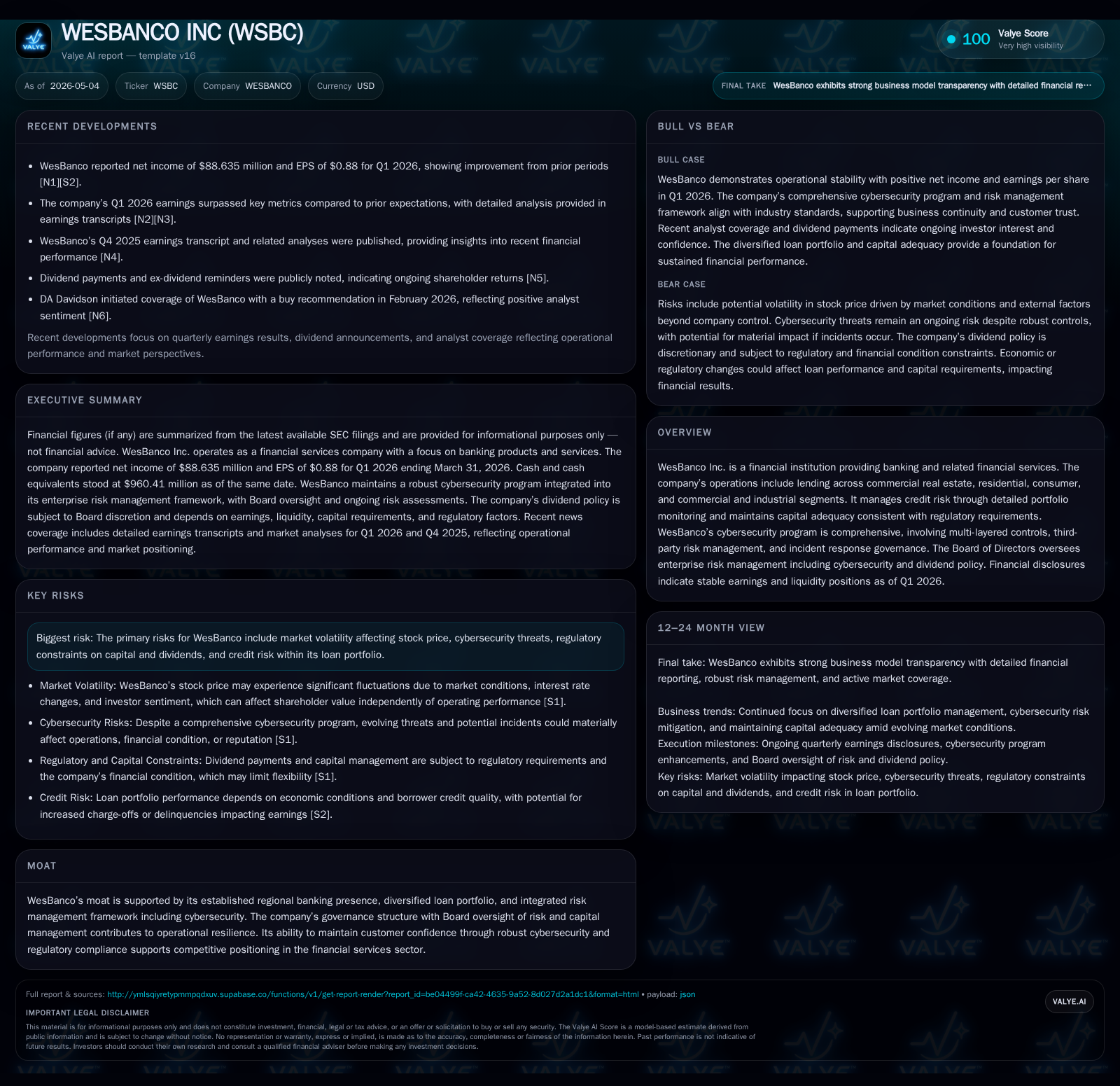
In its latest quarter ending March 31, 2026, WesBanco Inc. reported steady valuations in its held-to-maturity debt securities alongside ongoing shareholder dividend reinvestment activities, underscoring operational resilience. The company’s diverse lending across commercial real estate, residential, consumer, and industrial sectors is supported by a governance framework emphasizing credit risk oversight and cybersecurity integration within enterprise risk management. WesBanco competes effectively within the regional banking landscape through its broad loan portfolio, regulatory capital discipline, and customer trust bolstered by proactive cybersecurity measures.
Latest Quarterly Operating Update: Stability in Debt Securities and Shareholder Returns
WesBanco's Q1 2026 10-Q filing reveals that the fair values of its held-to-maturity debt securities remained relatively stable with amounts of $1.011 billion and $1.036 billion recorded previously now reflected as approximately $1.121 billion to $1.132 billion respectively, indicating minimal impairment or liquidity stress in these assets [S2]. This stability reflects a cautious approach to credit risk management amidst ongoing macroeconomic uncertainties that could impact fixed income portfolios.
Additionally, the company disclosed issuance of nearly 10,000 shares under its dividend reinvestment program during this period without altering overall dividend policy materially [S2]. This highlights a committed stance toward consistent shareholder returns while balancing regulatory capital frameworks. Such activity suggests an operational context focused on disciplined capital management aligned with prudent liquidity positions.
WesBanco’s Business Model: Diversified Lending and Integrated Risk Management
WesBanco generates revenue predominantly through interest income derived from lending activities that span four key segments: commercial real estate, residential mortgages, consumer credit products, and commercial & industrial (C&I) loans [S1]. This broad lending mix provides revenue diversification which helps mitigate concentration risks inherent in any single sector.
Central to its business model is an embedded risk management function where credit risk exposures are continuously monitored via portfolio-level analytics with allowance for loan losses periodically adjusted to reflect expected defaults [S2]. The company maintains capital adequacy standards consistent with federal regulatory mandates ensuring sufficient buffers to absorb losses without jeopardizing solvency.
In parallel, WesBanco has implemented a comprehensive cybersecurity program integrated into its overall Enterprise Risk Management (ERM) framework. This program employs multi-layered controls such as threat detection systems, regular vulnerability assessments conducted by third-party specialists, and incident response protocols overseen by senior executives including the Board of Directors [S1]. The cybersecurity strategy aims to protect sensitive customer data and uphold trust—critical components for sustaining long-term client relationships in financial services.
Industry Context: Regional Banking Competitiveness and Regulatory Frameworks
Operating as a regional bank headquartered in West Virginia, WesBanco benefits from entrenched market presence across its service areas that fosters strong local client relationships and nuanced market insights [S1]. This localized footprint contrasts with national megabanks often less connected to regional economic dynamics.
The company's moat is reinforced by its diversified loan portfolio spanning multiple segments reducing vulnerability to shocks concentrated in one industry vertical. Furthermore, the Board’s active oversight of both enterprise risk—including cybersecurity—and capital allocation policies provides operational resilience amid industry volatility.
Banking regulations continue to evolve post-financial crisis emphasizing stress testing and capital thresholds that regional banks must meet without impairing growth investments.
Growth Drivers: Loan Portfolio Diversification, Cybersecurity Strength, and Customer Confidence
From an expansion perspective, WesBanco’s focus remains on growing higher-yielding segments such as commercial real estate development loans and commercial & industrial financing where demand reflects broader economic investment cycles [S2][S1]. These categories offer scope for larger loan volumes with attractive pricing spreads compared to lower-margin consumer portfolios.
Simultaneously, strengthening cybersecurity capabilities supports client retention by mitigating data breach risks which could erode customer confidence and result in costly reputational damage. WesBanco’s multi-faceted cyber defenses—including collaboration with third-party security providers—position it well amid escalating cyber threats targeting financial institutions [S1].
Pricing power benefits from this combination of trusted security frameworks alongside comprehensive personal banking services delivered regionally further enabling moderate margin expansion opportunities through fee-based income enhancements.
Key Risks: Market Volatility, Credit Exposure, and Regulatory Constraints
Notwithstanding these strengths, WesBanco faces several notable risks. Market volatility can induce wide swings in its stock price independent of operating fundamentals potentially impacting investor perceptions and access to capital markets [S1]. The possibility of securities class action litigation following such fluctuations adds a layer of legal risk.
Credit risk remains an inherent challenge driven by borrower defaults especially within commercial real estate or C&I segments exposed to economic downturns. The allowance for credit losses captured periodically shows the company’s vigilance but cannot fully eliminate unexpected spikes in charge-offs during recessions or sectoral stress events [S2].
Additionally, evolving regulatory constraints impose limits on dividends relative to retained earnings and capital buffers constraining flexibility in shareholder distributions even when earnings are stable [S1]. Compliance costs associated with these regulations also contribute operational headwinds.
Next Steps: Monitoring Earnings Trends, Capital Adequacy, and Risk Metrics
Stakeholders should closely track upcoming quarterly earnings reports focusing on net interest margin trends given prevailing interest rate environments as well as loan growth velocities within targeted segments such as commercial real estate.[S2][N3]
Key credit performance indicators including changes in non-performing loans or allowance coverage ratios will signal shifts in portfolio quality demanding closer scrutiny.[S2] Additionally, announcements regarding dividend adjustments post-regulatory review periods will provide insight into board-level capital allocation priorities.[S3]
Given the criticality of cybersecurity as a competitive differentiator for WesBanco, disclosures relating to incident responses or expanded control investments will merit observation to assess resilience against emerging cyber threats.[S1]
Supporting Financial Profile: Snapshot from Q1 2026
As of March 31, 2026, WesBanco reported cash & cash equivalents totaling approximately $960 million underscoring solid liquidity positioning conducive to meeting operational needs and regulatory liquidity requirements.[F1][S2] The balance sheet also reflects held-to-maturity securities valued over $1.12 billion net of credit loss allowances demonstrating asset stability.[S2]
Net income figures reported at prior year-end were $223 million serving as a backdrop for expected earning capacity though quarterly specifics continue as the main reference points moving forward.[F1]
This financial snapshot aligns cohesively with the company’s narrative of prudent risk management combined with continuous customer-focused service delivery supporting sustainable regional banking operations.
This analysis synthesizes recent SEC disclosures along with available financial data up to Q1 2026 for WesBanco Inc., aiming to provide an informed overview pertinent for understanding current operational dynamics without providing investment guidance.
Disclaimer: This is research-only, informational analysis and not investment advice. It may include AI-generated interpretation and general industry context. Always verify important details using primary sources.

Comments