
Iron Mountain’s Q1 2026 Revenue Growth Driven by Data Center Expansion and Record Management
IRM’s latest quarter highlights synergistic growth from Data Center lease commencements and steady physical records demand amid digital transformation efforts.
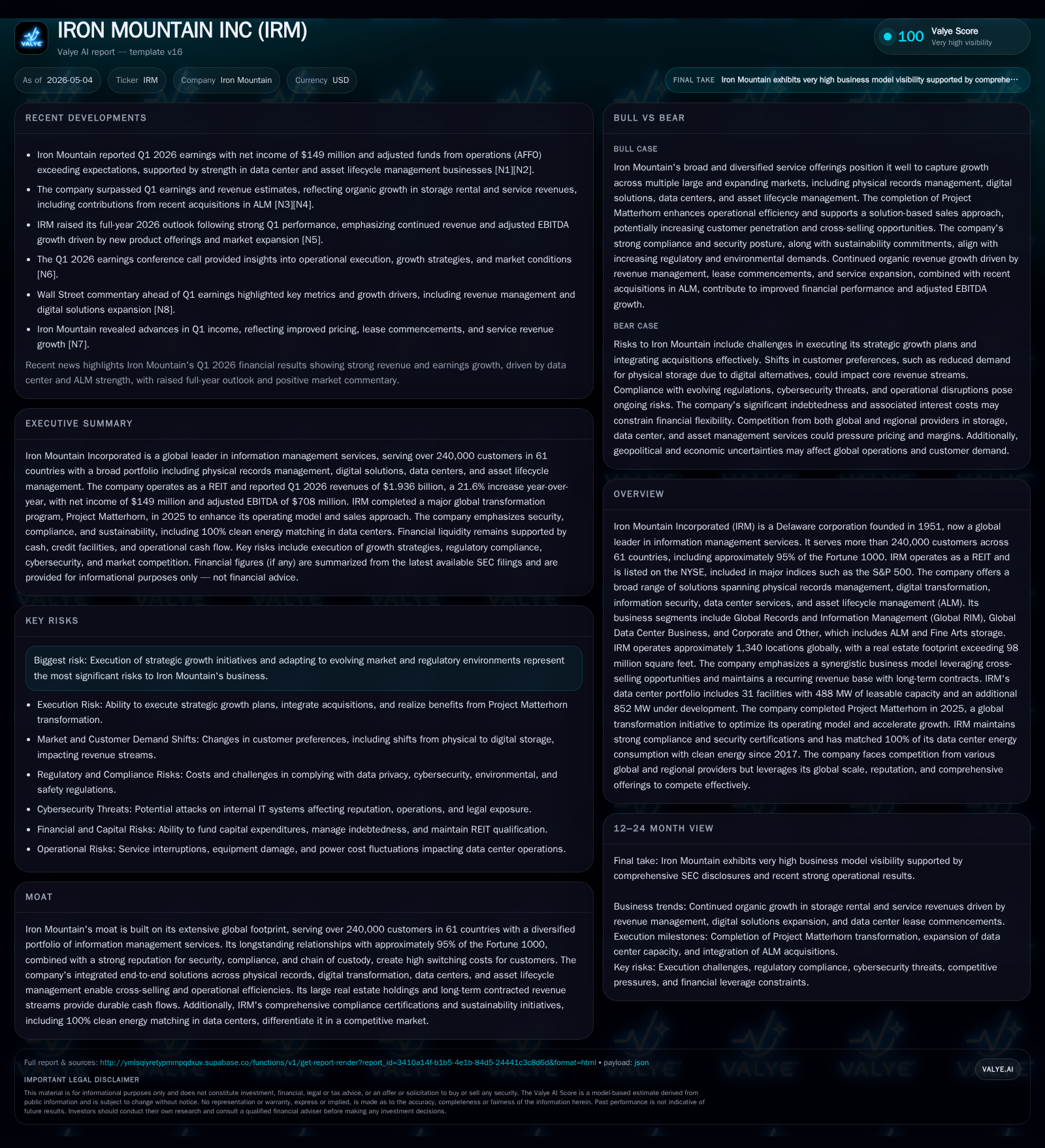
In Q1 2026, Iron Mountain posted significant organic revenue growth led by its Global Data Center Business and continued stability in physical records management. Its integrated business model spans physical storage, digital services, and asset lifecycle management, supported by a large global footprint and REIT structure that secures long-term cash flows. The company benefits from strong competitive moats in client trust, regulatory compliance, and cross-selling capabilities, while growth is propelled by expanding data center capacity, geographic market penetration, and innovation in digital offerings. Execution risks and evolving data storage preferences remain key watchpoints. Financially, IRM maintains compliance with covenants and healthy liquidity despite elevated leverage.
Q1 2026 Operating Performance Flags Data Center Momentum and Stable Records Business
Iron Mountain’s Q1 2026 earnings disclosed in the April 30 filing underscore robust top-line momentum anchored by organic growth in both its cornerstone Global Records and Information Management (RIM) segment and the rapidly expanding Global Data Center business [S2]. The company reported total revenues rising approximately 21.6% year-over-year to $1.936 billion for the quarter [S5], driven primarily by strong lease commencements in its data centers alongside continued revenue management gains within the RIM business where volumes are expected to remain steady near term.
The Global RIM segment posted about an 8.7% increase in storage rental revenue on an organic basis supported by meticulously managed pricing strategies rather than volume expansion [S18]. Meanwhile, the data center business contributed meaningfully via new leased capacity coming online that enhances the contract backlog—a key leading indicator—and revenue mix [S2]. Adjusted EBITDA for the quarter improved by 22.1%, reaching $708 million with margins expanding slightly to 36.6%, reflecting operational efficiencies offsetting some mix effects particularly in the RIM services component [S18]. These developments reinforce the strategic balance IRM maintains between stable recurring revenues from physical assets and higher-margin growth from digital infrastructure.
Business Model Overview: Integrated Physical and Digital Information Lifecycle Solutions
Iron Mountain operates as a Real Estate Investment Trust (REIT), deriving recurring storage rental revenues through long-term contracts tied to extensive real estate assets exceeding 98 million square feet globally [S1],. Its three core reportable segments include:
- Global Records & Information Management (RIM): The traditional backbone focused on physical records retrieval, secure storage, document imaging digitization services, and related service offerings.
- Global Data Center Business: Provides leased space for IT infrastructure with a prominent emphasis on sustainability initiatives including green power passes that match customer consumption with renewable energy hourly.
- Corporate & Other: Encompasses Asset Lifecycle Management (ALM), including IT asset disposition (ITAD) services and specialty fine arts storage solutions.
Revenue mechanics pivot largely on long-term contractual arrangements where customers pay rental fees for secure space plus ancillary services often bundled to enhance value [S1]. This creates significant switching costs anchored by IRM's chain-of-custody rigor—critical to regulated verticals like healthcare, legal, financial services, and government agencies that represent major parts of its roughly 240,000 customer base encompassing almost all Fortune 1000 firms. The REIT status prioritizes strong cash flow generation aligned with capital expenditure discipline tied chiefly to growth initiatives like data center construction or selective acquisitions [S2], [S1].
Digital solutions delivered via platforms such as Insight Digital Experience Platform (DXP) increasingly complement physical offerings by unlocking “dark data” for clients amid complex regulatory environments [S1], positioning IRM uniquely at the nexus of physical-to-digital transformation.
Competitive Positioning within Information Management and Data Services Industries
IRM's moat derives from its unmatched scale—over 1,340 facilities across 61 countries—and deeply embedded client trust built over seven decades. This global breadth enables IRM to meet stringent compliance demands including data privacy laws (e.g., HIPAA, GDPR) backed by comprehensive certifications bolstering its competitive edge.
Pricing power stems from indispensable chain-of-custody assurance coupled with extensive value-added services making substitution costly. Additionally, the company's sustainability leadership—highlighted by SBTi-validated emission targets and a Green Power Pass offering—is increasingly resonant among clients seeking to minimize carbon footprints without compromising security or reliability [S1]. Nevertheless, technological substitution risk remains a latent factor as clients gradually shift toward more digital-native storage paradigms; IRM counters this through integrated offerings blurring physical-digital lines.
Cross-segment synergies facilitate upselling opportunities whereby digital transformation adoption drives additional demand for data center capacity or enhanced records digitization services—strengthening client retention dynamics and operational leverage.
Growth Drivers: Digital Transformation, Geographic Expansion, and Cross-Selling Synergies
Key growth levers include:
- Digital Transformation: Accelerated adoption of cloud-based data workflows supports demand for both IRM's digital platforms like Insight DXP and expanded underlying infrastructure hosted at its data centers [S1], [N13].
- Geographic Penetration: Targeted investments aim at emerging markets with higher growth potential in Central/Eastern Europe, Latin America, Asia-Pacific regions where record digitization volumes and data sovereignty requirements are intensifying [S1].
- Data Center Capacity Expansion: Growing leasing activity evidences broadened enterprise reliance on outsourced colocation services with a green energy mandate that differentiates IRM’s multi-market portfolio [S2].
- ALM Growth: Strong momentum in IT asset disposition fueled by environmental regulations and corporate sustainability commitments adds incremental service revenue streams [S6].
- Cross-Selling Synergies: Integrated sales efforts leveraging trusted relationships allow bundled contracts blending physical records with digital or ALM services increasing wallet share per client.
Volume-based growth tends to be moderate given structural shifts but is compensated by improving price/mix dynamics achieved through revenue management strategies focusing on differentiated service tiers within core segments.
Risk Factors: Execution Challenges, Regulatory Compliance, and Market Transition Pressures
The foremost risks impinging on IRM’s trajectory are strategic execution of capital-intensive expansion projects—especially within highly competitive data center markets—and managing acquisition integration friction [S2], [S23]. Failure to maintain REIT qualification carries tax implications potentially dilutive to shareholder returns.
Regulatory complexities around data privacy/security necessitate ongoing compliance investments; breaches could materially impact customer confidence given reputational stakes tied closely to chain-of-custody reliability. Furthermore, evolving client preferences migrating away from paper toward fully digital ecosystems may compress traditional storage volumes faster than offsetting digital growth can compensate.
Market cycles affecting corporate spending on infrastructure or regulatory changes influencing content retention policies could introduce variability into leasing patterns particularly within data centers where lease commencements drive near-term upside but also heighten fixed cost profiles.
Labor cost inflation noted in filings could pressure margins absent proportional price adjustments or operational gains [S1]. Managing sustainability investments prudently aligns with long-term value but entails upfront capital deployment requiring disciplined financial stewardship.
Forward View: Key Milestones, Client Demand Signals, and Strategic Investment Focus
Looking ahead in 2026 IRM anticipates sustained organic revenue progress buoyed by incremental leases commencing at recently commissioned or acquired data centers paired with ongoing enhancements to its digital offering suite [S2], [N14]. Expanding presence within fast-growing international markets serves as a bellwether for broader structural adoption trends.
Capital expenditures remain focused on:
- Completing remaining buildouts in Project Matterhorn,
- Scaling capacity at strategic colocation hubs,
- Investing further in green energy sourcing initiatives,
- Broadening AI-driven digital platform capabilities aiding customer insights extraction.
Monitoring KPIs such as new client wins across ALM units, utilization rates within global facilities, renewal rates of long-standing record management contracts—and pricing elasticity resulting from differentiated service innovations—will be crucial indicators of sustainable growth momentum.
Latest Financial Snapshot: Balance Sheet Strength Supporting Growth Strategy
Latest financial snapshot
| Metric | Value | Period |
|---|---|---|
| Cash & equivalents | $251mm | |
| 2026-03-31 | ||
| Total debt | $17.2bn | |
| 2026-03-31 | ||
| Net debt | $17.0bn | |
| 2026-03-31 | ||
| Current assets | $2.0bn | |
| 2026-03-31 | ||
| Current liabilities | $2.7bn | |
| 2026-03-31 | ||
| Current ratio | 0.77x | |
| 2026-03-31 |
Source: SEC companyfacts cache [F1].
| Metric | Value (USD) | Date |
|---|---|---|
| Cash & Equivalents | $250.7 million | |
| 2026-03-31 | ||
| Total Debt | $17.22 billion | |
| 2026-03-31 | ||
| Net Debt | $16.97 billion | |
| 2026-03-31 | ||
| Current Assets | $2.04 billion | |
| 2026-03-31 | ||
| Current Liabilities | $2.66 billion | |
| 2026-03-31 | ||
| Current Ratio | 0.77x | |
| 2026-03-31 |
Iron Mountain’s financial position remains robust enough to support ongoing investments while maintaining compliance with restrictive covenants governing its credit facility—currently boasting leverage metrics well below maximum allowable limits as of quarter-end [S2], [F1]. Despite sizeable net debt reflecting capital intensity especially linked to property and infrastructure holdings across business segments,, liquidity sources including operating cash flows along with credit line availability provide cushion against economic or sectoral headwinds. Interest rate hedging mitigates exposure given floating rate components embedded principally within certain term loans supporting its growing data center footprint [S2],[S10].
Disclaimer: This analysis is based solely on publicly available filings as indicated; no proprietary company insights or nonpublic information were utilized. It does not constitute investment advice or recommendation but aims to provide an informed perspective on Iron Mountain's current operational landscape rooted in concrete evidence.
Disclaimer: This is research-only, informational analysis and not investment advice. It may include AI-generated interpretation and general industry context. Always verify important details using primary sources.

Comments