
Regency Centers Corp Strengthens Portfolio Amid Rising Retail Leasing Momentum
Q1 2026 results reveal robust lease income growth propelled by redevelopment completions and strategic acquisitions in grocery-anchored shopping centers.
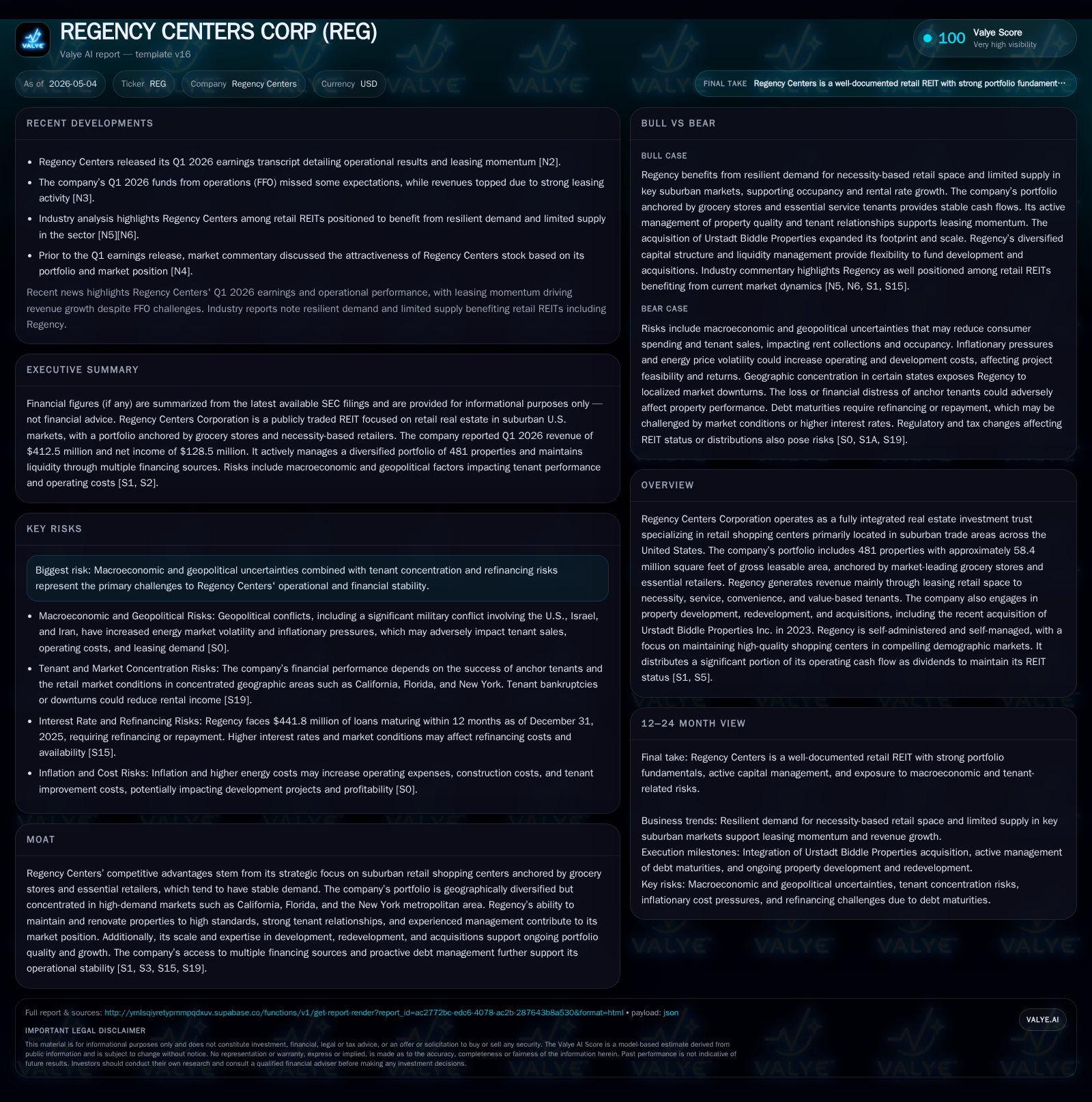
Regency Centers Corp’s latest quarterly filing highlights a $100 million increase in lease income driven by same-property rental escalations, redevelopments entering operations, and acquisitions consolidated into the portfolio. The company’s business model, centered on suburban retail centers anchored by essential grocers and value retailers, underpins resilient demand and stable cash flows despite inflationary pressures and geopolitical uncertainties. Growth prospects remain anchored in leasing momentum, active redevelopment projects, and selective acquisitions while risks primarily pertain to cost inflation, tenant credit quality, and refinancing needs. Regency’s sound balance sheet with approximately $5 billion total debt and proactive capital management support its operational strategy and dividend policy.
Q1 2026 Operating Update and What’s New
Regency Centers Corp reported substantial progress in its latest quarterly filing dated May 4, 2026 ([S2]). Lease income for Q1 increased by approximately $100 million compared to the prior year period. This uplift was mainly attributable to base rent growth driven by multiple factors: $25.7 million reflected higher occupancy rates and positive rental spreads on lease renewals; $14 million stemmed from new rental contributions as redevelopment projects initiated operations during 2025; an additional $5.5 million arose from consolidation of properties previously held through unconsolidated partnerships following acquisition of remaining ownership interests. Acquisitions completed in 2025 added $16.2 million in base rents while newly developed properties commencing rent generation contributed another $5 million. These gains were partially offset by disposals causing a small $3.5 million reduction.
Tenant recoveries increased by over $31 million primarily due to higher operating costs driven by elevated occupancy levels and increased recovery rates for maintenance and real estate taxes. Lease termination fees also rose contributing some incremental "other lease income." Overall revenues reached $1.55 billion for the quarter reflecting this leasing momentum.
On the expense side, operating outlays rose correspondingly by just over $30 million year-over-year due to property operating expenses (maintenance/upkeep), real estate taxes increases tied to higher valuations or municipal rates, and incremental depreciation/amortization reflecting asset additions from acquisitions and redevelopments becoming operational ([S2], [S1]). Despite this revenue growth outpacing operating cost increases, adjusted funds from operations (AFFO) for Q1 slightly missed consensus estimates as noted in earnings commentary ([N5], [N6]). This suggests some near-term margin pressure potentially linked to cost inflation or timing nuances around capitalized project costs transitioning into expense.
Business Model: Core Revenue Streams and Asset Quality
Regency operates as a fully integrated REIT specializing exclusively in retail shopping centers predominantly located in suburban trade areas across the U.S., focusing on centers anchored by grocery stores—a segment critical for steady foot traffic given the essential nature of food retailing ([S1]). The company owns interests in 481 properties with about 58.4 million SF of gross leasable area (GLA). These assets are leased primarily to tenants fulfilling necessity-based, service-oriented, convenience, or value-driven consumer needs.
Revenue mainly derives from:
- Base Rent: Contractual fixed payments generally set on leases averaging multiple years providing stable cash inflows.
- Tenant Recoveries: Pass-through charges where tenants reimburse Regency for their share of operating expenses like common area maintenance, insurance, and taxes.
- Percentage Rent: A smaller but meaningful supplemental income stream based on tenants’ retail sales exceeding thresholds.
- Lease Termination Fees: Occasional upfront fees when tenants terminate leases early.
- Other Income: Includes management fees charged for services or transactions related to assets operated but not owned outright.
This diversified income mix leverages long-standing relationships with market-leading grocery anchors ensuring consistent shopper visitation patterns that sustain demand even through broader retail sector volatility ([S1], [S2]).
Industry Dynamics and Competitive Positioning
Within the competitive landscape of retail REITs, Regency Centers differentiates itself through its focused geographic footprint encompassing high-growth metropolitan areas such as California, Florida, and the New York tristate region—markets characterized by robust population growth trajectories and strong consumer spending power ([S1], [N8]).
The company’s scale (largest national owner of grocery-anchored retail centers) alongside its reputation for maintaining high-quality properties fortified by targeted redevelopment initiatives enhances customer retention capabilities amid shifting consumer preferences ([S15]). Its self-management model supports close integration between asset management teams and development functions facilitating swift responses to evolving market dynamics.
Notably, grocery-anchored centers exhibit defensive characteristics due to recurring demand for essentials—beneficial during economic downturns or periods marked by discretionary spending retrenchment. This structural advantage helps buffer Regency against cyclical retail headwinds impacting less essential formats such as big-box specialty or apparel-focused malls ([N9]).
Growth Drivers: Leasing Momentum, Redevelopment, and Acquisitions
The primary drivers supporting Regency’s growth are:
- Leasing Activity: Same-property base rents rose through increased occupancy rates (higher trailing occupancy than peers), contractual rent escalations (fixed annual steps), and positive renewal spreads indicating healthy tenant willingness to pay market or above-market rates ([S2],[N1]).
- Redevelopment Completions: Several active redevelopment projects transitioned into operation starting in late 2024 through 2025 adding both leasable area and repositioned assets commanding higher rents ([S2],[S3]). Redevelopment pipelines remain significant given favorable demographic profiles enabling property enhancements that reset valuation bases.
- Strategic Acquisitions: Continuing incorporation of previously unconsolidated partnership interests plus selective external acquisitions bolster scale while optimizing portfolio composition around necessity-based anchors like grocers and service providers ([S1],[S3]). Recent acquisition of Urstadt Biddle Properties Inc. in 2023 exemplifies this accretive approach.
These factors collectively drive top-line expansion visible in revenue increases alongside underlying improvements in net operating income metrics often referenced through non-GAAP measures such as Pro-rata Same Property NOI ([S1]).
Risks and Constraints: Macroeconomic and Tenant Credit Challenges
Several headwinds temper Regency’s outlook:
- Inflationary Pressures & Energy Price Volatility: The ongoing geopolitical tensions involving major oil suppliers (e.g., Middle East conflict) exacerbate input cost inflation particularly for construction materials influencing capital project margins and feasibility ([S2]). Rising operating expenses can compress NOI if not fully passed through via recoveries.
- Tenant Credit Quality: Despite solid anchor profiles, many retail tenants face margin pressures from rising costs adversely affecting ability to meet lease obligations especially smaller service-oriented tenants with less financial resilience ([S2],[S1]). Poor tenant sales performance reduces percentage rents collected further impacting revenue volatility.
- Refinancing Risk: With approximately $442 million loans maturing within twelve months before March 31, 2026—largely expected to be refinanced or paid off via available liquidity—the company must maintain prudent capital management amid elevated interest rates potentially increasing debt servicing costs ([S20],[F1]).
Upcoming Catalysts and Milestones To Monitor
Key near-term items include:
- Monitoring Q2 earnings release expected mid-to-late July 2026 for confirmation that leasing momentum sustains amid macro uncertainty ([N1],[S2]).
- Progress updates on existing redevelopment projects slated for completion during late 2026 or early 2027 could further augment revenues.
- Tenant credit environment developments that may influence bad debts/collection trends warrant attention.
- Any material acquisitions or disposition announcements reflecting strategic portfolio reshaping aims.
Financial Snapshot: Capital Structure and Debt Context
As revealed by companyfacts data ([F1]), Regency Centers carried total debt near $5.0 billion as of March 31, 2026 with net debt approximating $4.97 billion after deducting cash balances. Overall capital structure robustness imbues flexibility supporting continued investment into redevelopment pipelines while meeting shareholders' return expectations through distributions.
Disclaimer: This analysis is based solely on publicly available information up to May 4, 2026, including SEC filings and reported news sources cited herein. It is intended for informational purposes only without any recommendation regarding securities buying or selling decisions.
Disclaimer: This is research-only, informational analysis and not investment advice. It may include AI-generated interpretation and general industry context. Always verify important details using primary sources.

Comments