
Granite Construction’s Q1 2026 Growth Fueled by Vertical Integration and Public Infrastructure Backlog
Granite Construction reports solid revenue increases driven by acquisitions and public infrastructure funding, underpinned by strong backlog and vertical integration.
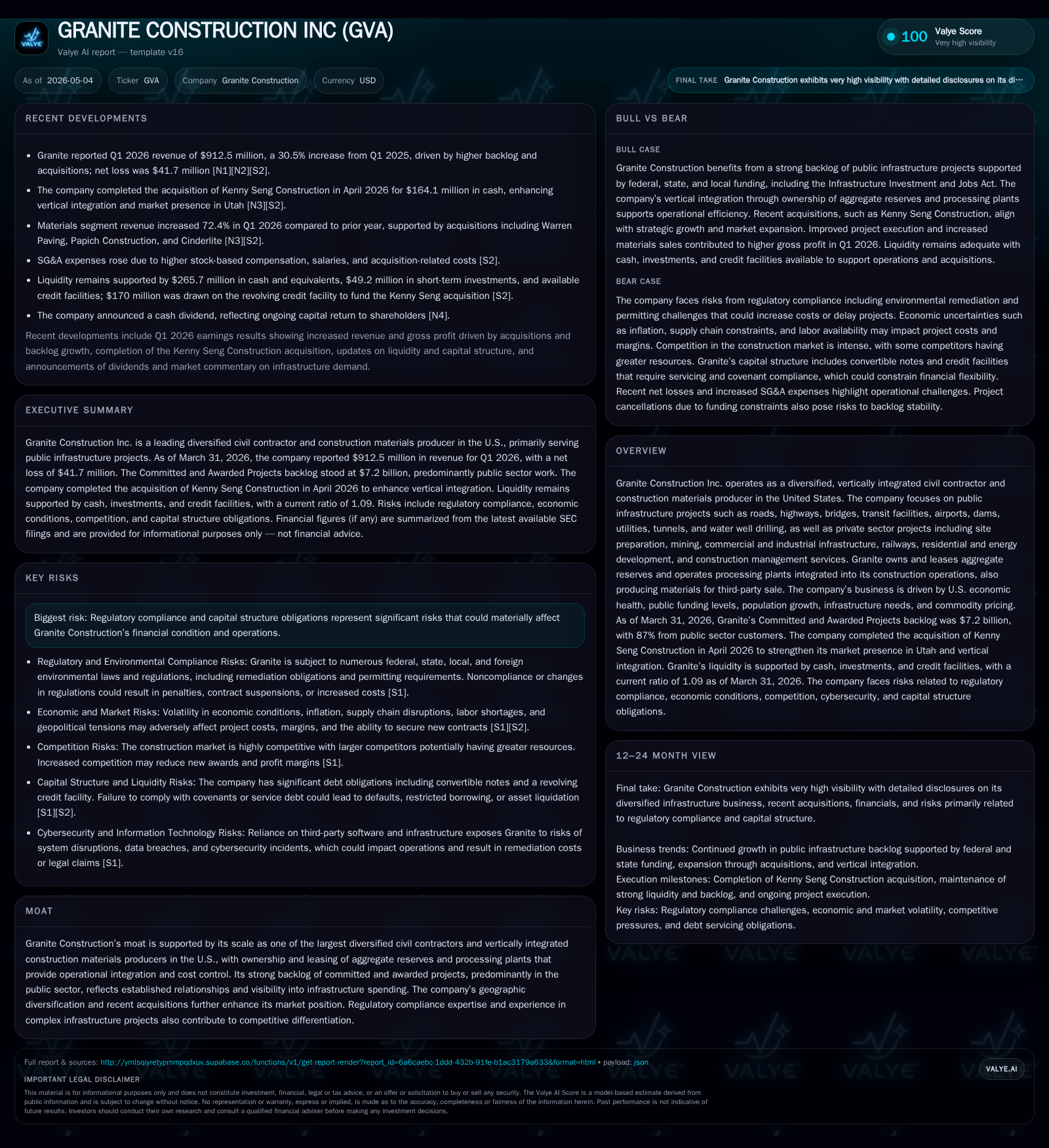
In Q1 2026, Granite Construction Inc. delivered a significant increase in revenue and gross profit fueled by higher project backlog, public sector spending, and strategic acquisitions. The company’s vertically integrated business model—combining civil contracting with construction materials production—provides key operational advantages amid competitive and regulatory challenges. Growth drivers include ongoing federal infrastructure funding under the IIJA, geographic expansion, and increased materials volumes. Risks remain tied to government funding variability, regulatory compliance, and capital structure management. The recent acquisition of Kenny Seng Construction enhances regional presence as Granite maintains liquidity and compliance with financial covenants.
Recent Operating Update: Q1 2026 Highlights
Granite Construction Inc.’s first quarter for fiscal 2026 marked an impressive revenue jump to $912 million, up from $700 million in Q1 2025—a 30% increase. This surge was anchored by a substantial rise in construction revenues to $766 million (+25%) fueled by execution of a larger Committed and Awarded Projects (CAP) backlog alongside contributions from newly acquired businesses Warren Paving and Papich Construction. Materials segment revenues also gained strongly (+72%) to $146 million aided by volume growth in aggregates and asphalt plus recent acquisitions including Cinderlite [S2][S3][S10][S26].
Gross profit climbed to nearly $110 million (+31%), though construction gross margin slightly declined from prior year due mainly to lack of a one-time claim settlement that benefited the prior period. The materials business swung back to profitability with a margin of 5.3%, recovering from prior loss owing to improved pricing and economies of scale from acquisitions [S2][S23].
Despite top-line growth, operating expenses rose notably—SG&A climbed by $25 million driven by stock-based compensation hikes, wage inflation, and acquisition-related costs. This contributed to an operating loss of $31 million for the quarter versus a larger loss last year, reflecting Granite’s typical asymmetric seasonal swings skewing results toward second-half earnings strength [S2][S12].
Liquidity remained solid with cash including joint venture holdings totalling roughly $266 million supported by revolver availability despite a large acquisition transaction funded partially through credit drawdown. Working capital swings pressured operating cash flow this quarter consistent with typical industry seasonality where execution timing impacts receivables/inventories dynamics significantly [F1][S2][S4][S14][S20].
Convertible note conversion conditions were met as of March end potentially impacting capital structure during upcoming quarters depending on investor actions [S6][S17]. Financial covenants were maintained.
Business Model Analysis
Granite Construction operates as a diversified civil contractor coupled tightly with vertically integrated construction materials production—primarily aggregates and asphalt. Revenue is derived through public infrastructure contracting (roads, highways, bridges, transit facilities, airports) accounting for roughly 70-85% of CAP value annually; complemented by private sector site preparation, mining support services, residential/commercial development infrastructure, energy projects (including rail), and contractual construction management services [S1][S2].
Strategically owning or leasing aggregate reserves along with operating proprietary processing plants ties directly into its contracting operations providing critical cost advantages amid volatile commodity prices. This vertical integration acts as a natural hedge on input costs while enabling Granite to capture margin both as contractor and materials supplier when selling third-party [S1][S2].
Revenue flows are contract-driven on mostly fixed-price or fixed unit price contracts with government customers subject to annual appropriations but often secured multi-year projects. Project award visibility—embodied in CAP backlog—is paramount for operational planning given size/scope complexity.
Granite’s customer mix is heavy on federal/state/local governments which accounts for about 70% of construction revenue; funding variability from budget cycles remains a structural risk [S1]. Private-sector work is typically smaller percentage but commands higher margins albeit slower payment terms.
Industry Structure & Competitive Position
The civil infrastructure space in which Granite competes is characterized by a fragmented marketplace with many regional competitors as well as larger national players such as Fluor Corporation or AECOM (though latter is more engineering focused). Competition intensifies for publicly funded projects due to limited governmental spending pools despite unprecedented federal funding inflows.
Granite’s moat derives from its scale—the company ranks among the largest diversified civil contractors combined with its integrated materials business enabling optimized pricing power. Geographic diversification across states reduces concentration risk; California remains biggest single market supported uniquely by stable state-level funding mechanisms like SB-1.
Moreover, Granite's expertise managing complex projects involving environmental regulation compliance adds barriers for smaller entrants lacking resources or bonding capacity. Its bonding relationships enable performance under multi-billion-dollar contracts providing competitive leverage [S1][S2].
Recent targeted acquisitions (Warren Paving, Papich Construction, Cinderlite) have expanded both construction services capabilities and materials footprint enhancing geographic density especially in Western U.S markets [S2][S10].
Growth Drivers
Federal Infrastructure Spending: The Infrastructure Investment and Jobs Act (IIJA) has propelled historic increases in highway/bridge/transit funding ($550B incremental over five years) greatly stimulating state/local project outlays—a primary driver behind rising CAP backlog [S1][S2]. While IIJA sunsets September 2026 Congress discussions on successor legislation will shape medium-term outlook.
Municipal & State Initiatives: Supplementary voter-approved transportation measures at local levels sustain demand independently of federal budgets.
Population Growth & Aging Infrastructure Needs: Demographics underpin ongoing replacement/repair cycles for deteriorated public assets requiring continual contractor engagement.
Vertical Integration Expansion: Acquisitions like Kenny Seng Construction augment Granite’s upstream control over critical material inputs while enabling localized economies.
Materials Demand & Pricing: Higher aggregate volumes combined with positive pricing trends improve margins; scalability gained via plants leveraged across multiple projects creates operating leverage.
Private Sector Selectivity: While smaller contribution today, commercial/residential buildout provides incremental opportunities complementary to public spend dynamics [S1][S2].[N1][N2]
Risks / Watchpoints / Growth Constraints
Government Funding Volatility: Reliance on appropriated budgets exposes Granite to political risks including potential federal shutdowns or diminished allocations impacting project pipelines [S1].
Fixed-Price Contract Risks: Inflationary pressures on labor/materials may cause cost overruns reducing margins or triggering losses if not fully recoverable within contractual terms [S1].
Regulatory Compliance & Environmental Liability: Increasingly stringent environmental regulations around aggregate reserve permitting may limit operational expansion or impose higher remediation costs [S1].
Competitive Pressure: Marketplace competition entrenched with larger firms capable of aggressive bidding could compress pricing especially if public budgets tighten.
Capital Structure & Debt Maturities: Convertible notes approaching conversion windows introduce uncertainty; failure to manage refinancing risk or covenant compliance could impair financial flexibility [S4][S5][S25].
Labor Supply Constraints: Nationwide skilled labor shortages common across heavy civil sector may impede capacity utilization or inflate costs.
What To Watch Next
- Congressional action on IIJA replacement legislation affecting long-term public infrastructure funding levels.
- Post-close integration progress of Kenny Seng Construction affecting regional market share gains beginning Q2 2026 results.
- Backlog evolution reflecting award rates aligned with funded programs providing forward revenue visibility.
- Liquidity metrics trends including working capital and cash flow generation vis-à-vis investment/acquisition spending.
- Convertible note holder behavior around June 30 conversion rights determining potential dilution or repayment requirements.
- SG&A expense trajectory signaling efficiency gains or further cost pressures tied to stock compensation inflation or labor market dynamics.
- Execution on maintaining bonding capacity amid large project awards serving as gating factors for growth opportunities.
Financial Profile Summary (Q1 2026)
Latest financial snapshot
| Metric | Value | Period |
|---|---|---|
| Cash & equivalents | $266mm | |
| 2026-03-31 | ||
| Current assets | $1605mm | |
| 2026-03-31 | ||
| Current liabilities | $1479mm | |
| 2026-03-31 | ||
| Current ratio | 1.09x | |
| 2026-03-31 |
Source: SEC companyfacts cache [F1].
Liquidity remained solid with cash including joint venture holdings totalling roughly $266 million supported by revolver availability despite a large acquisition transaction funded partially through credit drawdown. Working capital swings pressured operating cash flow this quarter consistent with typical industry seasonality where execution timing impacts receivables/inventories dynamics significantly [F1][S2][S4][S14][S20]. SG&A expense grew proportionately reflecting investments in personnel and acquisition integration costs impacting near-term earnings but supporting long-term growth plans [S12]. Convertible note principal classifications reflect accounting treatment responding to equity price triggers imposing balance sheet reclassifications affecting short-term debt profiles [S17].
This report is intended solely for informational purposes based on publicly available disclosures including SEC filings up to April 30, 2026. It does not constitute investment advice or recommendations regarding any securities or financial instruments issued by Granite Construction Inc. Readers should conduct their own due diligence or consult professional advisors before relying on this analysis.
Disclaimer: This is research-only, informational analysis and not investment advice. It may include AI-generated interpretation and general industry context. Always verify important details using primary sources.

Comments