
Westwood Holdings’ Q1 2026 Earnings Highlight Operational Resilience and Growth Opportunities
Westwood Holdings reported strong quarterly income growth and is pursuing digital innovation amid a competitive advisory market.
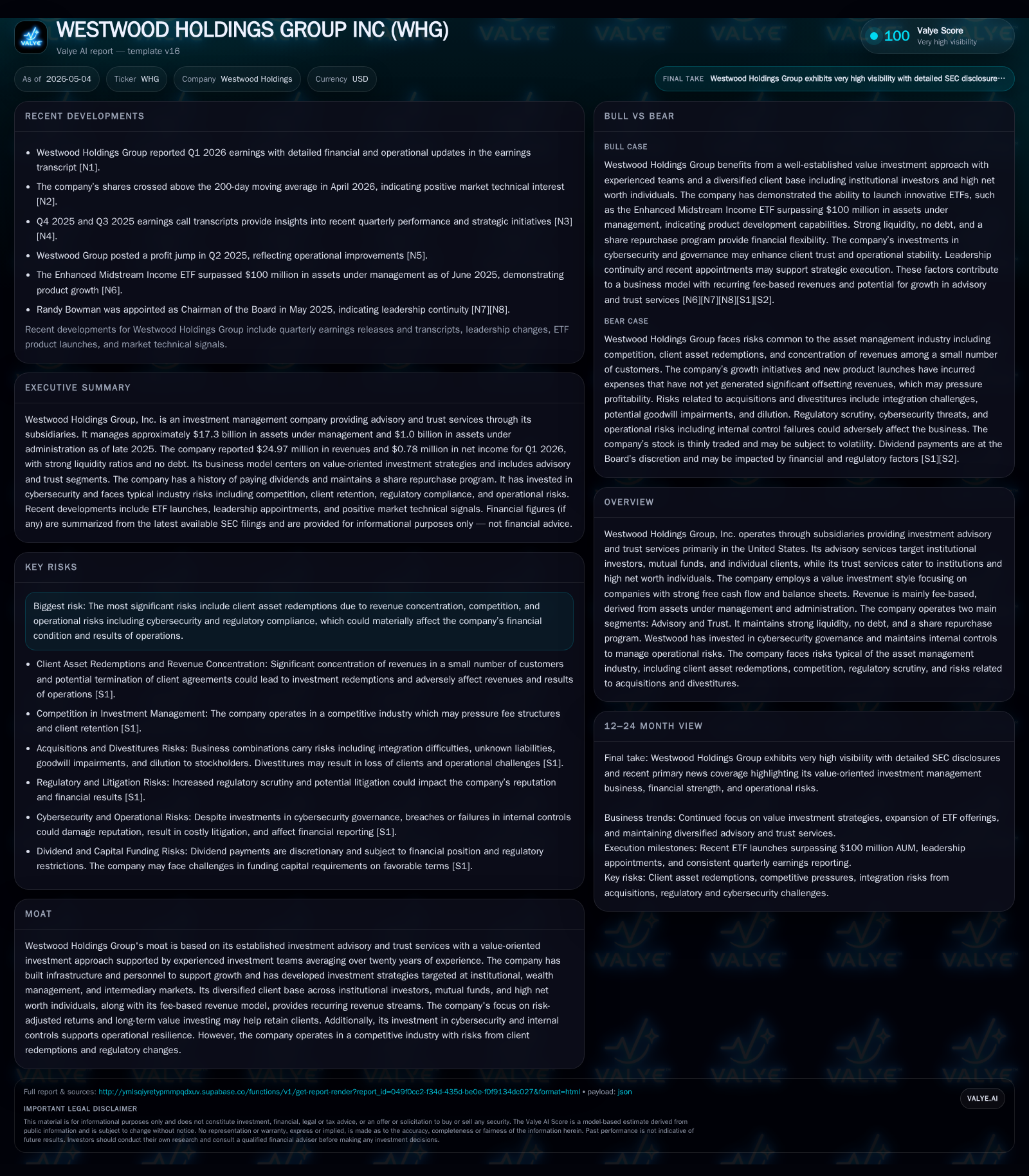
Westwood Holdings Group Inc demonstrated robust operational performance in Q1 2026, delivering a 64% increase in income attributable to the company and a 13% rise in economic earnings year-over-year. The firm's fee-based, value-oriented investment advisory and trust services continue to underpin stable recurring revenue streams, despite volatility in the trust segment. Westwood invests in digital solutions to meet evolving client expectations but faces industry challenges from asset redemption risks, regulatory scrutiny, and integration of acquisitions. The company’s solid liquidity position and zero debt afford flexibility as it seeks to capitalize on growth opportunities.
Latest Quarterly Operating Update: Signs of Increasing Economic Earnings
Westwood Holdings Group’s Q1 2026 results, filed on April 30, 2026 [S2][S3], revealed a meaningful rebound in operating performance compared to the prior year quarter. Income attributable to Westwood surged by 64% year-over-year to $782 thousand, reflecting improved top-line activity alongside disciplined expense control. Economic earnings—a metric adjusting GAAP income for non-cash items such as stock-based compensation and intangible amortization—increased by 13% to $2.85 million.
The Advisory segment contributed steadily to economic earnings with a 3% increase ($4.98M vs. $4.85M prior year), while the Trust segment saw a sharp contraction in economic earnings by 73% ($278K vs. $1.04M), driven by volatility in assets under administration (AUA) that affects fee generation [S2][S4]. Corporate-level expenses declined significantly (~29%), helping consolidate overall profitability gains.
Liquidity remained robust with cash and equivalents at approximately $23.4 million as of March 31, 2026 [F1], complemented by an absence of any debt obligations confirmed in filings [S2]. Working capital is ample, supported by a current ratio exceeding 4 based on recent balance-sheet data [F1]. These factors position Westwood with strong financial flexibility to fund operations, growth initiatives, or share repurchases.
Business Model and Service Quality: Fee-Based Value Investing and Diversified Clientele
Westwood operates through two main segments: Advisory and Trust [S1]. The Advisory segment predominantly serves institutional investors, mutual funds—including the Westwood Funds®—and individual clients utilizing a disciplined value investing style focused on companies exhibiting strong free cash flow generation coupled with sound balance sheets. This value orientation aims for superior long-term risk-adjusted returns while cushioning against market downturns.
The Trust segment caters primarily to institutions and high net worth individuals providing custodial services and participation in commingled trust funds [S1].
Revenue relies principally on percentage-of-assets fees derived from assets under management (AUM) or advisement (AUA). This fee-based structure supports recurring revenue streams that exhibit annuity-like characteristics when AUM remains stable or grows.
Experienced investment teams averaging over twenty years support client retention through consistent delivery of risk-adjusted returns. However, the Trust segment's higher volatility illustrates that fluctuations in client assets can dramatically affect short-term earnings stability.
Competitive Dynamics within Asset Management and Trust Services
The asset management industry Westwood inhabits is intensely competitive, encompassing global asset managers with scale advantages alongside more nimble boutique firms specializing in specific investment styles [S1].
Fee compression pressure is palpable industry-wide as large institutional clients demand lower costs while regulatory oversight tightens fiduciary requirements. Westwood faces headwinds maintaining its fee levels given these sector trends.
Additionally, advancing digital technologies compel asset managers to invest meaningfully in client-facing platforms enabling interactive portfolio views and enhanced service delivery [S1]. Failure to innovate technologically risks client attrition.
Moreover, Westwood must navigate regulatory complexities inherent in both the asset advisory realm and trust services, mandating robust compliance frameworks to safeguard operational integrity.
Growth Drivers: Digital Initiatives, Acquisition Integration, and Client Retention
Westwood has articulated an intent to develop digital solutions that cater to growing consumer demand for interactive portfolios and streamlined advisor engagement [S1][N1]. While still nascent with uncertain returns at this stage, these initiatives represent essential platforms for future competitive advantage.
Acquisitions remain part of growth strategy but bring typical integration challenges including risk of goodwill impairment or client churn if mergers disrupt service consistency [S1]. Management acknowledges these risks openly.
Long-term client retention benefits from the company's value investment approach aiming for durable risk-adjusted returns which can build loyalty during volatile markets.
Future growth metrics to monitor include AUM/AUA trends indicating net inflows or outflows, adoption rates of digital platform functionalities as they roll out, and successful closure plus integration of acquisition targets.
Risks and Constraints: Redemption Pressures, Regulatory Environment, Integration Challenges
Despite a strong balance sheet devoid of leverage [S2], Westwood remains exposed structurally to abrupt declines in fee-generating assets due to client redemptions—one of the most significant risks given its reliance on AUM-linked revenues [S1].
Regulatory compliance costs are escalating across fiduciary standard enforcement cycles affecting both advisory and trust operations. Non-compliance could invite penalties or reputational damage.
Operational risk remains elevated around cybersecurity exposures; the company has invested strategically into governance measures but cannot eliminate residual threat vectors entirely.
Acquisition-related risks encompass potential unknown liabilities from acquired entities as well as execution complexity around integrating personnel systems or cultural alignment which could disrupt organic growth momentum.[S1]
What to Watch Next: Key Milestones in Digital Strategy, AUM Trends, and Earnings Guidance
Market participants should closely follow forthcoming disclosures regarding:
- Progress updates on digital platform development efforts including investment scale, timelines for deployment, and early customer feedback gleaned from earnings calls transcripts [N1].
- Sequential quarterly trends in total AUM/AUA figures signaling sustained asset inflows or redemption patterns impacting fee revenues.[S2]
- Execution status on share repurchase authorization which serves as a barometer for management confidence in valuation and capital allocation priorities.[S2]
- Any additional business acquisitions or dispositions announced along with integration progress commentary.[S3]
- Margin trajectory vis-à-vis stock-compensation expense fluctuations reflecting personnel cost management efforts.[S2]
Current Financial Health: Strong Liquidity and Margin Developments
Westwood's liquidity remains noteworthy with $23.4 million in cash and liquid equivalents as of Q1 end [F1], supporting operations comfortably without any reliance on external financing sources according to disclosures [S2]. The company exhibits prudent working capital management evident from its high current ratio (>4) corroborated by last available balance sheet data [F1].
Stock-based compensation expense declined modestly versus prior year quarter (-5%), signaling effective cost controls amidst ongoing investments in talent retention programs [S2]. Concurrent reduction in intangible amortization expense further aided adjusted earnings expansion (+13%).
The company maintains an unleveraged capital structure, providing strategic optionality for future investments or shareholder distributions without refinancing constraints.
This analysis synthesizes fully documented SEC filings alongside credible news sources relevant as of May 2026. It aims at an informed perspective suitable for buy-side professionals evaluating Westwood Holdings Group Inc within the asset management sector landscape without issuing investment advice.
Disclaimer: This is research-only, informational analysis and not investment advice. It may include AI-generated interpretation and general industry context. Always verify important details using primary sources.

Comments