
Norwegian Cruise Line Returns to Profit but Faces Liquidity and Operational Risks in Q1 2026
Q1 2026 report reveals Norwegian Cruise Line's profitability rebound amid leadership changes and persistent liquidity challenges.
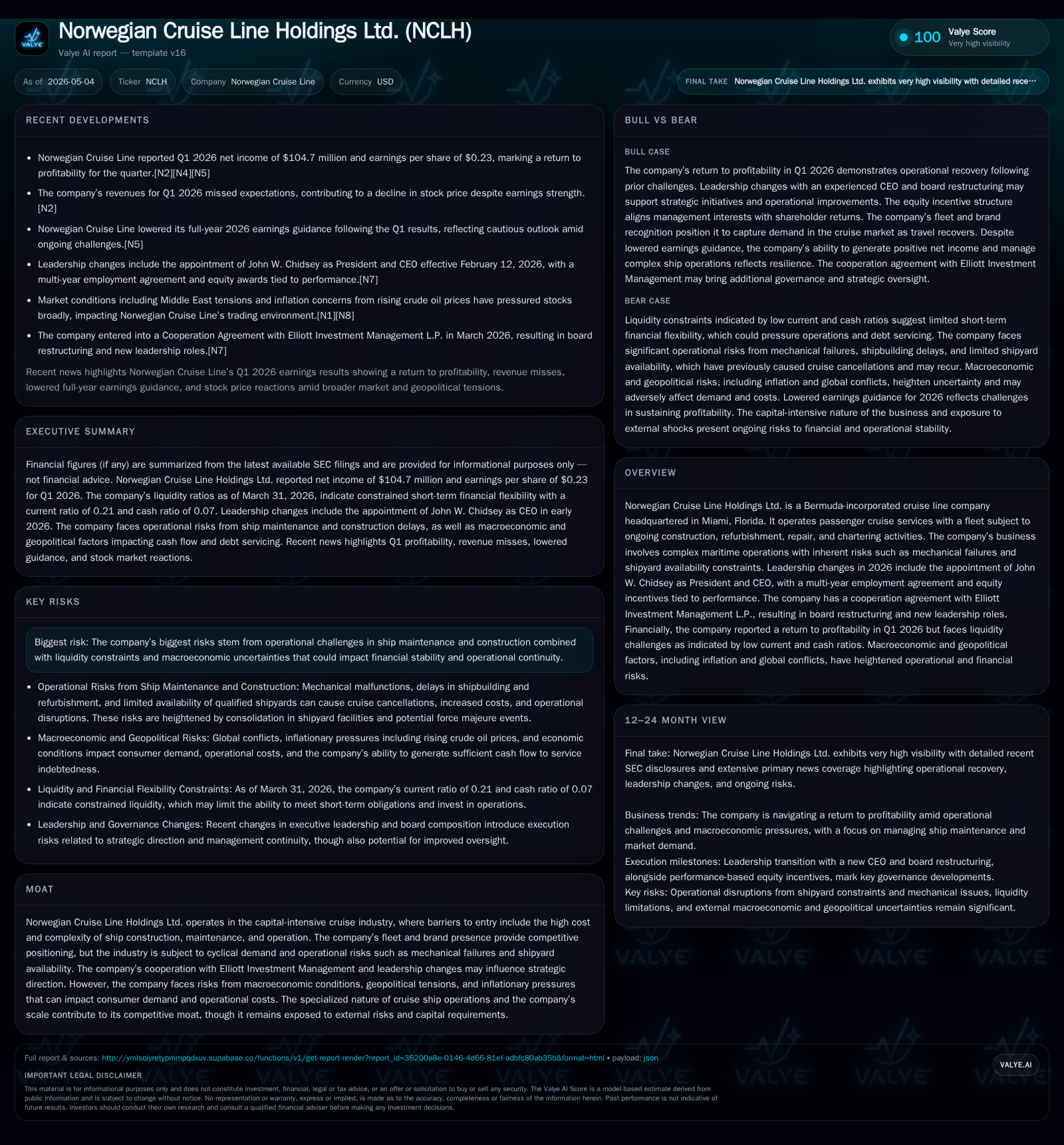
Norwegian Cruise Line Holdings Ltd. reported a profitable first quarter in 2026, marking a positive inflection point following post-pandemic recovery efforts. However, the company's balance sheet shows a notably weak current ratio of 0.21, reflecting significant liquidity constraints despite $185 million in cash. Leadership transitions, including CEO John W. Chidsey’s appointment and collaboration with Elliott Investment Management, suggest strategic shifts underway. The capital-intensive nature of cruise operations, combined with risks around ship maintenance and geopolitical factors, continue to pressure operational stability and growth prospects.
Recent Operating Update: Q1 2026 Highlights
Norwegian Cruise Line Holdings Ltd. (NCLH) returned to profitability in the first quarter of 2026 — a meaningful milestone on its recovery trajectory following pandemic-driven travel disruptions. According to the latest Form 10-Q filed May 4, 2026 ([S2][S25]), the company generated positive net income in Q1 while continuing to contend with elevated operating complexity and liquidity pressures. Cash & equivalents totaled approximately $185 million at quarter-end ([F1]), but this falls short relative to current liabilities exceeding $6.2 billion, leaving a precariously low current ratio of 0.21 ([F1]).
This disparity underscores ongoing challenges in balancing operational cash needs amid steep short-term obligations even as revenue dynamics recover.
Notably, on February 12, 2026 ([S18]), John W. Chidsey was appointed President and CEO with a multi-year employment contract linking equity awards to performance metrics — signaling a commitment toward firm operational leadership continuity through volatile market conditions. Further corporate governance shifts stem from a cooperation agreement signed March 26 involving Elliott Investment Management ([S13][S27]), an activist investor whose involvement has prompted board restructurings intended to sharpen strategic focus.
The quarter also saw the company addressing legacy risks around maritime operations. Ship maintenance remains challenging due to mechanical faults or accidents that periodically force route cancellations or dry-dock schedules ([S2]). Limited availability of qualified shipyards—particularly in the Western Hemisphere—constrains refurbishment timelines for an asset-heavy fleet dependent on compliance upgrades and customer experience enhancements.
Business Model Overview
NCLH operates passenger cruise lines offering leisure voyages primarily across North American markets but increasingly targeting global itineraries with its fleet comprising several large ships undergoing continuous construction, refurbishment, repair, or chartering activities ([S1]). Revenue generation hinges predominantly on ticket sales supplemented by onboard spending such as premium dining, excursions, beverage packages, and other amenities.
Revenue volumes are driven by effective capacity utilization (ship deployments), ticket pricing strategies sensitive to competitive dynamics and consumer discretionary income levels, as well as mix shifts favoring higher-margin offerings onboard.
Margins can be volatile given the high fixed-cost structure inherent in maritime logistics—crew salaries, fuel expenses (susceptible to crude price fluctuations), maintenance overheads—and sensitivity to regulatory compliance costs affecting environmental technology installations.
Customer retention benefits from brand loyalty programs and differentiated destination itineraries but faces competition from other major operators including Carnival Corporation and Royal Caribbean Cruises. Switching costs are moderate; customer choice is influenced by price sensitivity balanced against perceived service quality and brand prestige.
Industry Structure and Competitive Position
The cruise industry exhibits significant capital intensity with substantial barriers to entry: newbuilds cost upward of $1 billion per vessel requiring specialized maritime engineering expertise plus long lead times from order placement to delivery.
NCLH holds a competitive moat rooted chiefly in scale economies afforded by its fleet size and brand recognition among affluent leisure travelers seeking premium experiences. However, the market is subject to cyclical demand swings tied closely to broader economic conditions such as employment rates and consumer confidence.
Operational risks specific to industry participants include mechanical failures prone to ship downtime that impacts scheduling reliability. Limited shipyard availability introduces further constraints given few global facilities capable of handling complex dry-dock refurbishments—particularly when unexpected repairs overlap scheduled maintenance periods.
ESG regulation intensifies capex demands requiring innovation in propulsion systems or emissions controls that may challenge cost structures but could offer longer-term differentiation if executed effectively.
Growth Drivers
Several measurable drivers underpin NCLH’s path toward revenue expansion and margin improvement:
- Fleet Renewal & Refurbishment: Newly constructed vessels introduce modern amenities aligned with evolving consumer preferences for sustainability features and luxury accommodations—a clear avenue for pricing enhancement ([S2], [S1]). Planned dry-docks incorporating refurbishments bolster product relevance.
- Demand Recovery: Post-pandemic pent-up demand for cruising experiences supports improved booking volumes noted anecdotally following recent quarters ([N2], [N4]). Geographic expansion into emerging travel destinations offers diversification away from traditional routes.
- Onboard Revenue Optimization: Upselling excursions, specialty dining packages, and premium cabin categories enhances margin mix beyond base ticket sales.
- Strategic Leadership & Investor Alignment: The appointment of John Chidsey as CEO with linked performance incentives coincides with Elliott Investment’s activism which collectively aims at accelerating operational efficiency improvements and financial discipline ([S13]).
Risks / Watchpoints / Growth Constraints
- Liquidity & Balance Sheet Pressure: Despite returning profitability, NCLH’s capital structure appears leveraged with current liabilities far exceeding liquid assets—a severe short-term liquidity risk necessitating close monitoring of cash flow management ([F1], [S2]).
- Ship Maintenance Complexity & Delays: Mechanical failures or unexpected repairs disrupt schedules triggering costly cancellations or reputational damage; constrained dry-dock facility access adds unpredictability ([S2]).
- Macroeconomic Volatility: Inflationary pressures increase fuel costs and labor expenses; geopolitical tensions pose potential disruptions along key cruise corridors affecting consumer travel willingness ([S2]).
- Regulatory Changes: Compliance with increasingly strict environmental mandates could require accelerated capital investment potentially squeezing margins if costs cannot be passed through.
- Consumer Behavior Sensitivity: Travel remains discretionary; economic shocks or adverse publicity can rapidly erode booking pipelines impacting near-term revenue forecasts.
What To Watch Next
Investors should track several near-term milestones:
- Q2 operating results revealing trajectory stability beyond Q1 profitability.
- Updates on ship deployment plans including newbuild completions or refurbishment schedules indicating enhanced capacity/product mix execution.
- Management commentary on navigating liquidity tightness specifically regarding covenant compliance or refinancing progress if any arise.
- Any changes in earnings guidance reflecting operational headwinds or demand softness reported alongside macroeconomic developments.
- Progress in integrating strategic objectives under new executive leadership aligned with Elliott Investment influence including potential asset disposals or capital allocation shifts.
Financial Profile Snapshot (Q1 Ending March 31, 2026)
Latest financial snapshot
This stark imbalance highlights the company’s urgent need for strong working capital management post-pandemic despite profit gains.
Disclaimer: This analysis is based solely on information extracted from recent SEC filings and publicly available news sources as of May 4, 2026. It does not constitute investment advice or an endorsement of any securities issued by Norwegian Cruise Line Holdings Ltd.
Disclaimer: This is research-only, informational analysis and not investment advice. It may include AI-generated interpretation and general industry context. Always verify important details using primary sources.

Comments