
Cohen & Co Inc. Reveals Q1 2026 Operational Shifts and Strategic Portfolio Outlook
The latest quarterly filing highlights valuation adjustments, liquidity posture, and segment dynamics in Cohen & Co’s multi-segment business.
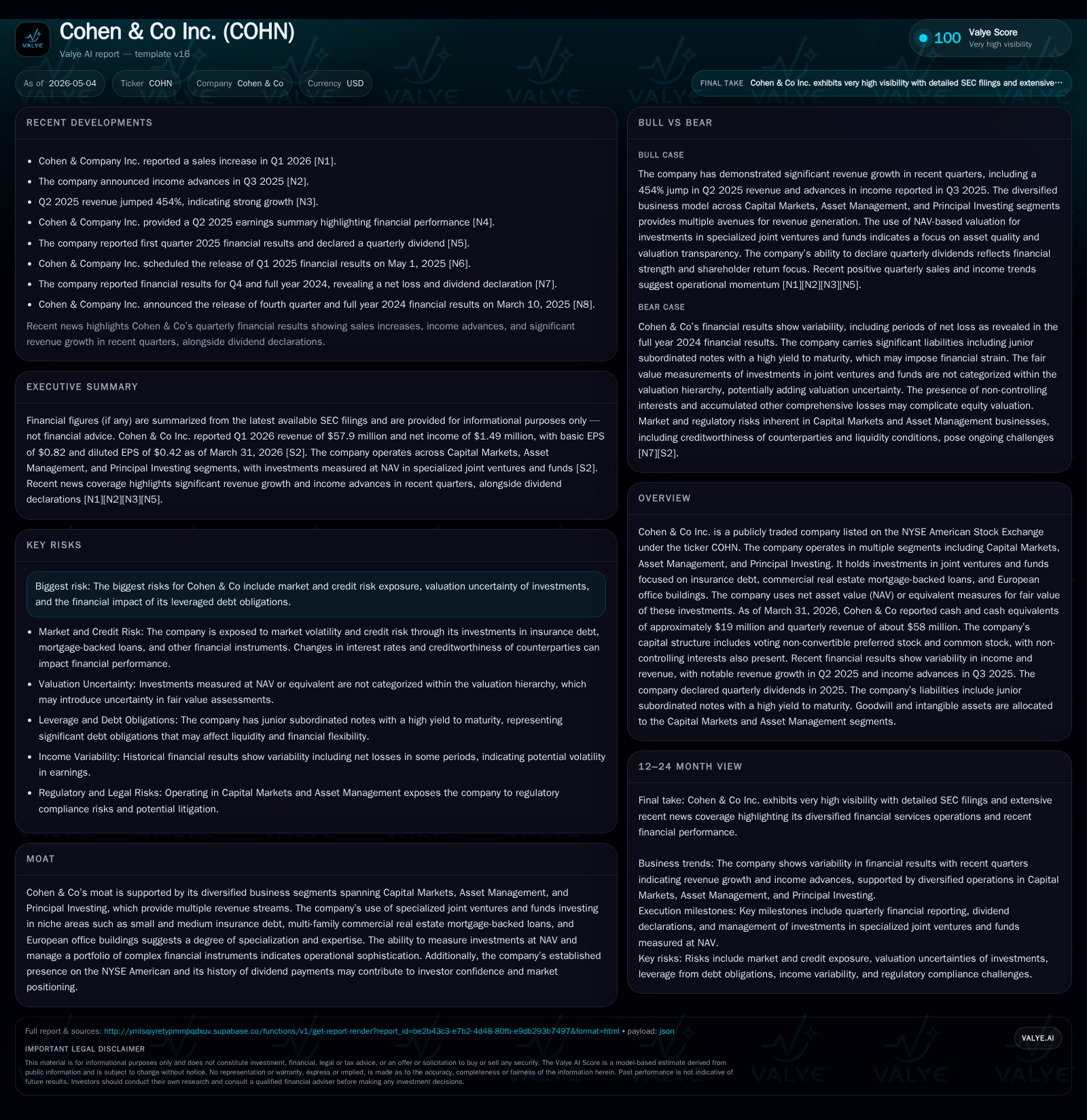
Cohen & Co’s Q1 2026 results reveal nuanced shifts in portfolio valuation methods primarily anchored around NAV-based assessments of joint ventures in insurance debt and commercial real estate loans. The company maintains a strong liquidity position with cash reserves near $19 million and reports no outstanding debt, supporting operational flexibility. Its diversified model spans capital markets advisory, asset management fees, and principal investing via specialized funds focused on niche credit and real estate assets. Near-term growth hinges on scaling fund deployments and managing valuation risk amid credit market pressures, while key risks include the opacity of fair value estimates and counterparty credit exposure.
Latest Quarterly Developments Illuminate Company Focus
Cohen & Co Inc.'s most recent quarterly filing dated May 4, 2026 ([S2], [S3]) notably emphasizes its continued reliance on net asset value (NAV) or similar methodologies to measure the fair value of key investments within its portfolio. Specifically, the firm uses NAV valuations as a practical expedient for interests held in its U.S. Insurance Joint Venture (JV), the CREO JV focusing on multi-family commercial real estate mortgage-backed loans, and the CK Capital Value Fund invested mainly in Dutch office properties. These investment vehicles account for a substantial portion of Cohen's principal investing segment. The use of NAV is explicitly noted as these assets are generally illiquid and do not fit within conventional ASC 820 valuation hierarchies ([S2]).
This approach introduces a layer of complexity in valuing underlying assets that fluctuate with credit cycles and real estate market fundamentals but provides an operational means to estimate fair value regularly. The quarterly report also confirms Cohen’s robust liquidity status with approximately $19 million cash on hand at quarter-end and no outstanding debt liabilities ([F1], [S2]), underpinning its capacity to pursue growth or absorb interim volatility without pressure from leverage.
Business Model: Multi-Segment Operations and Investment Approach
Cohen & Co operates across three primary segments: Capital Markets advisory services including investment banking and new issue underwriting; Asset Management where it manages fee-generating mandates; and Principal Investing comprising stakes in niche alternative investments such as insurance-related debt funds and real estate loan portfolios ([S1], [S2]).
Revenue flows are generated through fees on capital markets transactions and assets under management (AUM) fees tied to growth or retention within managed funds. Principal investing contributes income via direct returns on equity-method investments measured at NAV or an equivalent standard. This hybrid structure spreads Cohen’s revenue base across advisory fees, asset management recurring revenues, and realized/unrealized gains from principal holdings.
The firm’s strategic strength lies in its specialization within underserved niches: namely, U.S.-denominated debt issued by small to medium insurers via its Insurance JV; multi-family CRE mortgage loans through CREO JV; and European office real estate via the Dutch CK Capital Value Fund ([S2]). This expertise caters to investor demand for diversification beyond traditional equity markets into specialized credit assets that typically offer higher yields albeit coupled with greater valuation complexity.
Industry Context: Specialized Niche Investments and Competitive Positioning
Within the alternative asset ecosystem, Cohen & Co occupies a distinctive niche characterized by targeted investment themes requiring deep credit underwriting skills and localized market knowledge — particularly relevant when managing portfolios concentrated in small insurer obligations or CRE loans which carry idiosyncratic risks.
Competition arises from larger diversified asset managers who also pursue similar strategies but often at greater scale with broader distribution networks. Cohen's boutique positioning offers agility but may limit access to institutional investors seeking size or standardized products.
Pricing power appears moderate given that fee structures must remain competitive against peers yet justify the proprietary analytical capability to manage these complex portfolios. Regulatory scrutiny—especially around valuation standards for private investments—and fluctuating creditworthiness of counterparties introduce layers of risk that can affect transparency and investor confidence ([S1], [S2]).
Growth Catalysts: Expanding Asset Classes and Market Penetration
Key growth drivers are linked predominantly to expansion across existing fund platforms through increased inflows—the U.S. Insurance JV’s ability to deploy capital into insurance debt markets stands out as a scalable avenue given current yield spreads relative to benchmarks ([S2]).
Similarly, deploying capital into multifamily CRE mortgage-backed loans via the CREO JV aligns with sustained demand for residential rental housing in major U.S. metropolitan areas underpinning underlying asset stability.
Geographic diversification into European office markets through CK Capital Value Fund provides additional avenues for incremental fees and NAV appreciation potential but also introduces sensitivity to regional economic conditions affecting office occupancy rates.
Successful navigation of fundraising cycles aligned with improved NAV marks would feed into recurring management fees while principal investing returns could compound earnings if executed prudently.
Risk Factors: Valuation Uncertainty and Market Credit Exposure
The foremost risks cited stem from inherent challenges valuing sizable holdings concentrated in non-liquid instruments where observable market inputs are scant ([S1], [S2]). Reliance on NAV-based estimates exposes Cohen & Co to potential mark-to-market volatility driven by credit rating migrations or economic shocks affecting insurance companies or real estate collateral.
Further complicating matters are potential legal contingencies related to activities within SPAC sponsorship structures highlighted in annual filings — indicating ongoing regulatory vigilance could impose financial or operational burdens ([S1]).
Although the company currently reports no financial leverage ([F1]), market disruptions affecting counterparties’ liquidity or solvency could adversely impact underlying investment performance or impair fee revenue stability.
Monitoring Key Execution Metrics and Upcoming Milestones
Critical performance indicators going forward include fund AUM trends reflecting new investor commitments vs redemptions within core JVs; NAV revisions signaling underlying asset appreciation or impairment; capital markets deal flow quality particularly within advisory segments; and any updates related to regulatory environments affecting SPAC activities or other investment vehicles ([S2], [S3]).
Management commentary at subsequent earnings releases will be pivotal for gauging the success of deployment strategies especially amid evolving macroeconomic backdrops impacting interest rates, property values, as well as insurer balance sheet health.
Brief Financial Overview — Liquidity, Revenue, and Capital Structure
As of March 31, 2026, Cohen & Co reported cash and cash equivalents on hand just under $19 million without any recorded long-term debt ([F1]), underscoring a conservative balance sheet stance conducive to weathering episodic valuation swings characteristic of its principal investing segment.
The firm exhibited trailing annual revenues around $275 million with operating income near $59 million demonstrating sustained profitability driven by its diversified business segments ([F1]). While income exhibits some variability reflective of mark-to-market noise inherent in private asset holdings, these figures reinforce an underlying operational strength balanced across fee-revenue streams and principal gains.
This analysis leverages the most recent quarterly disclosures alongside annual context to distill Cohen & Co's strategic posture amid evolving portfolio valuations. As the firm continues leveraging its expertise within alternative credit niches juxtaposed against complex valuation challenges and industry headwinds, active scrutiny of fund-level NAVs alongside capital market franchise health will provide meaningful insight into execution efficacy going forward.
This report is informational only; it does not constitute investment advice or recommendations.
Disclaimer: This is research-only, informational analysis and not investment advice. It may include AI-generated interpretation and general industry context. Always verify important details using primary sources.

Comments