
Catalyst Crew Technologies Advances AI Healthcare Platforms with Venezuelan Market Focus but Faces Capital and Commercialization Barriers
Development-stage digital health company Catalyst Crew Technologies consolidates AI health analytics solutions and telehealth services via a Venezuelan subsidiary while remaining pre-revenue and capital constrained.
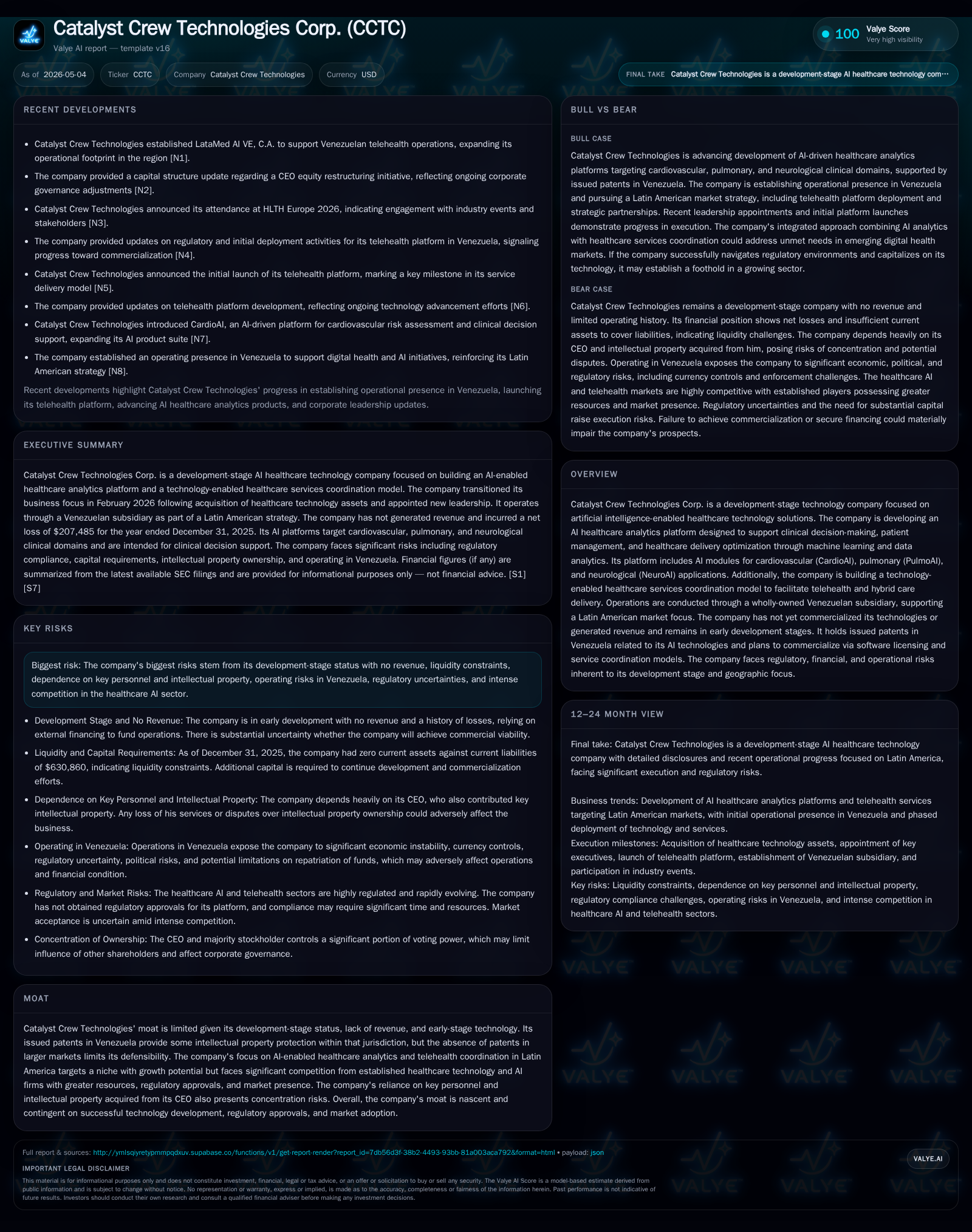
Catalyst Crew Technologies Corp. completed its strategic pivot in early 2026 acquiring AI-enabled healthcare analytics and telehealth assets from its CEO, transitioning from shell status to an active development-stage digital health firm. Its AI platform includes niche modules for cardiovascular, pulmonary, and neurological applications, supported by issued patents in Venezuela, where it has also established an operating subsidiary to spearhead Latin American expansion. Despite these foundational moves, the company remains pre-commercial with no revenue, limited financial resources, and significant execution risks tied to regulatory approvals and market adoption within a competitive digital health landscape.
Recent Operating Update
Catalyst Crew Technologies Corp. finalized a pivotal change of control in February 2026 when Kevin Rodan Levy acquired a controlling interest and sold his proprietary artificial intelligence (AI) healthcare technology assets to the company in exchange for 12 million shares [S3][S13][S16]. This acquisition transformed Catalyst Crew from a dormant shell company into a development-stage healthcare technology firm focused on AI-enabled analytics and telehealth platforms. Since then, the company has set up a wholly-owned Venezuelan subsidiary, Inversiones Long 33 C.A., as part of its broader strategy targeting the burgeoning Latin American digital health market [S3][S19].
In April 2026, Catalyst Crew reassigned key patent rights related to its CardioAI (cardiovascular), PulmoAI (pulmonary), and NeuroAI (neurological) modules to this subsidiary—reflecting an operational consolidation within Venezuela [S21]. These platforms launched publicly through press announcements between March and April 2026 but remain under development without commercial deployment or revenue [N1][N4][N5][N6]. The company also unveiled initial telehealth capabilities via its technology-enabled services model integrating digital consultations with hybrid care coordination [N1][S1].
Despite these strategic developments, Catalyst Crew’s latest quarterly report from November 2025 highlights no revenue generation to date and continuing net losses consistent with its pre-commercial status [S2]. Financials reveal very limited operating cash with total debt at approximately $272K against zero current assets and $630K in current liabilities as of year-end December 2025 [F1], underscoring the critical need for additional financing to proceed toward commercialization.
Business Model Overview
Catalyst Crew aims to generate value through the development and eventual commercialization of an integrated digital health platform combining:
Artificial Intelligence Healthcare Analytics Platform: Modular AI tools designed to provide predictive risk assessment, diagnostic support, and workflow optimization across multiple clinical domains—initially cardiovascular (CardioAI), pulmonary (PulmoAI), and neurological (NeuroAI) conditions. These modules leverage machine learning models trained on clinical datasets and are intended as clinical decision-support systems rather than autonomous diagnostic devices [S1][S26].
Technology-Enabled Healthcare Services Coordination Platform: This complements analytics by facilitating telehealth service delivery paired with hybrid in-person care coordination. The platform aims to enable risk-based triage prioritization, patient monitoring, structured follow-up workflows, and data-driven reporting to providers within an integrated system architecture [S25].
Revenue is envisioned from subscription-based software licensing for healthcare providers along with usage-based fees tied to telehealth consultations and care coordination activities once regulatory clearances are secured in target markets [S18]. However, all offerings remain non-operational at present.
The business depends heavily on sustainable capital injections given zero cash flow from operations. The company funds ongoing development through equity issuances—with management emphasizing the acquisition of intellectual property assets from its CEO as foundational IP—and has yet to achieve any recurring revenue stream [S5][S15].
Industry Structure and Competitive Position
Catalyst Crew operates within the highly competitive global digital health ecosystem that intersects artificial intelligence healthcare analytics, telemedicine infrastructure, and coordinated care delivery models. Key industry incumbents include well-capitalized established software vendors servicing hospital systems with clinical decision-support tools—such as IBM Watson Health (now restructured)—and dominant telehealth platforms like Teladoc Health or Amwell.
The market demands significant clinical validation data, regulatory approvals (particularly if software is regulated as medical devices), robust data security compliance (HIPAA-equivalent measures), extensive provider network integrations, and scalable infrastructure—all areas where Catalyst Crew currently lacks operational credentials or revenue traction [S23].
Regionally focused on Latin America through its Venezuelan subsidiary positions the company into a niche with meaningful growth potential due to expanding mobile connectivity and private healthcare expenditure growth—but also heightened geopolitical risks, economic instability, currency controls, variable digital health regulations, and infrastructural barriers [S1][S25].
The competitive environment includes local telemedicine startups leveraging regional knowledge as well as large multinational digital health firms increasingly entering Latin American markets. Catalyst’s limited patent protection confined solely to Venezuela diminishes defensibility against larger competitors who invest heavily in global IP portfolios [S23][S24].
Key person risk intensifies competitive vulnerability given the CEO’s outsized role providing essential IP assets alongside strategic leadership [S1][S10].
Growth Drivers
Catalyst Crew’s future growth is predicated on several sequential milestones:
- Successful Development Completion: Delivery of stable versions of CardioAI, PulmoAI, NeuroAI modules along with integration into the telehealth coordination platform.
- Regulatory Approvals: Clearance or certification as required for clinical decision-support software across initial target markets including Venezuela; validation that the platform complies with local healthcare data laws.
- Commercial Deployment & Market Adoption: Pilot programs launching via the Venezuelan subsidiary aiming for scalable customer engagements with healthcare providers.
- Strategic Partnerships: Alliances with regional clinics or hospitals enabling data access for model validation plus eventual subscription sales.
- Capital Raising: Accessing necessary funding rounds or equity financing sufficient to support sustained R&D investment, marketing efforts, technology infrastructure build-out.
- Geographic Expansion: Potential stepwise extension into other Latin American countries such as Colombia that present more advanced digital health ecosystems but require separate regulatory navigation [S18][N8].
As of December 31, 2025, total debt stood at approximately $272,304 with zero current assets and current liabilities of $630,860, resulting in a current ratio of 0 [F1]. This reflects negligible operational liquidity requiring near-term capital that poses going concern risks absent new financing sources [F1][S1][S5]. The absence of employees beyond executive leadership further demonstrates nascent operations relying heavily on contracted R&D activity.
This analysis synthesizes information exclusively from SEC filings up through May 4th, 2026 ([S1],[S2],[S3]), supplemented by recent news releases () and financial data ([F1]). It relies explicitly on disclosed facts without conjecture. Investors are advised that Catalyst Crew Technologies remains highly speculative due to its early-stage status combined with material execution risks typical of emerging healthcare AI companies.
Disclaimer: This is research-only, informational analysis and not investment advice. It may include AI-generated interpretation and general industry context. Always verify important details using primary sources.

Comments