
RLJ Lodging Trust Signals Resilience with Premium Hotel Portfolio in Q1 2026
The company’s Q1 2026 results showcase operational stability fueled by its focus on premium-branded, focused-service hotels amid competitive lodging dynamics.
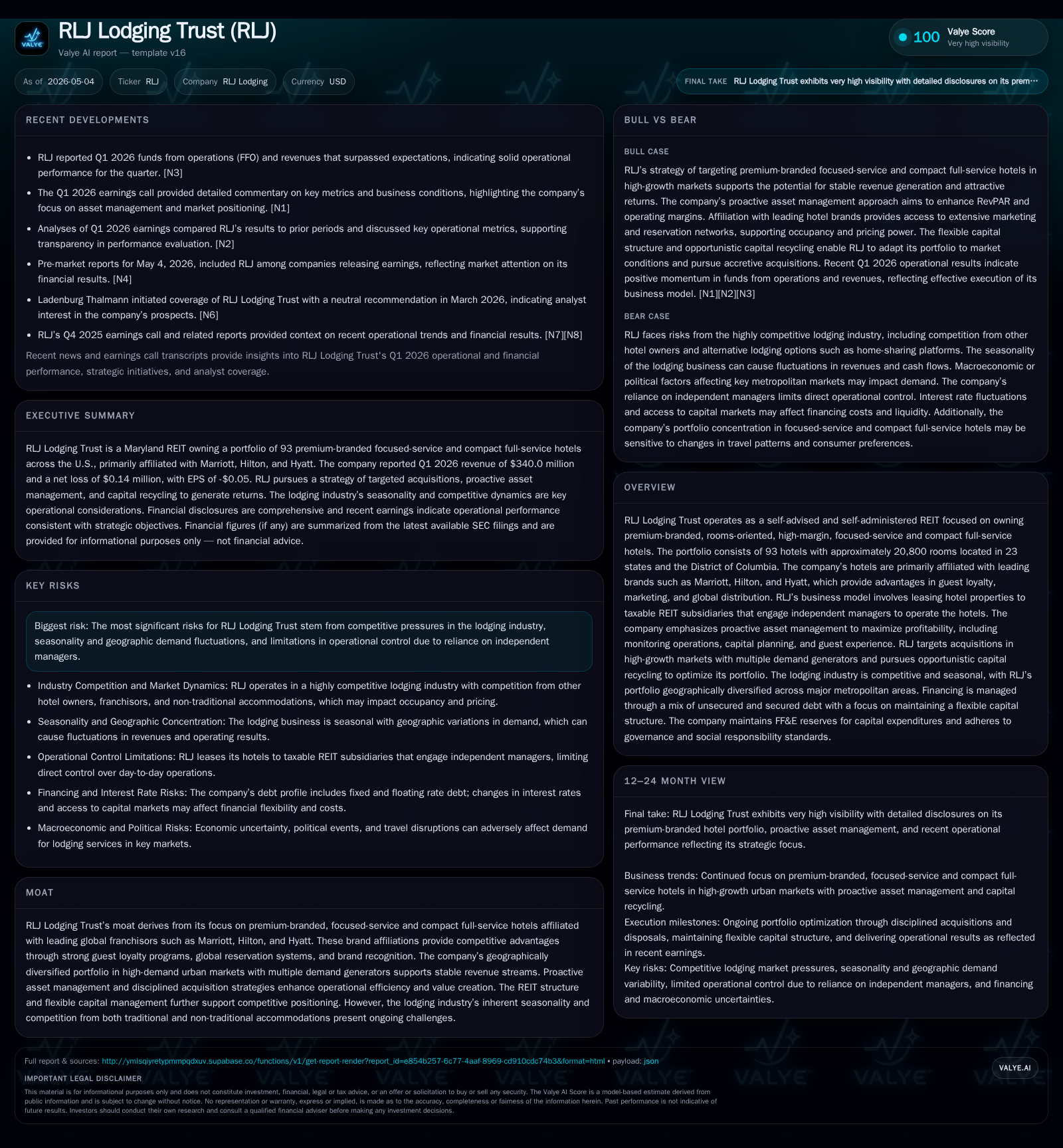
RLJ Lodging Trust’s first quarter of 2026 reflects steady revenue and cash flow generation driven by its strategically curated portfolio of premium-branded focused-service hotels. Leveraging brand affiliations with Marriott, Hilton, and Hyatt, the REIT navigates industry cyclicality and competitive pressure through disciplined asset management and capital recycling. Recent filings highlight the company’s robust operational performance, proactive growth initiatives, and a capital structure that supports flexibility despite seasonality and third-party management constraints.
Q1 2026 Operating Update: Performance Highlights and Implications
RLJ Lodging Trust’s Q1 2026 filing (10-Q dated May 4) reveals continued operational resilience in an otherwise competitive lodging environment [S2]. The company reported stable occupancy trends across its portfolio of 93 premium-branded focused-service and compact full-service hotels. Revenue performance exceeded certain expectations as room demand held firm despite industry-wide cyclicality noted in recent commentary [N1][N6]. Margins benefited from disciplined cost control and proactive asset oversight. The recent event filing augments this narrative by confirming no material disruptions or deviations from the company’s strategic operating plan in early 2026 [S3]. This snapshot is critical, considering the lodging sector typically experiences volatility driven by macroeconomic factors and seasonality.
Business Model Focus: Premium Branded, Focused-Service Hotels
RLJ operates as a self-advised REIT owning primarily premium-branded properties affiliated with marquee franchisors Marriott, Hilton, and Hyatt [S1][S8]. The company strategically focuses on focused-service and compact full-service hotels characterized by higher profit margins due to streamlined operations versus traditional full-service peers. Its business model features an umbrella partnership (UPREIT) structure where hotel properties are leased to taxable REIT subsidiaries (TRSs). These TRSs contract independent third-party managers who handle day-to-day operations including staffing, pricing strategy, and customer service [S11]. While this approach limits direct operational command—which is a double-edged sword—it leverages the benefits of brand loyalty programs, centralized reservation systems, and global distribution capabilities that foster robust demand pipelines.
RLJ’s asset management philosophy emphasizes close monitoring of hotel operations combined with tactical capital planning—such as renovations or repositioning projects—to maximize RevPAR and EBITDA margins. The geographic concentration in high-growth metropolitan areas with multiple demand generators underpins stable cash flows and mitigates isolated market shocks.
Industry Context: Competitive Positioning Within U.S. Lodging Markets
The U.S. lodging industry is intensely competitive with numerous players ranging from luxury full-service chains to emerging alternative accommodations like Airbnb platforms [S1]. RLJ competes primarily through its portfolio’s location quality and brand affiliation strength that help maintain pricing power despite market fragmentation. Its hotels are situated predominantly in urban markets where there is sustained business travel demand alongside leisure traffic—sectors less vulnerable to economic downturns [S27]. The focused-service niche captures a sweet spot with near comparable RevPAR levels to full-service but better operating leverage.
However, restrictive covenants embedded in franchise agreements can constrain RLJ’s flexibility in asset sales or refinancing decisions. For instance, franchisors may require approval rights over management changes or possess rights of first offer for property dispositions [S1]. This places subtle limits on strategic agility compared to wholly owned-and-operated hotel models.
Strategic Growth Drivers: Market Targeting, Asset Management, and Capital Recycling
RLJ’s growth trajectory hinges on disciplined acquisitions within target metro areas exhibiting vibrant economic growth and diverse demand generators such as corporate headquarters, convention centers, universities, or airports [S2]. The firm pursues a value-enhancement approach through opportunistic capital recycling—disposing of assets where returns have peaked while redeploying proceeds into higher-yielding properties or renovations.
Moreover, asset management initiatives continue to focus on optimizing guest experience enhancements that support pricing resiliency along with efficiency programs trimming operational costs [N1]. Management commentary highlights ongoing investments balanced prudently against cash flow generation targets amid cautious market outlooks.
Risks and Constraints: Seasonality, Competition, and Management Levers
Seasonality remains an inherent challenge for RLJ as certain markets observe fluctuating occupancy linked to travel patterns or event calendars [S1]. Amplified competition from both established hotel chains and non-traditional accommodations continually pressures pricing strategies.
The reliance on independent managers under franchise umbrellas introduces complexity; RLJ does not directly run hotel operations but influences them through contracts. This restricts immediate responsiveness to cost or revenue optimization levers during rapid market shifts [S1][S2]. Additionally, franchise covenants related to sales restrictions or refinancing approvals further temper maneuverability.
Milestones to Monitor: Upcoming Guidance, Acquisition Activity, and Operational KPIs
Investors should watch upcoming quarterly guidance updates post Q1 release for signals on demand momentum or margin evolution [S3][N1]. Any announcements around new acquisitions or dispositions will illuminate RLJ’s ability to deploy capital effectively in competitive markets [N2]. Key operating metrics remain RevPAR trends—which proxy demand health—and occupancy rates within core markets. The success of ongoing renovation projects or rebranding efforts could also materially impact future earnings profiles.
Brief Snapshot of Financial Health: Liquidity and Capital Structure Insights
As of March 31, 2026, RLJ reported cash and equivalents totaling approximately $353 million—an ample liquidity buffer facilitating capital spending or opportunistic acquisitions [F1][S2]. The estimated net debt position stands near $710 million (difference between total debt & cash), reflecting moderate leverage typical within lodging REITs.
The company maintains access to multiple unsecured revolving credit facilities and term loans with staggered maturities extending through 2027-2030 periods providing flexibility amid evolving interest rate environments [S4][S5][S6]. Compliance with financial covenants remains solidly affirmed at latest reporting dates ensuring no near-term refinancing distress risks. Debt service coverage ratios and unencumbered asset coverage metrics comply comfortably with lender mandates supporting ongoing strategic options.
This analysis draws solely from documented company filings dated through early May 2026 along with relevant market commentary cited. It aims to provide an informed spotlight on RLJ Lodging Trust's current operational posture within a dynamic lodging sector environment without extrapolating beyond presented data or offering investment recommendations.
Disclaimer: This is research-only, informational analysis and not investment advice. It may include AI-generated interpretation and general industry context. Always verify important details using primary sources.

Comments