
Alignment Healthcare Expands Membership with Integrated Medicare Advantage Model Fueled by Technology and Clinical Innovation
Latest quarterly results show robust membership growth and confirm the strength of Alignment Healthcare's consumer-centric Medicare Advantage platform.
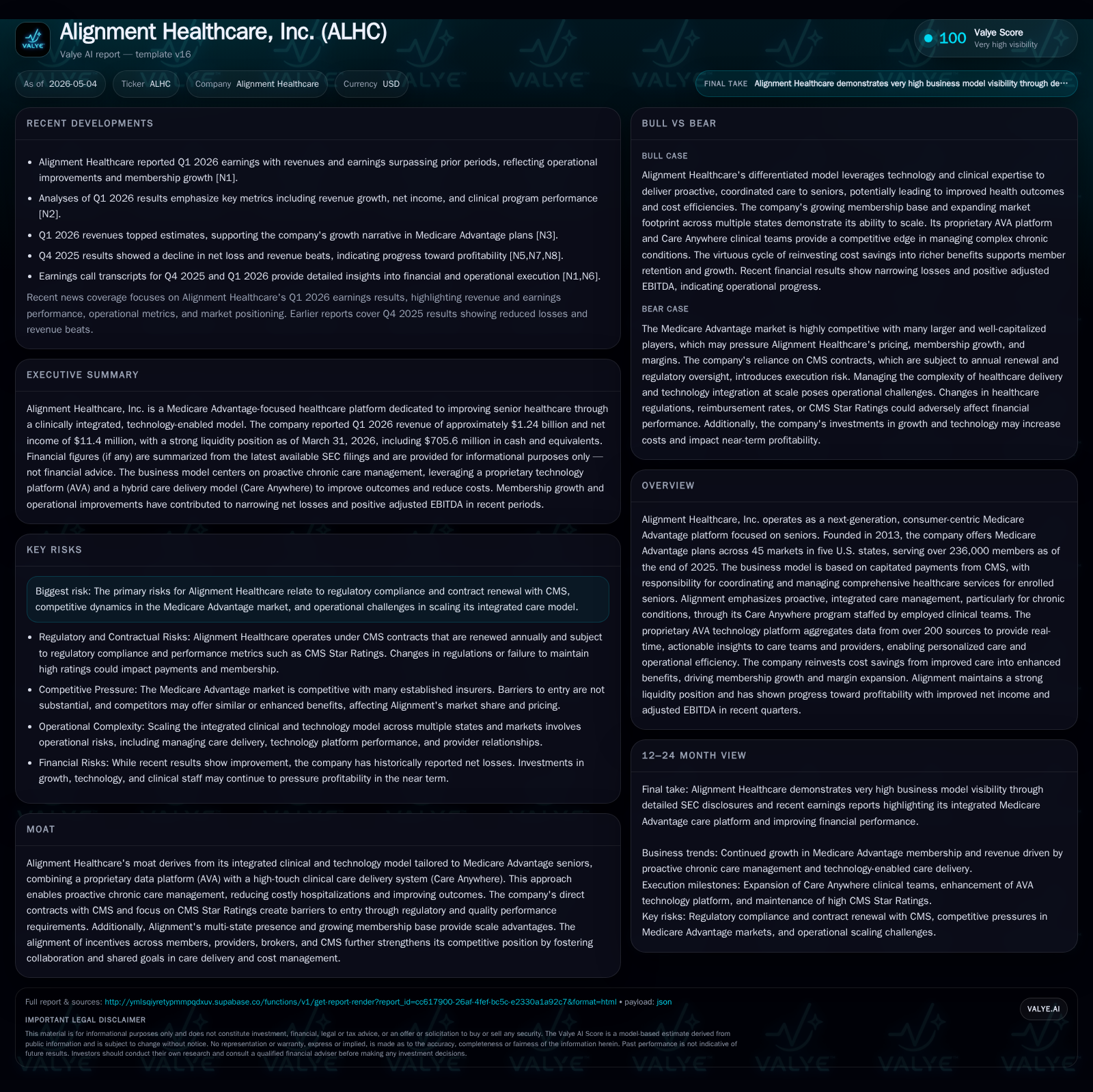
In Q1 2026, Alignment Healthcare continued its rapid expansion, growing health plan members to approximately 275,300, a 31% increase year-over-year. The company’s integrated approach combines a proprietary data platform (AVA) with an employed clinical model (Care Anywhere), enabling aligned incentives across stakeholders and supporting improved outcomes for seniors. Operating across five states and 45 markets, Alignment leverages capitated CMS payments with risk-adjusted premiums to incentivize cost-effective care, while reinvesting savings into enhanced member benefits. The Medicare Advantage industry presents growth through market expansion and rising enrollment, but risks include regulatory compliance, CMS contract renewals, and operational scaling challenges. Financially, Alignment maintains a strong liquidity position with $705 million in cash and manageable debt of $330 million as of March 2026.
Recent Operating Update
Alignment Healthcare reported its first quarter results for the period ended March 31, 2026 [S2][S3]. The company highlighted that Health Plan Membership grew to approximately 275,300 members as of January 1, 2026 — a remarkable 31% increase compared to the prior year [S1]. Moreover, it forecasted further growth to between 290,000 and 296,000 members by year-end 2026, translating to around 24-27% growth relative to the end of 2025. This continued momentum underscores the effectiveness of Alignment's integrated Medicare Advantage offering across its markets.
The quarter's filing confirmed no material changes to previously disclosed risk factors [S2], indicating stable operational conditions without emerging unexpected threats.
Business Model
Alignment Healthcare operates a Medicare Advantage platform targeting senior citizens aged primarily over age 65 who qualify for Medicare. It offers HMO and PPO plans under direct contracts with the Centers for Medicare & Medicaid Services (CMS) [S1]. Key revenue is derived from capitated monthly payments per member (PMPM), which are adjusted not only by geography but also by member health risk scores and quality performance measured via CMS Star Ratings.
This capitation arrangement transfers financial risk for members' comprehensive healthcare services — including primary care, specialty visits, hospitalizations, post-acute care, prescription drugs — from CMS to Alignment. Consequently, the company must manage care cost-effectively while delivering high-quality outcomes.
Alignment differentiates itself through a vertically integrated clinical model branded as Care Anywhere: directly employed clinicians coordinate proactive care management emphasizing chronic disease oversight to reduce costly emergency visits or inpatient stays [S1].
Supporting this clinical approach is AVA—a proprietary technology platform aggregating information from over 200 diverse healthcare data sources into real-time clinical intelligence informing providers’ decision-making and enabling personalized interventions [S1].
These dual pillars form the core competitive advantage facilitating improved unit economics: managing chronic conditions effectively lowers costs while enhancing member satisfaction, allowing Alignment to reinvest savings into supplemental benefits that strengthen retention.
Membership typically enrolls on annual renewable terms; high retention rates support revenue visibility. The interplay between membership volume and PMPM rates drives topline revenue alongside careful cost management influencing gross profit margins.
Industry Structure and Competitive Position
The Medicare Advantage (MA) market serves over two-thirds of Medicare beneficiaries nationally but remains highly fragmented regionally with large incumbents such as UnitedHealth Group (Elevance Health), Humana, CVS Health/Aetna among top competitors. These companies benefit from scale advantages but may lack the nimbleness of newer platforms focused on deep integration.
Alignment targets mid-to-large metropolitan markets within five key states: California, North Carolina, Nevada, Arizona, and Texas—regions collectively housing about 8.4 million Medicare eligibles across their footprint [S1]. Despite operating in some developed MA markets with share ranging from roughly 10-30%, Alignment’s penetration remains low at about 6% market share of local MA enrollment [S1], signaling sizable room for growth via market share capture.
Its moat arises primarily from the proprietary AVA platform coupled tightly with an employed clinician model that achieves superior coordination compared to traditional MA plans relying more heavily on external providers or fee-for-service arrangements.
Contractual relations directly with CMS establish regulatory barriers; achieving high Star Ratings is critical since these influence payment premiums and consumer choice—pressuring competitors lacking sophisticated data-driven capabilities.
Broker networks also prefer plans demonstrating consistent quality outcomes coupled with attractive benefit packages powered by reinvested cost savings — further entrenching Alignment’s differentiated positioning.
Growth Drivers
Market Share Gains in Existing Footprint
Alignment routinely displaces incumbents through delivering better integrated care experiences that translate into visible member benefits such as reduced hospital admissions and enhanced supplemental services tailored to seniors' needs [S1]. Continued investment in marketing aligned with broker partnerships supports acquisition pipeline robustness.
Geographic Expansion
The company pursues new market entries selectively into regions where demographic profiles align with its model’s scalability potential [S1]. Since inception through recent years it has expanded aggressively into multiple new counties/states leveraging proven operational playbooks.
Technology & Clinical Innovation
Ongoing evolution of AVA enhances precision medicine capabilities making care coordination increasingly efficient as datasets grow richer. Simultaneously expanding Care Anywhere clinician headcount drives deeper engagement with complex patients yielding returns on population management investment.
Regulatory Incentives via Star Ratings
Maintaining near universal enrollee placement in plans rated four stars or above (~100% target) optimizes reimbursement uplift grants financial power for reinvestment into plan enhancements—closing virtuous cycle loops supporting enrollment growth [S27].
Risks / Watchpoints / Growth Constraints
- Regulatory Compliance & CMS Contract Risk: CMS audits like Risk Adjustment Data Validation (RADV) pose substantial payment recoupment risks if coding practices are challenged [S5]. Contract renewal depends heavily on adherence to rigorous quality metrics which could tighten unexpectedly.
- Competitive Pressures: Dominant national insurers have vast capital resources allowing rapid product innovation or aggressive pricing strategies; new entrants competing on specialized models may encroach on membership.
- Operational Scaling: Growth requires proportionate scaling of Care Anywhere clinical staff while maintaining service quality; labor shortages or productivity dips could impair performance.
- Market Concentration: Geographic exposure limited primarily to five states adds regional economic or regulatory vulnerability potentially impacting business cyclicality.
- Dependency on Capitated Payments: Shifts in CMS policy altering payment formulas or introducing novel value-based payment models require adaptation; misalignment could affect margins.
What to Watch Next
- Progress toward year-end membership guidance of roughly up to 296,000 members will serve as a key volume indicator confirming continued growth trajectory [S1][S3].
- Updates on CMS Star Ratings especially any changes impacting reimbursement levels are critical given their leverage effects on profitability [S27].
- Execution milestones expanding Care Anywhere team size without diluting clinical effectiveness will be important operational KPIs during scaling phase.
- Regulatory developments regarding RADV audit results or broader Medicare Advantage rule reforms will bear watching closely due to potential financial impact.[S5]
- Quarterly financial disclosures referencing adjusted EBITDA against guidance will provide additional color on margin trends amid growth investments.[N1][N2]
Financial Profile (Latest Quarter Context)
Latest financial snapshot
| Metric | Value | Period |
|---|---|---|
| Cash & equivalents | $706mm | |
| 2026-03-31 | ||
| Total debt | $330mm | |
| 2026-03-31 | ||
| Net debt | $-376mm | |
| 2026-03-31 | ||
| Current assets | $1145mm | |
| 2026-03-31 | ||
| Current liabilities | $725mm | |
| 2026-03-31 | ||
| Current ratio | 1.58x | |
| 2026-03-31 |
Source: SEC companyfacts cache [F1].
As of March 31, 2026 ([F1]), Alignment held cash and equivalents totaling $705.6 million against total debt of $330.0 million yielding a net cash position approximately -$375.6 million (cash exceeds debt).
Reported total revenue was $3.95 billion for calendar-year-end December 2025 ([F1]) driven by premium income linked directly to member volumes under capitated CMS agreements. Operating income was modest at $14.8 million though net income showed a slight loss weighted by ongoing investments in clinical expansion and technology development ([F1]).
Overall financial posture supports execution capability in scaling strategies while managing underlying regulatory compliance burden and pricing environment uncertainties.
Alignment Healthcare exemplifies a modern Medicare Advantage insurer combining technology-enabled proactive care models backed by strong clinical integration aligned tightly with CMS incentives for quality-driven cost containment. Its substantial recent membership gains demonstrate market traction in competitive environments dominated by larger peers—but ongoing diligence is required across regulatory compliance dimensions and operational execution scales going forward.
This analysis is based solely on publicly available information including recent SEC filings dated through April 30, 2026.
Disclaimer: This is research-only, informational analysis and not investment advice. It may include AI-generated interpretation and general industry context. Always verify important details using primary sources.

Comments