
Beazer Homes: Quarterly Operational Challenges and Strategic Growth Targets
Beazer Homes’ latest quarterly results reveal revenue miss and loss amid mortgage-driven market softness, while reaffirming multi-year growth and deleveraging goals.
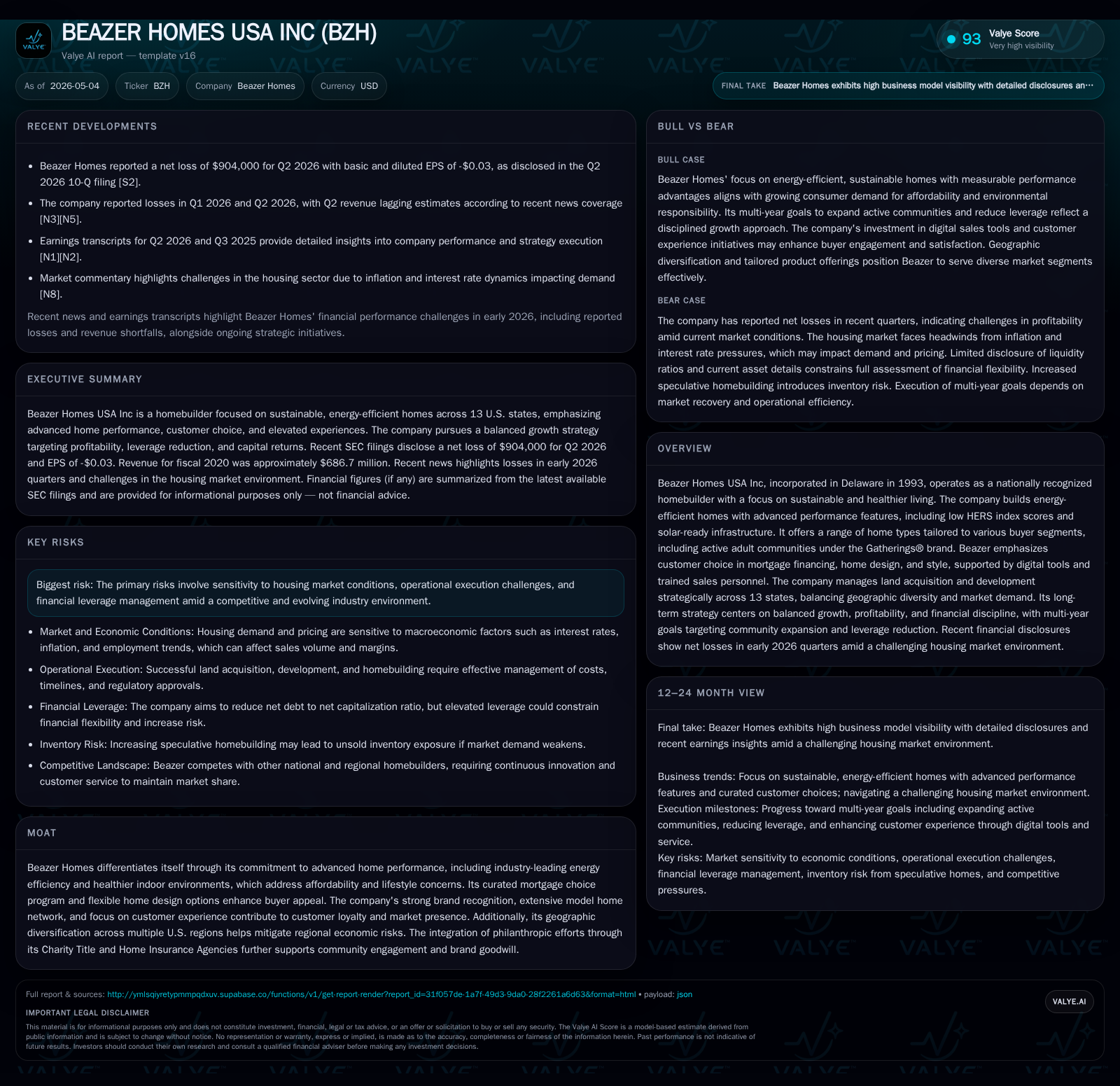
In its 2026 Q2 filing, Beazer Homes reported revenue below expectations and a net loss, reflecting persistent challenges in homebuyer demand driven by elevated mortgage rates and affordability pressures. However, the company reiterated its long-term strategy focused on expanding active communities, improving energy-efficient home offerings, and reducing financial leverage. Its distinctive value proposition around sustainable, performance-focused homes provides differentiation amid a competitive and cost-pressured residential construction sector. Key risks persist from market volatility, mortgage financing availability, and litigation exposure. Stakeholders should monitor community growth pace, margin recovery signals, and progress on deleveraging in upcoming quarters.
Latest Quarterly Operating Snapshot and Near-Term Implications
This shortfall is symptomatic of broader market softness where demand softness translates into lower orders per community per month—reported at 2.0 during FY2025 down from 2.4 the prior year—as buyers hesitate amid macroeconomic uncertainty [S1]. Beazer has responded by adjusting pricing strategies, incentives, and features to align with continuing competitive pressures. The near-term picture involves cautious inventory management and calibrated land spend to preserve capital discipline without stymying long-term growth aspirations.
Business Model Overview: Delivering Energy-Efficient, Buyer-Centric Homes
Beazer’s core business model hinges on constructing homes with superior energy-efficient characteristics designed to meet rising consumer expectations for sustainability and healthier living environments [S1]. The company operates across diverse geographies—13 states spanning West, East, and Southeast regions—to complement product offerings with land portfolio diversification that mitigates regional economic variability.
Their homes feature low HERS® index scores indicating best-in-class energy efficiency versus average existing stock (~130 HERS). This emphasis not only lowers utility costs for homeowners but also addresses mounting affordability concerns via reduced total cost of ownership. Furthermore, Beazer incorporates solar-ready infrastructure into new builds anticipating growing renewable energy adoption.
Strategically notable is the company’s Gatherings® brand targeting active adult communities—a segment benefiting from demographic tailwinds seeking lifestyle-oriented housing with wellness-centric design elements. Backed by digital tools aiding customer choice on mortgage financing options and flexible home design/styling packages supported by trained sales personnel, Beazer enhances buyer empowerment which can improve sales conversion rates despite headwinds.
The company balances traditional land acquisitions alongside increased reliance on lot option agreements (~62% of lots under options as of FY2025 end), offering flexibility to scale work-in-progress communities responsively without overextending capital or timing mismatches [S1]. This controlled approach aligns tightly with their stated goal of growing profitability while minimizing operational risk.
Industry and Competitive Dynamics in Residential Construction
Within the highly fragmented U.S. homebuilding industry, Beazer competes against national players (e.g., D.R. Horton, Lennar) as well as regional builders like Century Communities [N5][N6]. Pricing power remains constrained amid cyclical demand fluctuations intensified by elevated raw material prices (lumber, steel) and ongoing skilled labor shortages that inflate construction costs.
The sector is simultaneously navigating increasing regulatory complexities surrounding sustainability disclosures especially under state regimes such as California’s climate-related requirements [S1], adding incremental compliance costs that can pressure margins if not effectively managed.
Customer buying behavior has evolved toward prioritizing energy efficiency coupled with affordability. Builders offering tangible utility savings via advanced home performance standards enjoy differentiation potential but must contend with balancing feature upgrades against cost inflation risk. Experienced homebuyers are demanding more transparency on lifecycle operating expenses beyond purchase price alone.
Amid these dynamics, successful market incumbents must exhibit operational agility—controlling build cycles through lot options—and ensure strong brand resonance reinforced by customer experience excellence. Beazer’s curated mortgage choice program helps address affordability limitations when conventional lending tightens.
Growth Drivers: Geographic Expansion & Sustainability-Focused Product Differentiation
Beazer’s management continues to press forward with multi-year ambitions to scale to more than 200 active communities by the end of fiscal 2027 while achieving a net debt-to-capitalization ratio within the low 30%s [S1]. The expansion trajectory is supported by disciplined land acquisition spending ($684 million in FY2025) albeit reduced relative to prior year reflecting cautious allocation responsive to macro conditions.
Driving organic growth is the expected compounding impact of broadening energy-efficient home penetration leveraging recognized HERS scoring metrics that appeal increasingly to eco-conscious buyers seeking savings amid inflationary cost pressures. Active adult communities under their Gatherings® brand represent another tangible platform for growth addressing demographics aged 55+, a cohort projected to expand steadily.
The strategic reliance on lot option agreements enables capacity growth flexibility without immediate cash outlays required for full lot ownership, representing an effective means to manage risk while preserving future scalability options [S1]. As this lot option portfolio represents over 60% of controlled lots—with substantial remaining purchase price commitments mitigated by non-refundable deposits—the model supports dynamic operational cadence aligned with actual bookings levels.
Overall margin improvement potential exists if Beazer can sustain premium pricing for advanced-performance homes that deliver utility savings validated by third-party ratings plus achieve operational leverage benefits through economies of scale as community counts rise.
Risks and Constraints: Market Sensitivity, Mortgage Financing, and Legal Exposure
Primary downside risks stem from volatility in mortgage interest rates which directly influence affordability thresholds for prospective buyers [S1]. While modest Federal Reserve rate cuts were observed in late 2025, prevailing elevated borrowing costs maintain downward pressure on order volumes as evidenced by declining net new orders in recent years (3,890 units FY2025 vs. 4,221 prior year).
Legal contingencies remain significant due to inherent exposure from construction defect claims including moisture intrusion allegations common industry-wide [S1][S21]. While insurance coverage exists for some claims categories, policy limitations or rescission risks expose Beazer financially to repair costs or litigation settlements potentially outside insured limits. Escalating insurance premiums further burden operating expenses impacting net profitability.
Additional constraints include raw material price inflation unpredictability and labor shortages raising build costs; regulatory demands relating to sustainability reporting requiring continuous internal system investments; plus cyclical fluctuations in consumer confidence exacerbated by macroeconomic uncertainty affecting timing of transactions [S1].
Key Milestones and What to Watch Next
Going forward investors and industry watchers should keenly observe:
- Progress toward surpassing 200 active community count target by FY2027 as measure of successful geographic expansion execution,
- Improvement or stabilization of gross margins amidst current softness indicating rebound potential post volume disruptions,
- Deleveraging trajectory enabling net debt-to-net capital ratio movement toward low-30%s reflecting financial discipline success,
- Management commentary updates regarding litigation claim exposures or insurance coverage developments,
- Quarterly sales bookings trends providing leading indication of consumer demand response amid shifting mortgage environment,
- Any recalibration of land acquisition approach balancing option agreement expansions against outright purchases,
- Regulatory updates influencing operational cost structures particularly around sustainability disclosures compliance frameworks.
Select Financial Insights Supporting Operating Context
Per the latest quarterly reports [S2][S3], Beazer maintains a robust liquidity position with no borrowings drawn on its $365 million unsecured revolving credit facility while carrying letters of credit totaling approximately $41 million. This suggests available financial flexibility notwithstanding near-term earnings volatility.
Fiscal year-end September 30, 2025 data highlights total debt around $1 billion with net debt after cash adjustments showing modest deleveraging trends compared to prior periods [F1][S1]. Capital allocation remains balanced between reinvestment for growth—including model home infrastructure—and returning capital via measured share repurchases authorized up to $100 million since early 2025 [S8].
Credit ratings currently stand at B (S&P) and B1 (Moody’s) with stable outlooks suggesting moderate risk but accessible financing under prevailing conditions [S6][S7]. However, these ratings carry sensitivity linked closely to leverage levels and profitability stability thus underscore importance of continued disciplinary focus described in strategy disclosures.
This analysis synthesizes public SEC filings up to April 30, 2026 ([S1], [S2], [S3]) complemented by relevant news transcripts ([N1]-[N4]) providing an integrated view of Beazer Homes' operational stance within the broader homebuilding environment. The company's commitment to energy-efficient homes combined with controlled community expansion offers differentiation but not without exposure typical for publicly traded residential construction firms navigating interest rate volatility and structural cost pressures.
Disclaimer: This article is an analytical overview intended solely for informational purposes based on disclosed public filings. It does not constitute investment advice or recommendations.
Disclaimer: This is research-only, informational analysis and not investment advice. It may include AI-generated interpretation and general industry context. Always verify important details using primary sources.

Comments