
Ingram Micro's Q1 2026: Technology Distribution Strengthened by Digital Platform Enhancements
Q1 2026 results underscore Ingram Micro’s progress in leveraging its AI-driven platform Xvantage and expanding cloud-based solutions amid evolving IT demand.
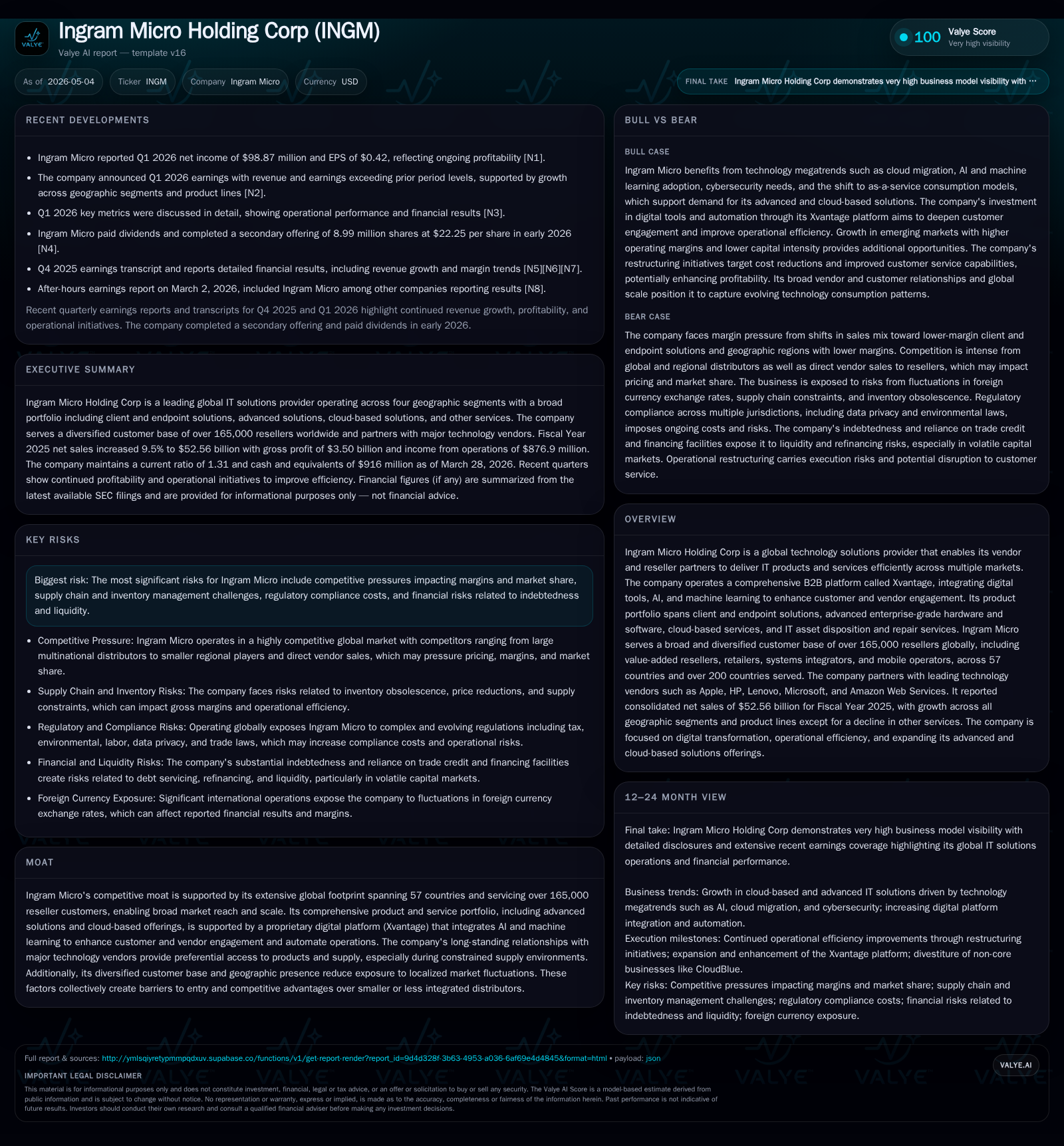
Ingram Micro Holding Corp’s Q1 2026 10-Q filing reveals operational momentum driven by enhancements in its proprietary digital platform, Xvantage, and a strategic shift toward cloud-based offerings. The company reported strength in Latin American mobility product sales contrasting some softness in advanced solutions, with management emphasizing AI and machine learning embedded in its platform to improve vendor and reseller engagement. This bolsters Ingram Micro’s competitive moat anchored on global scale, vendor relationships, and diversified customer base. Key risks include margin pressures from competition and supply chain complexity alongside financial leverage. Upcoming milestones center on platform feature deployment and cloud adoption metrics.
Q1 2026 Operational Developments: Focus on Platform and Product Mix
Ingram Micro’s first quarter ending March 28, 2026 ([S2]) elucidates nuanced shifts in regional demand juxtaposed with advanced digital platform execution. The company highlighted a continued upswing in mobility distribution across Latin America—particularly smartphones in Peru, Chile and Mexico as well as notebooks spanning Mexico to Colombia—fueling a 3.1% net sales increase for Fiscal Year 2025 compared to the prior year ([S1]). Conversely, the advanced solutions category faced an 8% decline driven by weakening server/networking sales in Mexico and cybersecurity slowdowns in Brazil. These dynamics illustrate a bifurcated landscape where client/end-user-centric devices show resilient demand against an episodic slowdown in enterprise-grade hardware.
The cornerstone of Ingram Micro’s strategic positioning remains the Xvantage platform, which has been increasingly infused with artificial intelligence (AI) and machine learning (ML) models—surpassing the integration of over 400 such models handling more than 42 million lines of code ([S1]). This investment is central to driving automation across vendor-distributor-reseller workflows, improving operational efficiency while deepening customer engagement through predictive analytics and intelligent product recommendations.
Supporting quarterly earnings outperformance ([N2], [N3]), these developments reflect operational execution turning innovation into measurable commercial advantage amid shifting product mix.
Ingram Micro’s Business Model: End-to-End Solutions Across the IT Ecosystem
Ingram Micro operates at the heart of the technology distribution value chain facilitating efficient market reach for major vendors to an expansive ecosystem of over 165,000 resellers worldwide (, [S1]). Its business spans four core lines: Client and Endpoint Solutions (PCs, peripherals, mobile), Advanced Solutions (server/storage/networking/cybersecurity), Cloud-based Solutions (infrastructure- and software-as-a-service offerings), and Other (IT asset disposition & repair).
The firm monetizes primarily via transactional revenues derived from distributing hardware/software products while increasingly layering value-added services facilitated through the Xvantage B2B digital platform. This proprietary platform enhances volume throughput by streamlining ordering processes, automating inventory management logistics using AI/ML insights, and enabling seamless integration of subscription-based cloud services that offer recurring revenue streams.
Key vendor partners—Apple, HP Inc., Lenovo, Microsoft, Amazon Web Services among others—rely on Ingram Micro’s extensive geographic reach across 57 countries to deliver products globally with preferential supply terms particularly beneficial under supply-constrained conditions ([S14], ). Meanwhile reseller partners benefit from bundled service offerings that reduce complexity as technology stacks grow increasingly hybrid and software-defined.
Navigating the Global IT Distribution Industry and Competitive Terrain
Operating within an industry characterized by slim gross profit margins tightly pressured by price competition ([S1]), Ingram Micro leverages scale and digital sophistication to sustain competitive advantages. The company’s expansive global footprint facilitates diversified exposure smoothing localized demand volatility while allowing negotiation leverage with vendors enabling improved rebate structures or return rights critical for inventory risk management.
Industry-wide supply chain volatility introduces ongoing complexity; however, Ingram’s integrated logistics infrastructure combined with automated replenishment decisions driven by Xvantage partially mitigates these headwinds. Vendor relations represent a critical barrier to entry—long-standing contractual ties safeguard preferential allocations absent widespread alternative global distributors matching its geographic breadth or technology stack capabilities.
Switching costs accrue through ecosystem entrenchment: resellers embedded within Xvantage’s workflow face friction dismantling interconnected processes across ordering, inventory parity checks, service provisioning to cloud platforms—a relevant factor sustaining client retention amid competitive pressures.
Key Growth Drivers: Digital Innovation, Cloud Migration, and Global Scale
Several strategic tailwinds propel Ingram Micro’s growth trajectory:
- Digital Platform Innovation: Ongoing augmentation of Xvantage with AI/ML capabilities automates procurement workflows reducing manual errors and accelerating order fulfillment times—measurable efficiency gains that appeal to both vendors seeking reliable channel performance and resellers demanding agility.
- Cloud-Based Solution Expansion: Cloud service offerings now constitute more than one-third of total net sales ([S1]), reflecting structural secular shifts in IT consumption from capital expenditure-heavy on-premises products to subscription-based models yielding higher gross margins. Investments in go-to-market support reinforce this transition.
- Global Geographic Reach: Emerging markets particularly Latin America and Asia-Pacific demonstrate above-average growth rates as mobile computing adoption intensifies alongside increasing technology penetration. This scale advantages volume purchasing terms alongside labor cost efficiencies supporting better operating margins.
- Vendor Partner Synergies: Preferential access during constrained supply environments creates differentiation not replicable easily by smaller competitors or standalone resellers.
Risks and Constraints: Margin Pressures, Supply Chain Complexities, and Leverage
While structural growth drivers remain intact, notable headwinds warrant monitoring:
- Gross Margin Compression: Ongoing price competition compounded by variability in vendor-provided rebates and promotions challenge sustained margin improvements ([S1], [S23]).
- Supply Chain Vulnerabilities: Exposure to tariffs/customs duties practices necessitates pass-through pricing but complicates customer pricing dynamics; geopolitical uncertainties could disrupt supplier continuity.
- Financial Leverage: As of March-end 2026 balance sheet data shows total debt approximating $3.34 billion against $916 million cash equivalents resulting in net debt near $2.42 billion paired with a current ratio of roughly 1.31 ([F1]). While liquidity appears sufficient short term this leverage level constrains balance sheet flexibility impacting borrowing capacity or acquisition ability under adverse market conditions.
- Execution Risk: Any delays or failures scaling AI features within Xvantage or cloud go-to-market initiatives could stall momentum.
No material changes were disclosed this quarter regarding risk factors ([S2]).
Upcoming Catalysts: Guidance, Market Signals, and Execution Priorities
Investors should track key indicators including:
- Release schedules for new Xvantage AI-enabled modules that enhance automation depth or introduce agentic capabilities altering reseller workflow dynamics.
- Shifts in cloud portfolio revenue shares reported in forthcoming quarters signifying adoption velocity; margin improvement trends linked to cloud migration success.
- Geographically segmented sales data revealing durability or softness especially within Latin America’s robust mobility segment versus any continued erosion in advanced hardware demands.
- Commentary around vendor contract renewals or changes potentially influencing rebate structures or inventory risk assumptions.
These markers will illuminate whether recent operational gains convert into sustainable profitability improvements amidst cyclical/global economic uncertainties.
Condensed Financial Snapshot and Liquidity Overview
Latest financial snapshot
| Metric | Value | Period |
|---|---|---|
| Cash & equivalents | $916mm | |
| 2026-03-28 | ||
| Total debt | $3.3bn | |
| 2026-03-28 | ||
| Net debt | $2.4bn | |
| 2026-03-28 | ||
| Current assets | $17.9bn | |
| 2026-03-28 | ||
| Current liabilities | $13.6bn | |
| 2026-03-28 | ||
| Current ratio | 1.31x | |
| 2026-03-28 |
Source: SEC companyfacts cache [F1].
| Metric | Value (USD) |
|---|---|
| Cash & Equivalents | 915.99M |
| Total Debt | 3.34B |
| Net Debt | 2.42B |
| Current Assets | 17.92B |
| Current Liabilities | 13.64B |
| Current Ratio | 1.31 |
As per latest quarter data ([F1]), Ingram Micro maintains solid liquidity buffers enhancing near-term operating stability despite material financial leverage. Working capital is well managed balancing inventory levels against trade payables supported by committed financing facilities detailed in annual disclosures ([S4]-[S7]).
This analysis synthesizes publicly available SEC filings including the latest quarterly Form 10-Q dated April 30, 2026 ([S2]) complemented by the recent event filing ([S3]) plus prior annual Form 10-K disclosures through March 3, 2026 ([S1]). It aims to present an objective operational appraisal grounded explicitly on documented company reporting without forward-looking investment judgements.
Disclaimer: This is research-only, informational analysis and not investment advice. It may include AI-generated interpretation and general industry context. Always verify important details using primary sources.

Comments