
NMI Holdings Advances Mortgage Insurance Leadership with Broader Market Penetration
NMI Holdings' latest quarterly results highlight its expanding mortgage insurance portfolio and strengthening market position amid regulatory and capital challenges.
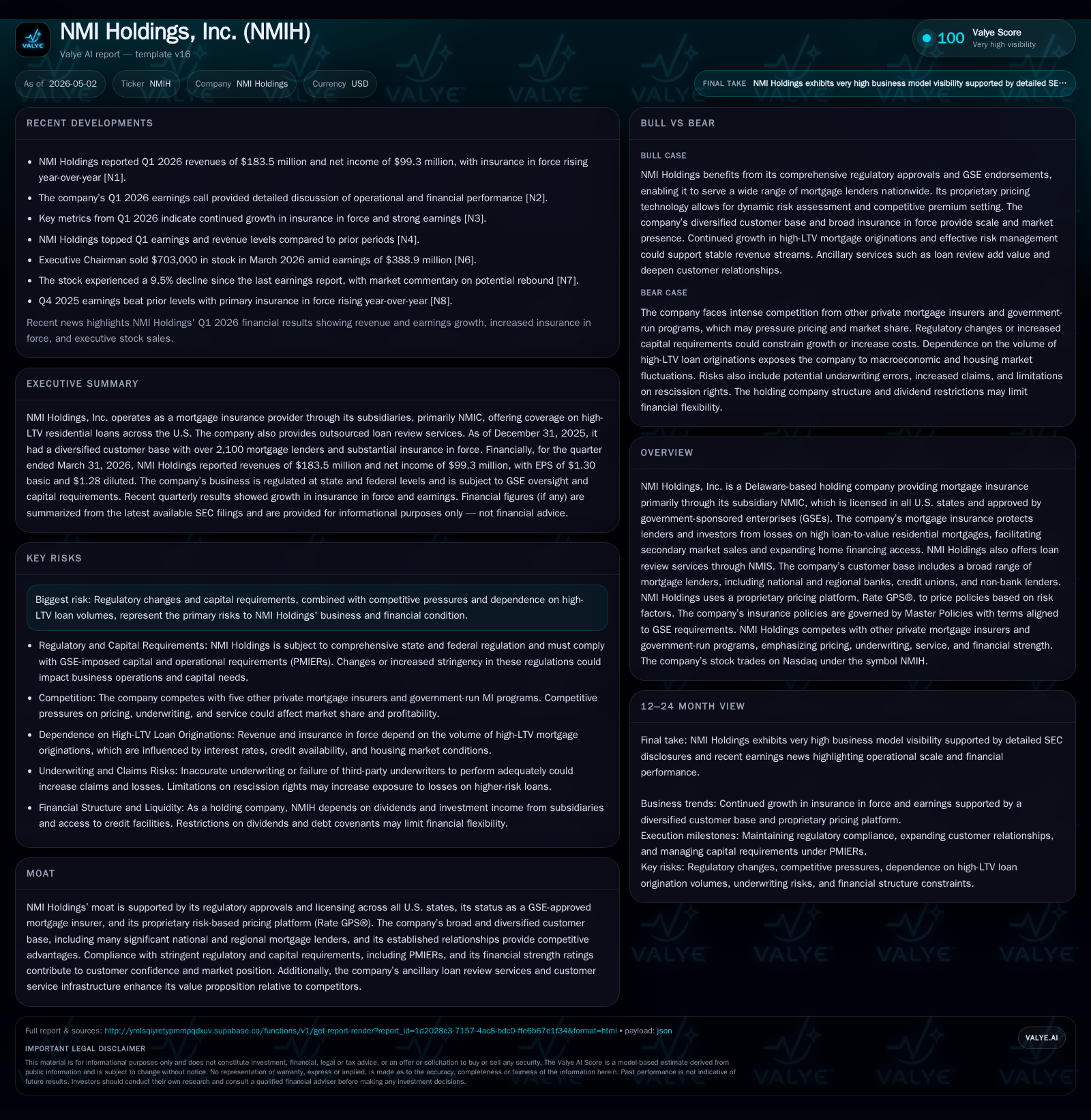
In Q1 2026, NMI Holdings demonstrated notable growth in new insurance written and overall insurance-in-force, reflecting wider acceptance among diverse mortgage lenders. Leveraging its proprietary Rate GPS® pricing platform and comprehensive licensing, the company is well-positioned within the private mortgage insurance (PMI) industry. However, capital adequacy requirements under PMIERs and evolving regulatory landscapes remain key constraints. Going forward, growth will depend on disciplined underwriting, customer expansion, and navigating complex industry regulations.
Q1 2026 Operating Highlights Reflect Market Penetration Gains
NMI Holdings filed its latest quarter results on May 1, 2026 ([S2]), reporting operational momentum highlighted by growth in new insurance written (NIW) and primary insurance in force (IIF). Although exact figures for Q1 NIW were not detailed in the excerpted SEC filing, news sources referencing the earnings release emphasized that NIW rose year-over-year alongside a sustained increase in total insured loans ([N1], [N3]). This expansion suggests that NMI is successfully broadening its footprint among mortgage lenders during a period where high-LTV loan originations remain structurally critical for demand.
Moreover, continued issuance of master policies—a contractual framework governing many lender relationships—has supported this volume growth. Maintaining these long-term relationships across a broad base of over two thousand customers helps diversify exposure across geographic markets and lender types ([S1], [S20]). The latest event filing ([S3]) did not report any material negative developments but reaffirmed steady business conditions.
This quarter's operational updates reinforce NMIH’s narrative of deepening market penetration despite ongoing macroeconomic uncertainties that influence home lending activity.
NMIH’s Mortgage Insurance Business Model and Product Value Proposition
NMI Holdings generates revenue primarily through premiums charged on mortgage loans with loan-to-value ratios exceeding 80%, where mortgage insurance mitigates lender credit risk. The core value proposition lies in facilitating secondary market sales of these higher-risk loans to GSEs such as Fannie Mae and Freddie Mac by providing essential loss mitigation coverage ([S1]). The MI policies are issued under "master policies" aligned with GSE standards that provide standardized terms enhancing loan saleability.
The company conducts most underwriting via its principal subsidiary NMIC, which holds licenses in all fifty states plus D.C., ensuring comprehensive geographic reach ([S19], [S27]). NMIC’s status as a GSE-approved insurer makes it eligible to insure loans destined for these secondary market agencies—a critical competitive moat since GSE endorsement predicates lender participation.
Risk selection and pricing are central to NMIH's approach. Its proprietary Rate GPS® platform integrates borrower credit factors, loan vintage, LTV ratios and other characteristics into a dynamic model that calibrates premiums relative to expected loss profiles (). This technology enables disciplined risk-based pricing that protects margin integrity amidst fluctuating market risk factors.
Additionally, NMIS provides ancillary loan review services for mortgage originators, augmenting the core MI offering with risk evaluation tools that improve underwriting quality ([S1]), further enhancing customer retention through integrated solutions. Overall, the business model combines scale licensing footprint with advanced analytics and service offerings designed to embed NMI deeper into lender workflows.
Competitive Landscape and Regulatory Positioning in Private Mortgage Insurance
NMI competes chiefly against other private MI providers such as Arch Capital Group who similarly seek GSE approval while balancing regulatory capital demands (; [N5]). Securing broad state licensing coupled with GSE counter-party status serves as a significant entry barrier given the extent of oversight involved.
The company must comply with PMIERs—GSE-imposed minimum capital standards setting rigorous asset requirements based on granular loan risk exposures—imposed to ensure insurer solvency and claim-paying ability ([S18], [S25], [S26]). This compliance is mandatory for retaining GSE approval; failure would restrict business writings severely. While these standards safeguard financial integrity industry-wide, they also curtail rapid growth unless matched by commensurate capital increases or reinsurance arrangements.
Other regulatory challenges include state-imposed monoline restrictions limiting insurers solely to mortgage insurance lines ([S27]) and oversight by various state insurance departments which regulate policy forms and premium rates. Additionally, shifts in federal oversight—for example at the Consumer Financial Protection Bureau addressing referral fee practices under RESPA—add layers of compliance complexity ([S10]).
Maintaining favorable financial strength ratings remains crucial since they underpin customer confidence and competitive positioning against peers supported by larger parent companies or diversified capital bases ([S28]).
Growth Drivers: Expanding Customer Relationships and Proprietary Pricing Platform
NMI’s growth centers on increasing master policy holdings across a growing number of lender customers spanning national banks to community institutions and prominent non-bank online lenders ([S20]). These diverse relationships enhance portfolio stability by reducing dependence on any single borrower segment or channel.
Their Rate GPS® platform underpins scalable underwriting by enabling precise segmentation of borrower risk attributes to price policies dynamically in line with evolving market conditions (; [N2]). This capability provides improved margin management potential relative to competitors reliant on less granular models.
Ancillary services from NMIS loan review further differentiate NMI by embedding value-added underwriting support services that deepen lender reliance on their ecosystem.
Operational improvements focus on deploying system enhancements for better automation of risk assessment workflows which reduces cycle times while maintaining underwriting discipline—the balance necessary to write profitable volumes amid fluctuating credit environments.
Through these levers—master policy breadth, technological differentiation via Rate GPS®, and integrated service offerings—NMI aims to steadily grow its high-quality insured portfolio while managing credit risks prudently.
Risks and Constraints: Capital Requirements, Regulatory Uncertainty, and Competitive Pressures
The foremost constraint facing NMI is maintaining regulatory capital adequacy under the PMIERs framework ([S18], [S26]). As net risk-in-force grows over time with additional insured loans, NMIC must hold increasing amounts of available assets. Failure to comply could result in suspension or curtailment of writing authority across states or loss of GSE approval.
Efforts to manage this constraint involve raising additional capital or ceding business through reinsurance arrangements; success here remains uncertain due to market conditions and regulatory approvals required ([S26]).
The volume of high-LTV loans materially influences revenue since these loans require mortgage insurance coverage. Should housing market softness depress originations above the 80% LTV threshold or prompt tighter lending standards reducing high-LTV share, NIW volumes may decline adversely affecting top-line growth ([S1]).
Competitive intensity from larger insurers backed by more extensive financial resources could pressure pricing levels or capacity availability. Furthermore, emerging alternative credit risk transfer mechanisms threaten to displace traditional private MI coverage over time if favored by regulators or investors ([S22]).
Litigation risks arising from class actions or enforcement actions related to compliance (e.g., RESPA challenges) add further uncertainty that could impact reputation or operating costs ([S10], [S21], [S23]). Inaccurate risk modeling or unexpected default spikes could exacerbate claims costs beyond reserved levels amplifying losses.
Hence, regulatory adherence integrated with disciplined underwriting remains pivotal to mitigating downside exposures while pursuing measured expansion.
Upcoming Catalysts and Operational Milestones To Monitor
Investors should track quarterly trends in new insurance written as a forward indicator of sustained market acceptance and portfolio scaling ([N1],[S2],[S3]). Announcements regarding master policy acquisitions or renewals from major lender groups will serve as tangible markers of relationship success.
Watch for updates related to potential changes in PMIERs financial requirements or GSE endorsement criteria which could alter capital needs significantly. Monitoring disclosures around Rate GPS® platform upgrades or adoption metrics may provide insight into operational efficiency gains affecting profitability.
Management commentary during subsequent earnings calls regarding competitive developments or changes in loan mix composition will provide contextual clarity about how evolving macroeconomic conditions affect volume forecasts ([N2]). Finally, execution progress against any announced product expansions or service enhancements should be observed closely for signs of differentiation strengthening.
Financial Overview: Capital Structure and Liquidity as Enablers of Growth
NMIC possesses statutory authority approved by Wisconsin OCI allowing dividends up to approximately $101 million within twelve months ending 2026 without prior regulator approvals facilitating upstream cash flows to the holding company for corporate expenses including servicing debt obligations ([S4], [S13]).
It does not constitute investment advice or recommendations but aims to provide a detailed operating overview grounded in the company's most recent SEC filings.*
Disclaimer: This is research-only, informational analysis and not investment advice. It may include AI-generated interpretation and general industry context. Always verify important details using primary sources.

Comments