
OFS Capital Strengthens Middle-Market Credit Portfolio Amid Strategic Financing Shift
Latest quarter highlights portfolio credit recalibration and a key refinancing that underpin OFS Capital’s income distribution stability.
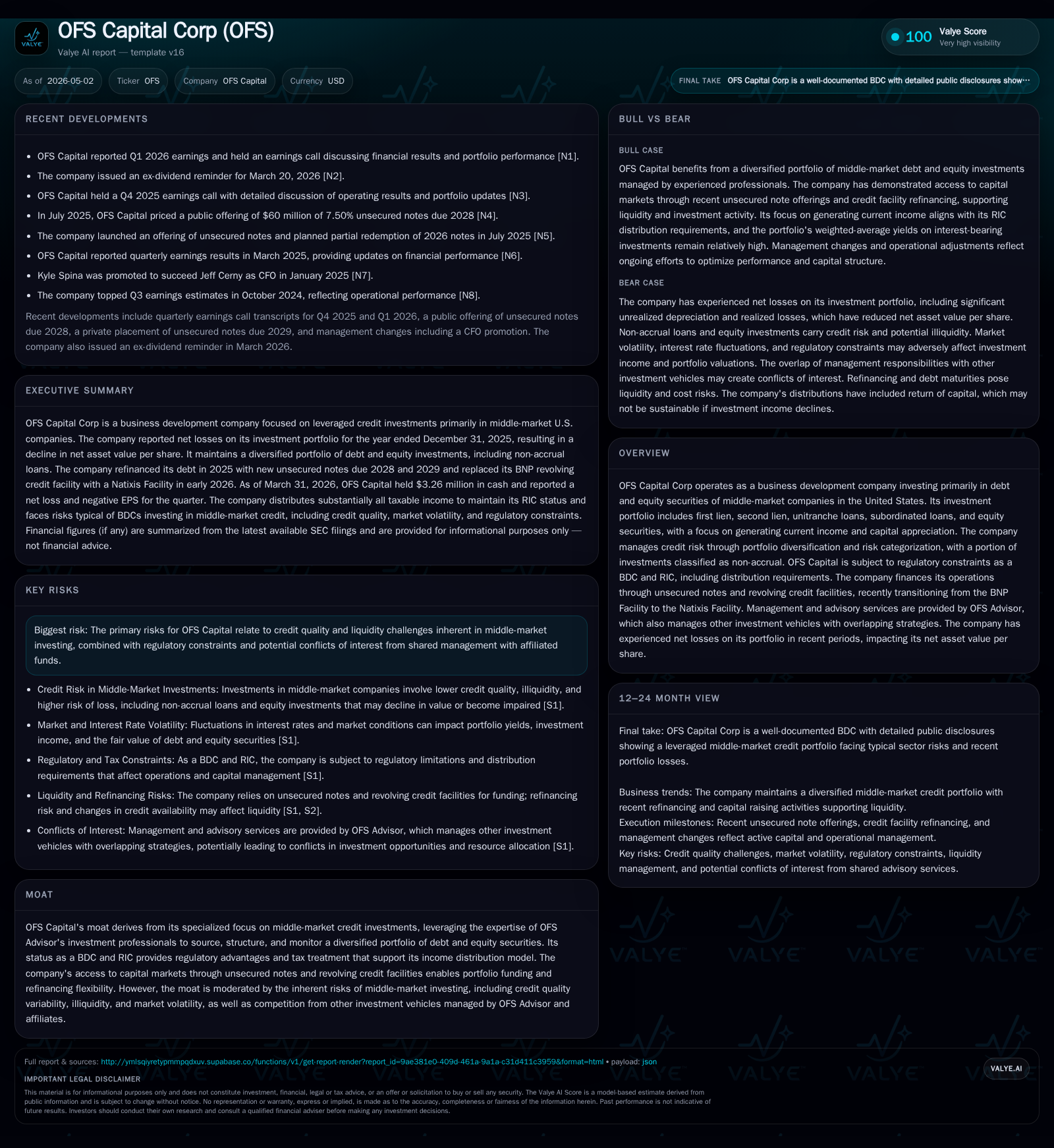
In its Q1 2026 10-Q, OFS Capital reported a reduction in non-accrual loans and completed a significant financing transition from its BNP Facility to a new Natixis revolving credit facility, extending maturities and enhancing liquidity. The company maintains its core strategy of investing across first lien, second lien, unitranche loans, subordinated debt, and equity securities focused on U.S. middle-market companies, leveraging regulatory frameworks that allow favorable tax treatment and income distributions. While competitive pressures within the BDC space and credit quality risks persist, OFS Capital's refined capital structure and disciplined portfolio management position it for sustained net investment income growth. Key risks include middle-market credit illiquidity and management conflicts due to shared advisory arrangements.
Recent Quarterly Operating Update: Key Changes and Implications
In its latest Q1 2026 Form 10-Q filed May 1 [S2], OFS Capital disclosed several important developments shaping its near-term operating landscape. This signals some stabilization in the company's middle-market loan portfolio risk profile during ongoing market uncertainties.
A pivotal change affecting OFS Capital’s funding cost and flexibility was the February 18, 2026 retirement of its BNP Paribas revolving credit facility ("BNP Facility") followed immediately by entering into a new $80 million unsecured revolving credit facility with Natixis ("Natixis Facility") maturing February 18, 2031 [S3]. This transition replaced the terminated BNP Facility's more limited reinvestment period post-September 2025 with a longer-dated, currently unused commitment line that may support future portfolio growth or refinancings. Such refinancing actions notably enhance liquidity posture while potentially lowering borrowing costs due to market spreads on SOFR-based pricing plus margins.
Operationally, the quarter also saw net investment income (NII)—a critical metric supporting dividend distributions—moderate slightly quarter-over-quarter but remain robust by historical standards. Noteworthy reductions in incentive fees contributed to decreased expenses during the quarter ending December 31, 2025 compared with the previous period [S2]. These figures imply disciplined expense management alongside recalibrated income streams from interest, fee income, and dividends across diversified loan instruments.
Business Model and Portfolio Strategy: Middle-Market Investment Focus
OFS Capital operates as a BDC primarily focused on investing across the U.S. middle-market spectrum via an array of debt instruments: first lien loans providing senior secured claims; second lien and unitranche loans blending secured junior positions; subordinated loans bearing greater risk/reward; complemented by equity securities typically taking form as warrants or minority stakes [S1]. This multi-tiered structure targets generating steady current income supplemented with capital appreciation potential.
The company’s revenue drivers hinge on interest collections—cash and PIK (payment-in-kind)—dividends on equity components, along with syndication or prepayment fees arising sporadically from transactions structured by its advisor [S1]. This diversified revenue mix cushions against sector-specific or economic shocks characteristic of middle-market lending cycles.
Risk management is integral with strict categorization of portfolio credits from average risk to substandard/doubtful designations guiding provisioning and valuation decisions. Concentration is mitigated through geographic spread and varied borrower industries though inherent illiquidity remains given private market focus [S1]. The strategic emphasis on middle-market credits leverages OFS Advisor's sourcing expertise while regulatory constraints under the Investment Company Act necessitate rigorous compliance around leverage limits (typically capped leverage at twice NAV) and distribution rules for maintaining retail investor tax advantages.
Competitive Environment and Regulatory Framework Impacting OFS Capital
Within the niche middle-market credit BDC segment, OFS Capital competes with both standalone funds and affiliated vehicles managed by its own advisory firm — presenting internal competition for deal flow alongside external pressure from other BDC peers. Pricing power vis-à-vis borrowers thus depends heavily on reputation for flexibility in structuring bespoke loans including unitranche solutions combining senior/subordinated tranches.
Regulatory dynamics importantly shape portfolio construction freedoms; as a BDC qualified RIC under Subchapter M tax code provisions, the company must distribute substantially all taxable income annually yet face constraints on leverage (asset coverage regulation) and derivative use under Rule 18f-4 which can limit hedging capabilities [S1], impacting risk management options relative to private credit counterparts without such limits.
The shared management model—where OFS Advisor concurrently oversees associated funds—introduces potential conflicts necessitating transparent allocation policies amid competing investor interests. Furthermore, navigating evolving compliance burdens while sustaining competitive returns requires agility.
Growth Drivers Enhancing Income and Capital Appreciation Potential
Growth at OFS Capital resides mainly in expanding the asset base through prudent originations balanced by opportunistic acquisitions within established risk categories. The recent shift to the Natixis revolving facility grants more runway for incremental lending backed by improved financing economics relative to expiring BNP terms [S3]. Rising interest rate environments add accretion benefits particularly for floating-rate loans bolstering net investment income streams which fund recurring dividends [N1].
Moreover, recovering credit fundamentals support upside in realized yields through fewer impairments. Equity securities embedded in certain instruments offer capital appreciation upside during favorable market cycles providing diversification against pure interest-rate dependence.
Fee income sources such as syndications supplement interest revenue but remain modest portionally given cyclical variability. Portfolio diversification across loan types moderates downside volatility enhancing investor confidence in distribution sustainability.
Risks and Constraints: Credit Quality, Liquidity, and Conflict Considerations
Credit risk stands foremost given middle-market borrower profile sensitivity to economic cycles; while non-accrual loan reductions are positive signals they highlight ongoing vulnerability to rating downgrades or restructurings especially if recessionary pressures intensify [S2]. Illiquidity of private loans coupled with restrictions on resale impose challenges to exit timing that can depress NAV during distress.
Potential conflicts stemming from common advisor oversight among multiple related funds require vigilance in corporate governance measures to avoid adverse allocation outcomes disadvantaging shareholders of one vehicle over another. Operational dependencies on key personnel expertise underline vulnerability should turnover occur amid competitive recruitment landscapes.
Near-Term Monitoring Points: Milestones, Market Signals, and Management Guidance
Investors should closely monitor upcoming quarterly disclosures for further trends in non-accrual ratios across loan categories given their direct correlation to impairment charges impacting net asset value and distributable earnings [N1][S2]. Changes in NAV per share will serve as barometers for portfolio valuation robustness.
Execution progress against strategic leverage deployment via the Natixis Facility along with any announced equity offerings or unsecured notes issuance will signal capacity expansion or contraction intentions aligned with growth targets.
Management’s commentary on prevailing interest rate impacts—particularly any increased hedging activities permitted under Rule 18f-4—and outlook for fee income streams will provide color on near-term earnings sustainability amid market volatility [N1]. Tracking dividends paid relative to NII gauges cash flow health supporting investor distributions.
Latest Financial Snapshot: Balance Sheet and Leverage Overview
Latest financial snapshot
| Metric | Value | Period |
|---|---|---|
| Cash & equivalents | $3.26M | |
| 2026-03-31 | ||
| Total debt | $202.45M | |
| 2026-03-31 | ||
| Net debt | $199.19M | |
| 2026-03-31 |
Source: SEC companyfacts cache [F1].
As of March 31, 2026 per latest filings and companyfacts data [F1], OFS Capital holds cash balances sufficient for near-term operational needs but modest relative to gross debt load reflecting typical BDC capital structures utilizing substantial leverage capped under regulatory limits. Total debt includes unsecured notes comprising various maturities plus revolving facility borrowings recently transitioned from BNP to Natixis lines enhancing maturity profiles up to 2031.[S3]
Net debt dynamics underscore ongoing refinancing needs balanced against anticipated future cash flows from investments servicing principal and interest inflows supporting dividend payouts.[F1] Expense control measures noted in recent quarters contribute positively toward safeguarding net investment income margins amidst fluctuating interest rate environments.[S2]
This analysis strictly summarizes current public disclosures without offering investment recommendations. It emphasizes key operational changes impacting OFS Capital's strategic positioning within the middle-market credit-focused BDC peer group while highlighting fundamental operational risks inherent in this specialized lending domain.
Disclaimer: This is research-only, informational analysis and not investment advice. It may include AI-generated interpretation and general industry context. Always verify important details using primary sources.

Comments