
AIG Executes Strategic Growth With Solid Q1 Underwriting Gains
AIG's Q1 2026 report highlights strong underwriting income and strategic investments underpinning its insurance platform expansion.
In the first quarter of 2026, American International Group demonstrated robust operational execution, with underwriting income rising sharply supported by disciplined risk selection and expense management. The company’s strategic investments in specialty insurers and asset managers, alongside its diversified global insurance portfolio, reinforce its competitive moat amid a complex regulatory environment. Regulatory constraints and market volatility remain key watch points as AIG leverages capital flexibility to drive growth across specialty lines and strengthen financial strength ratings.
First Quarter 2026 Operating Performance Highlights
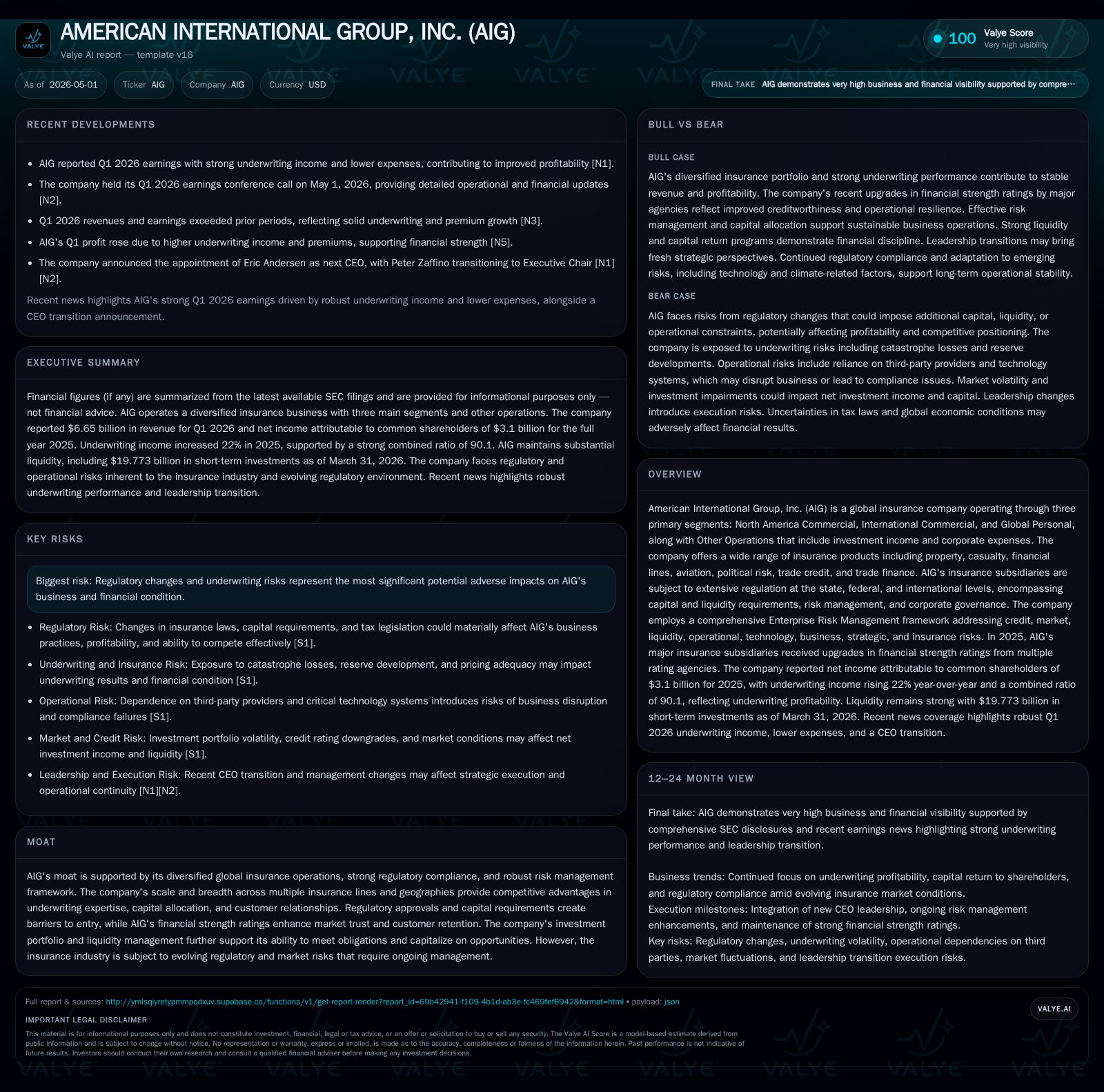
AIG's Q1 2026 results as disclosed in the May 2026 10-Q reveal a meaningful uptick in underwriting profitability alongside prudent expense management. The company delivered underwriting income of approximately $2.3 billion, marking a 22% increase compared to the prior year period [S2]. This was achieved against a notably strong combined ratio of approximately 90.1%, indicating efficient claims handling and pricing discipline amid a challenging insurance claims environment [N1]. Operating expenses declined partly due to lower restructuring costs, further bolstering net results.
Importantly, the Board declared an 11% hike in quarterly dividends to $0.50 per share reflecting confidence in continued cash flow generation and capital adequacy [S3]. Together, these metrics underscore AIG's ability to leverage underwriting execution to generate shareholder value while navigating market uncertainties.
Business Model and Product Quality: Diverse Insurance Platforms
AIG operates through three principal insurance segments: North America Commercial, International Commercial, and Global Personal, complemented by Other Operations encompassing investment income from corporate activities [S1][S20]. The North America Commercial segment offers property, casualty, and financial lines tailored for clients ranging from SMEs to multinationals. International Commercial extends similar offerings across diverse geographies including EMEA, Asia-Pacific, Latin America, with added specialty coverage such as aviation and political risk via Talbot Holdings Ltd.
The Global Personal segment provides personal lines insurance globally. Across these categories, AIG emphasizes underwriting quality supported by robust enterprise risk management frameworks that integrate credit, market, operational, technology, business strategy, and insurance-specific risk controls [S1].
AIG’s expansive product mix secures revenue streams from premiums paid predominantly by corporate clients seeking customized risk solutions as well as retail customers. The company generates revenues through premiums earned adjusted for claims paid (losses), acquisition costs including commissions and taxes, and investment income derived from the substantial invested asset base pooled within regulated subsidiaries.
Competitive Position and Regulatory Environment
AIG’s scale—both geographically and across insurance product lines—affords significant competitive advantages including enhanced underwriting expertise, diversified capital allocation capabilities, broad customer relationships, and sustained regulatory compliance leading to upgraded insurer financial strength ratings from Fitch, S&P, Moody's, and affirmation by A.M. Best over recent years [S1]. These ratings boost market trust allowing AIG better terms in reinsurance placements and capital markets access.
Regulatory oversight is intense; U.S. states impose stringent capital adequacy rules limiting dividend capacity from subsidiaries to the parent holding company without approval [S1]. Internationally varying regimes add complexity regarding solvency ratios, allowable investment portfolios (with some requiring local asset holdings), conduct rules for marketing/distribution practices or prohibitions on certain transactions among affiliates. These regulatory frameworks serve as high barriers to entry while demanding active capital management.
Growth Drivers: Strategic Investments and Underwriting Execution
AIG’s growth posture is markedly shaped by targeted investments aligned toward enhancing exposure in higher-margin specialty insurance sectors and alternative assets. Notable moves include a $2.1 billion investment in Convex Group Limited—a privately held global specialty insurer—and a $646 million acquisition of a roughly 9.9% stake in Onex Corporation, an asset manager with global reach [S1][S3].
Additionally, the acquisition of renewal rights for Everest Group’s global retail commercial insurance portfolio for $301 million expands their footprint into new client segments while boosting earnings potential [S1]. Coupled with a strategic deal partnering with Amwins Group Inc. and Blackstone Inc., which led to creating Lloyd’s Syndicate 2479 for specialty portfolios capacity expansion at Lloyd’s of London marketplace enhances capability to underwrite bespoke risks.
On the asset management front, collaboration with CVC Capital Partners introducing separately managed accounts totaling up to $2 billion illustrates AIG’s broader push into private equity secondaries evergreen platforms—improving diversification of investment returns beyond traditional fixed income sources tied closely to insurance liabilities [S1].
Underwriting discipline combined with these capex-light investments supports margin improvements via careful risk selection while allowing scalable growth through partnerships rather than heavy organic deployment alone.
Risks and Watchpoints: Regulatory Challenges and Market Sensitivities
Evolving regulations remain prominent headwinds; potential changes domestically or internationally could constrain product designs or raise compliance costs affecting competitiveness [S2][S1]. New laws influenced by climate change concerns pose particular threats through required reserving adjustments or liabilities recognition altering loss estimates.
Further operational risks persist around reserve adequacy judgments where unfavorable developments could materially impact reported earnings or solvency levels particularly after large catastrophes. Additionally, constraints on utilizing net operating loss carryforwards following ownership changes impose tax planning risks limiting future taxable income offsets in some scenarios [S1].
Market-sensitive factors like catastrophe frequency/severity volatility introduce cyclicality that requires ongoing adjustments in pricing models—underscoring the need for flexible risk appetite frameworks maintained via the integrated Enterprise Risk Management regime [S16][S24].
Upcoming Catalysts and Monitoring Points
Close attention should be paid to forthcoming quarterly releases detailing underwriting margins and combined ratios as immediate indicators of pricing adequacy vis-à-vis inflationary claims trends or reserve development clarity [S2][N2]. Equity market conditions influencing associated investment returns warrant circuiting via monitoring realized gains/losses metrics.
Further rating agency actions refining insurer financial strength scores will be critical as these influence borrowing costs along with client retention dynamics under commercial contracts requiring counterparties with stable counterparts.[N2]
Strategic deployment progression of announced $2+ billion specialty line investments plus efficacy of Lloyd’s Syndicate activity offer key signals regarding scaling effectiveness while CEO succession transitioning Eric Andersen into the helm may signal directional shifts worth gauging for operational execution consistency beyond Q2 onward when leadership change completes [N11].
Dividend policies parallel these benchmarks serving both as a barometer of internal capital confidence as well as direct shareholder return mechanism subject to regulator approval processes.
Supporting Financial Overview
At fiscal year-end December 31, 2025—the latest snapshot available—AIG reported revenues totaling approximately $26.8 billion supported by net income attributable to common shareholders near $3.1 billion reflecting underlying profitable operations despite near-flat net investment income experienced year-over-year mainly from portfolio repositioning effects [F1][S1]. Total reported debt was about $9.19 billion representing manageable leverage given sizeable asset base within regulated entities ensuring compliance with stringent capital requirements across jurisdictions [F1]
Capital return activity remained robust in FY2025 with nearly $6.8 billion distributed comprising $5.8 billion share repurchases lowering shares outstanding by ~11%, coupled with around $1 billion in dividends consistent with operational cash flow strength driving shareholder alignment objectives.[S5][S8]
This healthy financial profile corroborates operating improvements evident in Q1 maintaining liquidity buffers supported by revolving credit facilities of up to $3 billion that provide contingency options if needed within broader liquidity & capital resource frameworks monitored continuously at parent & subsidiary levels alike.[S4][S6]
This analysis reflects information publicly disclosed by American International Group through its SEC filings as of May 2026 without offering any investment recommendations or forecasts. It aims solely to provide an informed perspective on AIG’s operating performance trends, strategic positioning within the global insurance industry landscape, risks inherent to regulatory oversight complexity, and recent milestone developments shaping near-term trajectory.
Disclaimer: This is research-only, informational analysis and not investment advice. It may include AI-generated interpretation and general industry context. Always verify important details using primary sources.

Comments