
Huntsman CORP Faces Persistent Pricing Pressures Amid Portfolio Diversification
Huntsman's latest quarterly results reveal margin pressures, underscoring the importance of its integrated manufacturing and raw material strategy.
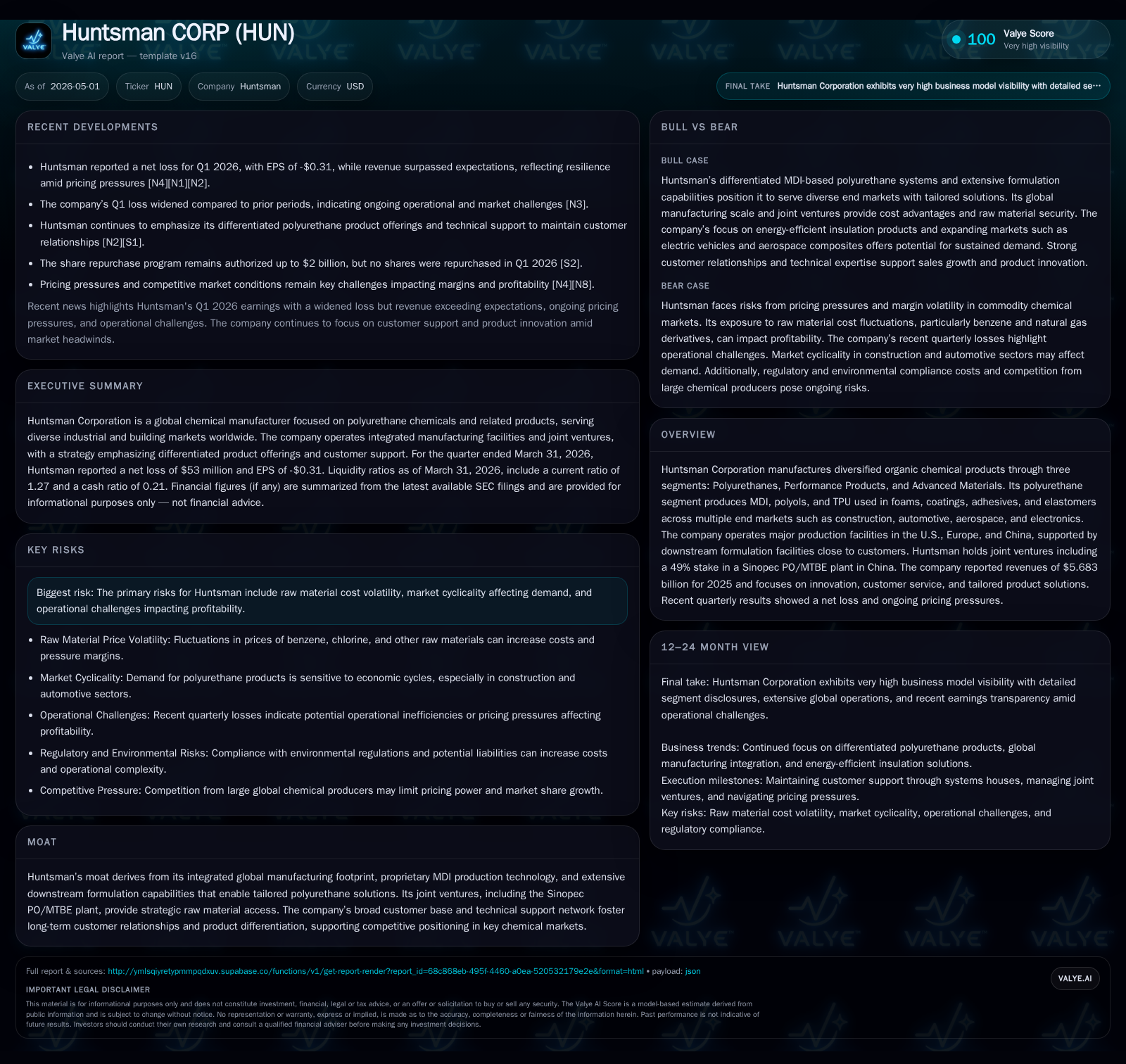
In Q1 2026, Huntsman Corporation reported ongoing pricing pressures contributing to a net loss despite stable revenues, reflecting challenging raw material cost environments. The company’s integrated global footprint and joint ventures, such as its stake in the Sinopec PO/MTBE plant, remain strategic advantages that help mitigate input volatility and support tailored polyurethane solutions. Demand dynamics across construction, automotive, and aerospace offer growth avenues, but cyclicality and commodity cost risks persist. Monitoring margin recovery and operational execution will be key in the near term.
Latest Quarterly Performance Highlights and Operational Developments
Huntsman's Q1 2026 earnings disclosure [S2], complemented by a press release and earnings call on April 30–May 1 [S3], [N1], [N3], revealed persistent pricing pressures adversely impacting margins. Despite revenues aligning with expectations—reflecting continued demand across core industrial end-markets—the company reported a net loss attributable primarily to margin compression during elevated raw material costs. No share repurchases occurred in the quarter despite a board-approved $2 billion buyback program [S17]. This environment underscores the continuing challenge of balancing volume stability with volatile commodity inputs, especially given Huntsman’s exposure to isocyanate precursors.
Incremental operational initiatives disclosed include ongoing cost controls and supply chain efficiency improvements targeted at offsetting input inflation. These efforts occur alongside capacity expansions such as the recently inaugurated Hungarian operational unit aimed at strengthening regional market presence [N9]. The near-term outlook hinges on managing feedstock pricing while capitalizing on resilient demand pockets.
Huntsman’s Business Model: Product Lines and Value Creation
Huntsman operates through three principal segments: Polyurethanes, Performance Products, and Advanced Materials [S1], [S7]. Polyurethanes represent the cornerstone of its product suite; this segment produces methylene diphenyl diisocyanate (MDI), polyols, and thermoplastic polyurethane (TPU). The versatility of these chemicals enables formulations for rigid/flexible foams used in insulation, automotive lightweight components, coatings, adhesives, sealants, and elastomers across diverse industries including construction, aerospace, footwear, and electronics.
A key competitive strength lies in Huntsman's vertically integrated manufacturing footprint spanning U.S. (Geismar), Europe (Rotterdam), and China (Caojing) plants that produce MDI using proprietary technology combined with captive or contracted aniline supplies—a critical MDI intermediate [S1], [S12]. The absence of a robust spot market for aniline mandates this integration or long-term contractual access for cost competitiveness [S1]. This is exemplified by the company’s approximately 49% ownership in a Sinopec joint venture producing propylene oxide (PO) and methyl tertiary-butyl ether (MTBE)—further securing supply chains for polyol feedstocks [S1], [S29]. Downstream formulation facilities positioned near customers augment service quality by providing tailored polyurethane systems alongside technical expertise critical to customer retention.
Sales are a mix of direct relationships with industrial end-users and intermediary distributors where applicable. Huntsman leverages its reputation for innovation-driven solutions combined with reliable product availability to foster long-term supply contracts. The breadth of over 2,200 distinct MDI-based polyurethane products evidences their capacity to customize formulations for specific performance needs [S29]. This capability elevates switching costs relative to commoditized chemical suppliers.
Competitive Positioning Within the Chemical Industry
Within the global organic chemicals landscape focusing on polyurethanes and related chemistries, Huntsman competes against BASF, Covestro, Dow Chemical, Wanhua Chemical Group among others [S7]. While proprietary MDI production technology and integrated aniline sourcing provide structural moats versus pure commodity producers, pricing power remains constrained by feedstock volatility—particularly raw materials like benzene derivatives linked to aniline—and cyclical demand effects that ripple through automotive manufacturing and construction markets.
The chemical industry’s capital-intensive nature necessitates large-scale production sites to achieve economies of scale. Huntsman’s world-scale complexes address this requirement but require steady utilization rates to realize full margin potential. Environmental regulations—especially emissions compliance—and evolving ESG standards introduce additional operational constraints potentially impacting costs or expansion timelines [S28]. Additionally, global trade dynamics can affect input procurement costs and market accessibility.
However, Huntsman’s ability to deliver formulated systems rather than bulk intermediates bolsters differentiation. Formulation houses close to customers facilitate just-in-time delivery models and responsive technical support which smaller competitors struggle to replicate. This value-add creates embedded customer loyalty amidst a fragmented competitive set.
Key Growth Drivers and Market Expansion Opportunities
Innovation represents a core growth pillar as Huntsman invests in next-generation polyurethane formulations targeting energy efficiency—a theme resonating strongly in aerospace lightweighting applications where reduced mass translates into lower fuel consumption as well as enhanced insulation technologies vital for construction sustainability goals. The company’s research campus in China supports development aligned with one of the fastest-growing global polyurethane markets [S29].
Geographic expansion also plays a notable role; inaugurating new units such as the Hungarian facility extends production capacity closer to European customers—potentially accelerating delivery times and reducing logistical complexity [N9]. Synergies from integrated raw material sourcing joint ventures are expected to underpin competitive feedstock cost positions supporting volume growth.
Demand tailwinds from electric vehicles further stimulate polyurethane volumes due to insulation needs for battery cooling systems. Meanwhile, high-value TPU applications continue gaining traction in footwear and coated films sectors. Huntsman’s technical sales teams engage deeply with clients across sectors optimizing product mix toward higher-margin specialty formulations consistent with secular shifts toward sustainability.
Risks, Challenges, and Industry Headwinds
Persistent raw material cost volatility defines a primary risk vector particularly linked to commodities such as aniline whose supply tightness can outpace demand adjustments causing margin contraction [S1],. Regulatory compliance burdens related to air emissions remain pertinent following historical enforcement cases resolved involving former facilities though now indemnified post divestiture [S28].
Market cyclicality impacts demand elasticity chiefly in durable goods sectors including automotive OEMs where economic downturns depress order volumes cascading into chemical consumption reductions. Geographic diversification mitigates but does not eliminate these effects.
Operational reliability is another focal risk area given complex multi-step chemistries requiring continuous production uptime at world-scale sites; unexpected outages can disrupt shipments causing client dissatisfaction or forcing spot purchases at unfavorable prices.
Notably absent from recent updates are indications of accelerated share repurchases or dividend increases suggesting cautious capital deployment pending stabilization of earnings performance amid current headwinds [S17].
Upcoming Catalysts and Monitoring Points
Looking ahead investors should track quarterly guidance updates offering clarity on feedstock price trajectories and their pass-through into selling prices. Margins will signal efficacy of operational adjustments under pricing pressure conditions. Volume trends within automotive electric vehicle components versus traditional sectors may provide early indicators of structural shifts affecting product demand composition.
Announcements related to capacity utilization improvements or new joint ventures enhancing vertical integration would also be important markers validating growth strategies.
Customer retention metrics driven by formulation innovations remain significant qualitative indicators complementing quantitative financial data releases.
Financial Snapshot and Capital Structure Overview
Latest financial snapshot
| Metric | Value | Period |
|---|---|---|
| Cash & equivalents | $369mm | |
| 2026-03-31 | ||
| Total debt | $2.06bn | |
| 2026-03-31 | ||
| Net debt | $1.69bn | |
| 2026-03-31 | ||
| Current assets | $2.18bn | |
| 2026-03-31 | ||
| Current liabilities | $1.72bn | |
| 2026-03-31 | ||
| Current ratio | 1.27x | |
| 2026-03-31 |
Source: SEC companyfacts cache [F1].
As of March 31, 2026 (Q1 end), Huntsman retained $369 million in cash & equivalents against total debt approximating $2.06 billion yielding net debt around $1.69 billion while holding current assets of $2.18 billion against current liabilities of $1.72 billion supporting a current ratio of about 1.27—indicative of manageable near-term liquidity coverage [F1].
Trailing operating income was negative at approximately -$131 million with net losses reflecting persistent margin challenges despite steady revenue generation totaling $5.683 billion for full year 2025 signaling intact top-line demand albeit squeezed profitability [F1].
Capital structure remains leveraged but supported by substantial-scale operations generating free cash flow potential enabling planned share repurchase programs capped at $2 billion; however activity has been muted reflecting cautious financial stewardship aligned with ongoing market uncertainties [S17], [S13].
Disclaimer: This analysis is based solely on publicly available information up to May 2026 without any investment recommendations or forecasts. Readers should conduct their own due diligence before making any investment decisions related to Huntsman Corporation.
Disclaimer: This is research-only, informational analysis and not investment advice. It may include AI-generated interpretation and general industry context. Always verify important details using primary sources.

Comments