
Smurfit Westrock’s Q1 2026 Performance Highlights Integration Challenges and Global Packaging Growth
Latest quarterly results emphasize integration execution and operational scale amid a complex macroeconomic environment.
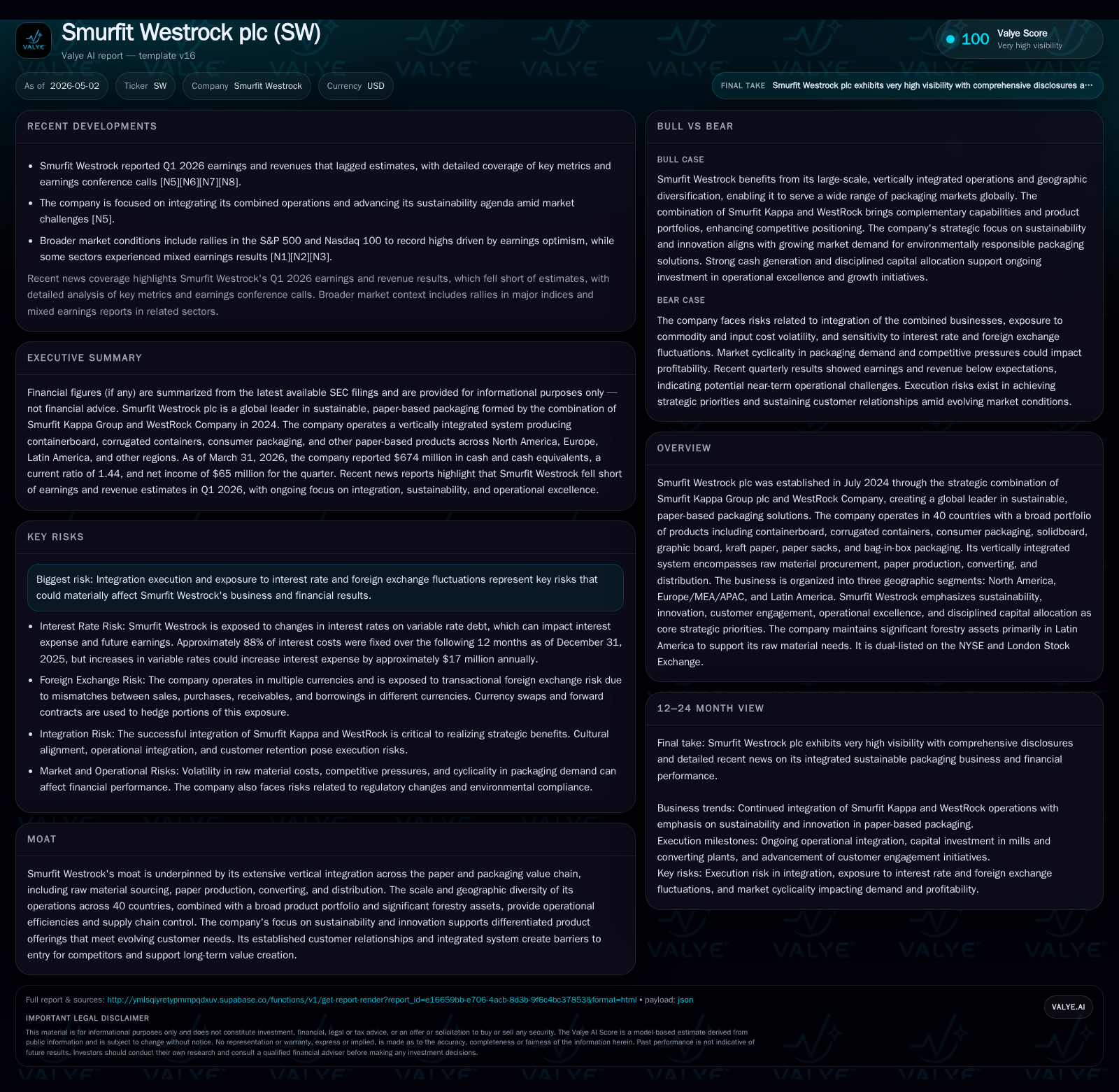
Smurfit Westrock plc, formed in mid-2024 by merging Smurfit Kappa and WestRock, reported first-quarter 2026 results that undershot market expectations, highlighting integration execution as a key near-term challenge. The company remains a global leader in sustainable, paper-based packaging with extensive vertical integration spanning raw materials to finished products across 40 countries. Growth is driven by diversified geographic exposure, innovation in sustainable packaging, and expanding end-market demand for eco-friendly solutions. Risks include sensitivity to commodity prices, currency fluctuations, interest rate changes, and ongoing integration complexities. Operational performance and capital discipline will be critical metrics to watch as the company advances its Medium-Term Plan.
Recent Operating Update
Smurfit Westrock plc’s latest quarterly report for Q1 2026 revealed that the company fell short of both revenue and earnings estimates, signaling continuing challenges stemming from the large-scale merger between Smurfit Kappa Group plc and WestRock Company completed in July 2024 [S2][N5][N7]. Despite these headwinds, management reaffirmed commitment to its Medium-Term Plan focused on seamless integration execution combined with operational excellence.
No material shifts were reported in risk factors relative to the prior annual filing; currency volatility around the U.S. dollar's strength against the euro and Latin American currencies remains a focal point alongside commodity price fluctuations tied to recovered paper and virgin fiber costs [S2][S1]. Interest expense sensitivity is noteworthy given the significant debt load: approximately $13.3 billion total debt with about 88% of borrowing costs fixed over the coming year minimizing potential adverse effects from rising rates [F1][S1].
Business Model Overview
Smurfit Westrock’s business model centers on offering fully integrated fiber-based paper packaging solutions. The company controls the value chain starting from raw material sourcing—wood fibers and recycled paper—to containerboard manufacturing converting into corrugated containers and consumer-facing packaging products such as folding cartons and bag-in-box systems [S1]. This vertical integration affords substantial advantages across cost control, supply reliability, quality management, and innovation agility.
The merger melded Smurfit Kappa’s pan-European reach with a strong Latin America foothold alongside WestRock’s leadership in North American containerboard production and consumer packaging solutions. This cross-continental footprint enables the group to serve diverse end-markets efficiently while tailoring product offerings according to regional dynamics [S20].
Revenue derives primarily from sales of corrugated containers manufactured from in-house produced containerboard — a product category serving logistics, retail display, and e-commerce sectors — supplemented by consumer packaging solutions that leverage paperboard substrates to replace plastic alternatives. Pricing mechanisms include contract negotiations keyed to input cost pass-through capabilities balanced by competitive pressures.
Margins benefit structurally from scale economies achieved through integrated mills supplying converting plants within geographic segments (North America; Europe/MEA/APAC; Latin America). Additionally, internal forestry operations in Latin America support raw material self-sufficiency reducing exposure to market pulp price swings [S1].
Industry Structure and Competitive Position
The global paper-based packaging industry is characterized by fragmented regional players alongside several consolidated multinational firms vying for leadership in sustainable solutions. Smurfit Westrock ranks among the top-tier global competitors owing to its breadth of operations spanning over 40 countries and comprehensive product portfolio.
Competitive moats arise from three main pillars: vertical integration granting supply chain control; ongoing investments in sustainability-driven product innovation meeting increasingly stringent regulatory demands for recyclability; and deep customer relationships reinforced through customized packaging designs enhancing brand visibility—thereby increasing switching costs.
Market dynamics also reflect rising substitution trends away from plastics toward fiber-based packaging propelled by environmental legislation and consumer preferences—a favorable secular driver supporting demand growth structurally beyond peak economic cycles.
Growth Drivers
Sustainability Tailwinds
Consumer goods companies globally are intensifying efforts to reduce carbon footprint resulting in expanded mandates for recyclable or bio-degradable packaging solutions. Smurfit Westrock’s commitment to sustainability through fiber-based solutions aligns well with this shift providing organic volume growth potential across regions.
Geographic Diversification
With operations segmented into North America accounting for roughly 58.5% of net sales along with Europe/MEA/APAC and Latin America covering complementary markets with different demand profiles, the company benefits from diversification that mitigates cyclical concentration risks while exploiting emerging market expansion opportunities [S1][S20].
Vertical Integration Enhancements
Continuous optimization of integrated supply chains—from improved pulp yield efficiencies at mills to advanced converting technologies—enables margin enhancement opportunities while supporting faster new product launches responsive to evolving customer needs.
Innovation Pipeline
Ongoing R&D investments targeting lightweighting papers without compromising strength or barrier properties position Smurfit Westrock at forefront of next-generation packaging appealing particularly in food & beverage, pharmaceuticals, electronics sectors.
Risks / Watchpoints / Growth Constraints
Integration Execution Risk
As a post-merger entity bringing together two established but previously separate operators across multiple continents, fully realizing cost synergies while harmonizing IT systems, procurement processes, corporate cultures remains an uncertain multi-year endeavor impacting near-term operational efficiency [S2].
Commodity Price Volatility
Raw material costs remain subject to external market forces especially recovered paper availability/pricing influenced by recycling policies plus virgin fiber price trends affected by forestry yields/severe weather events. Shifts here can pressure margins absent swift pricing adjustments downstream [S1][S7].
Foreign Exchange Exposure
Though hedging programs are employed thoughtfully for anticipated transactions denominated in foreign currencies including euro, Mexican peso, Brazilian real among others, significant exposures persist with USD strength potentially dampening consolidated earnings when translated back due to marking local cash flows at weaker spot rates [S1].
Leverage Profile Sensitivity
Total debt approximating $13.3 billion imposes financial risk particularly if economic conditions shift towards tightening credit markets or interest rates rise unexpectedly beyond hedged levels despite fixed-rate protections currently in place [F1][S1]. Liquidity however remains robust with current ratio above 1.4 as of quarter-end providing buffer against short-term stress.
What To Watch Next
- Quarterly updates on synergy realization progress including detailed disclosures on cost savings versus merger plan targets.
- Volume growth trends especially within corrugated container shipments amid e-commerce demand shifts.
- Pricing environment developments reflecting raw material cost pass-through success amidst inflation dynamics.
- Execution updates on sustainability initiatives such as percentage revenue from recycled-content products or green financing utilization.
- Currency fluctuation impacts disclosed alongside ongoing hedging effectiveness commentary.
- Capital expenditures planned for mill expansions or technology upgrades supporting medium-term capacity enhancements.
- Refinement or guidance updates associated with Medium-Term Plan targets including EBITDA margin improvement outlooks.
Financial Profile Summary (Q1 2026)
Latest financial snapshot
| Metric | Value | Period |
|---|---|---|
| Cash & equivalents | $674mm | |
| 2026-03-31 | ||
| Total debt | $13.3bn | |
| 2026-03-31 | ||
| Net debt | $12.6bn | |
| 2026-03-31 | ||
| Current assets | $10.6bn | |
| 2026-03-31 | ||
| Current liabilities | $7.3bn | |
| 2026-03-31 | ||
| Current ratio | 1.44x | |
| 2026-03-31 |
Source: SEC companyfacts cache [F1].
As of March 31, 2026 balance sheet data provides context around liquidity and leverage positioning:
- Cash & equivalents: $674 million
- Total debt outstanding: $13.275 billion
- Net debt (total debt minus cash): approx. $12.6 billion
- Current assets: $10.552 billion
- Current liabilities: $7.314 billion
- Current ratio: 1.44 [F1]
Operating income for year ended December 31, 2025 reached approximately $1.72 billion backing solid profitability pre-integration expenses while net income totaled $699 million reflecting underlying operating strength despite transitional costs [F1].
Liquidity facilities include a sizeable unsecured revolving credit facility extended through mid-2030 plus receivables securitization programs enhancing working capital flexibility without financial covenants restricting immediate actions [S4][S9].
Conclusion
Smurfit Westrock stands as a global heavyweight woven tightly into evolving sustainable packaging ecosystems underpinned by extensive vertical integration and geographic diversity. The recent quarterly results underscore real execution challenges typical of mega-mergers but also reaffirm medium-term strategic intentions centered on innovation-led growth supported by robust market fundamentals favoring fiber-based alternatives to traditional plastics.
Close attention to operational metrics around synergy realization velocity combined with macro inputs like raw material price trajectories and foreign exchange movements will be crucial lenses through which near-term performance is assessed going forward.
This analysis is based solely on publicly available information including filings up to May 2026 without any investment recommendation or opinion offered regarding securities mentioned herein.
Disclaimer: This is research-only, informational analysis and not investment advice. It may include AI-generated interpretation and general industry context. Always verify important details using primary sources.

Comments