
Abpro Holdings Faces Nasdaq Delisting and Liquidity Crisis Amid Early-Stage Oncology Development
Abpro Holdings delisted from Nasdaq due to equity shortfall, shifting to OTC Pink with structural liquidity and governance challenges.
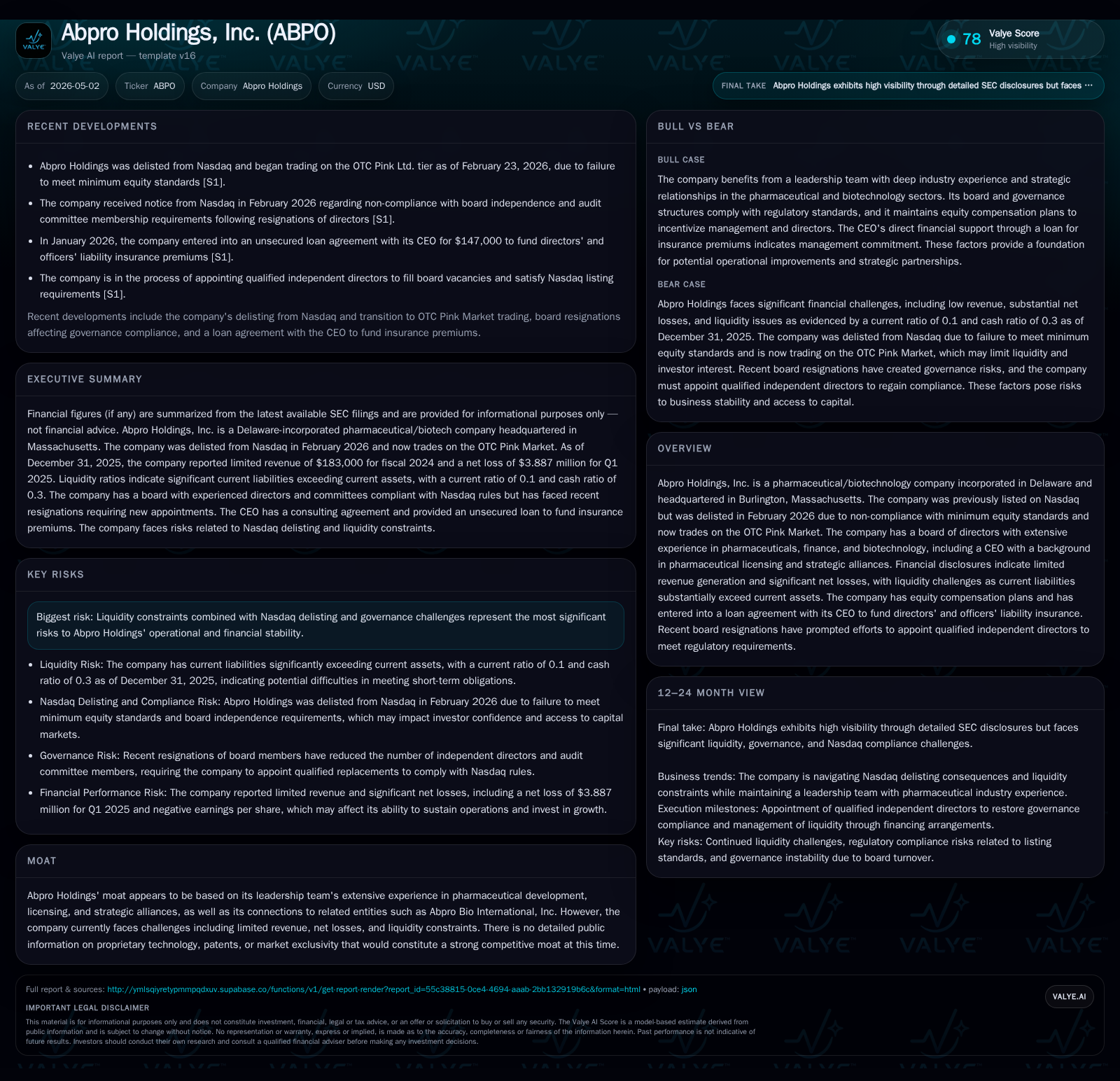
Abpro Holdings, a clinical-stage biotech specializing in multispecific antibody oncology therapies, was delisted from Nasdaq in February 2026 for failing minimum equity standards. Trading on the OTC Pink Market introduces liquidity constraints and investor uncertainty. The company’s business model centers on advancing a pipeline of early-stage immuno-oncology candidates in collaboration with Celltrion, leveraging its leadership’s pharmaceutical licensing expertise. Despite promising regulatory milestones including FDA IND clearance for ABP-102, Abpro’s limited revenue and significant liquidity shortfalls constrain near-term viability. Board resignations further complicate governance compliance amid efforts to reengage Nasdaq listing standards. Growth is contingent on clinical progress and capital raises, while risks include funding gaps, governance hurdles, and market illiquidity.
Recent Operating Update
Abpro Holdings’ most pivotal recent event is its February 18, 2026 notification from the Nasdaq Hearings Panel that it would be delisted from the Nasdaq Stock Market by February 23 due to noncompliance with Nasdaq’s minimum equity standards [S3][S19]. This suspension marks a critical inflection point since the company had been actively trying to maintain compliance but failed to meet the required thresholds despite prior extensions granted through late 2025 [S6]. The company has announced its intention to appeal but not assuredly expects reversal. Upon delisting, Abpro's common stock (ticker ABP) and public warrants (ABPWW) will trade instead on the OTC Pink Market [S3][S5]. However, management cautioned investors about elevated risks of reduced liquidity, transparency gaps, and increased price volatility inherent to such an OTC trading environment.
Compounding these challenges are recent board resignations by two independent directors in late January 2026 which resulted in immediate non-compliance with Nasdaq rules mandating a majority independent board composition and an audit committee consisting entirely of independent members [S25][S26]. This has forced a board-level recruitment process focused on restoring compliance as soon as feasible. Meanwhile, CEO Miles Suk arranged a $147K unsecured loan to fund directors’ & officers' liability insurance premiums indicating constrained cash resources [S23].
On a more optimistic note on the product front, Abpro achieved FDA clearance of its Investigational New Drug (IND) application for ABP-102 / CT-P72—a multispecific antibody T-cell engager targeting HER2-positive cancers—on January 6, 2026 [S10]. This asset is co-developed with South Korea-based Celltrion Plc under a collaborative agreement [S29]. Earlier in December 2025, Abpro submitted its IND application signaling progress toward initiating phase I clinical trials [S11].
Business Model Overview
Abpro Holdings operates as a pharmaceutical/biotechnology development company focused primarily on immuno-oncology therapeutics utilizing multispecific antibodies. Revenues are minimal at this stage given its clinical development focus; reported revenue was $183K out of milestone or licensing payments as of December 31, 2024 [F1]. The company generates value through the discovery and advancement of novel antibody drugs designed to engage immune cells against cancer targets—a strategy aligned with the growing preference for biologics over conventional chemotherapies.
Its business model relies heavily on strategic alliances such as the notable collaboration with Celltrion which provides capabilities ranging from clinical manufacturing to global commercialization networks—a critical factor for an emerging biotech lacking large-scale infrastructure. Licensing arrangements allow Abpro to monetize early-stage assets via upfront fees and future milestone payments while preserving upside through royalty streams post-commercialization.
The revenue mechanics at this stage are primarily contract-driven: partners pay for research collaborations or industry licenses with service volume depending on scientific milestones hit (e.g., IND clearance) or clinical trial progress. Pricing power is limited until later-phase validations; therefore operating margins remain negative reflecting R&D intensity combined with general administrative costs including board governance obligations.
Customer adoption focuses mainly on institutional entities such as pharma licensors rather than direct healthcare providers or patients. Switching costs stem from proprietary biologic platforms but are immature given limited public information on patented technologies. The offering aims to be differentiated by enabling specific immune engagement employing multispecific antibodies potentially addressing hard-to-treat oncological indications like HER2-positive tumors.
Industry Structure and Competitive Positioning
The oncology immunotherapy segment is highly competitive but also rapidly expanding driven by unmet medical needs in solid tumors and hematological malignancies. Key players range from large biologics companies with approved checkpoint inhibitors (e.g., Bristol Myers Squibb) to specialized mid-sized biotech firms pursuing bispecifics or multispecific constructs that aim to overcome resistance mechanisms or improve efficacy/safety profiles.
Abpro is positioned as an emerging player within this complex ecosystem leveraging bi-specific antibody technology developed collaboratively with Celltrion—a recognized biopharma leader—which could grant pathway advantages if clinical data validate safety and efficacy early. However, the company lacks scale or late-stage assets which places it relatively disadvantaged against better-funded peers who command broader pipelines and market reach.
Structurally, industry hurdles include prolonged development timelines possibly spanning years before regulatory approvals translating into commercial revenues. Intellectual property barriers underpin strong moats among incumbents; yet no explicit patents or proprietary platform details distinguish Abpro publicly today beyond collaborative know-how.
Governance issues stemming from multiple director resignations weaken investor confidence especially critical for smaller-cap micro-cap stocks navigating volatile biotech markets. The loss of Nasdaq listing further erodes visibility relative to competitors.
Growth Drivers
- Clinical Progression of Lead Product Candidates: Advancing ABP-102 into phase I trials post-IND clearance sets essential validation steps necessary before subsequent phases or partnering deals.
- Collaboration Expansion: Further partnerships or licensing agreements leveraging Celltrion’s international footprint could unlock additional non-dilutive funding sources.
- Capital Infusions: Success in securing adequate financing (equity raises or debt facilities) will underpin continuing operations through costly clinical programs.
- Governance Stabilization: Appointing qualified independent directors aiming for Nasdaq rule compliance can restore market confidence facilitating better liquidity.
- Potential Milestone Payments: Triggered by achieving development endpoints or regulatory approvals under collaboration terms boosting revenue visibility.
These growth levers depend heavily on execution risks inherent in early-stage biotech where trial failures or delays are commonplace making timeline predictability low but upside material if programs succeed.
Risks and Constraints
Liquidity Crisis: With current liabilities exceeding current assets nearly tenfold (current ratio ~0.1), Abpro faces acute funding shortages risking disruption of R&D activities absent timely capital interventions [F1].
Delisting Impact: Loss of Nasdaq listing reduces trading volumes sharply complicating shareholder exits and dampening share price support potentially increasing cost of capital.
Governance Challenges: Board vacancies impede compliance with key exchange rules delaying relisting prospects until resolved.
Clinical Development Uncertainty: Early pipeline stage means no commercial products exist; regulatory setbacks can materially impair valuations.
Market Awareness: Trading on OTC Pink limits analyst coverage reducing information dissemination impacting retail/institutional interest negatively.
Potential Dilution: Equity raises needed for survival may dilute existing shareholders substantially affecting valuation metrics.
What To Watch Next
- Outcome of appeal process against Nasdaq delisting decision expected within statutory timeframes influencing potential relisting scenarios [S3][S19].
- Appointment of new independent board members crucial to comply with governance standards fostering stability [S9][S26].
- Initiation of phase I trials for ABP-102/CT-P72 examining safety profiles providing important technical validation events [S10][S11].
- Cash runway monitoring considering operating cash burn versus available liquid assets including any new financing announcements.
- Updates on additional partnerships that could mitigate funding burdens and extend operational longevity.
Financial Profile Summary
Latest financial snapshot
| Metric | Value | Period |
|---|---|---|
| Current assets | $896000 | |
| 2025-12-31 | ||
| Current liabilities | $9mm | |
| 2025-12-31 | ||
| Current ratio | 0.1x | |
| 2025-12-31 |
Source: SEC companyfacts cache [F1].
Despite being clinically focused without commercial sales ramped yet, available data shows modest revenue generated ($183K FY2024) but significant operating losses consistent with early-stage biotech investment patterns [F1]. Notably:
- Operating Income: -$8.45 million (FY2025) corroborates high R&D spend level [F1]
- Net Income: Last positive reported ~$2.82 million in FY2023 before increasing losses emerged indicating shifting financial posture across timeframes [F1]
- Cash & Equivalents: Approximately $2.85 million at end-Dec 2024 signals limited liquidity buffer ahead of FY2025 results [F1]
- Total Debt: Minimal at roughly $170K as mid-2025 [F1], supplemented by CEO’s recent unsecured $147K loan earmarked solely for D&O insurance illustrating tight credit access [S23]
- Current Liabilities: High short-term obligations at around $9.35 million overwhelms current assets (
$896K) resulting in critically below-par liquidity ratio (0.1) suggesting immediate refinancing necessity [F1]
This indicates material financial stress compatible with typical developmental biotechs at inflection points but demanding successful near-term fundraises or milestone monetization to sustain operations without insolvency risk.
Abpro Holdings embodies characteristics emblematic of micro-cap clinical-stage biotechs attempting breakthrough innovation within competitive oncology segments but currently constrained by severe capitalization inadequacies compounded by regulatory listing setbacks and board instability. Its growth prospects hinge largely on translating promising pipeline assets through costly developmental stages supported prudently by strengthened governance frameworks alongside consistent capital inflows—factors whose interplay will shape its trajectory amidst an unforgiving market landscape marked by investor risk aversion toward OTC-listed entities absent clear evidence of de-risked product profiles.
This analysis is based solely on publicly filed SEC documents as of May 2026 without any investment advice implied or expressed.
Disclaimer: This is research-only, informational analysis and not investment advice. It may include AI-generated interpretation and general industry context. Always verify important details using primary sources.

Comments