
Boston Scientific Reframes Growth after Q1 2026 Beat and Strategic Acquisitions
Boston Scientific's robust Q1 2026 results and recent acquisitions recalibrate its growth trajectory, leveraging innovation across diversified medical device sectors.
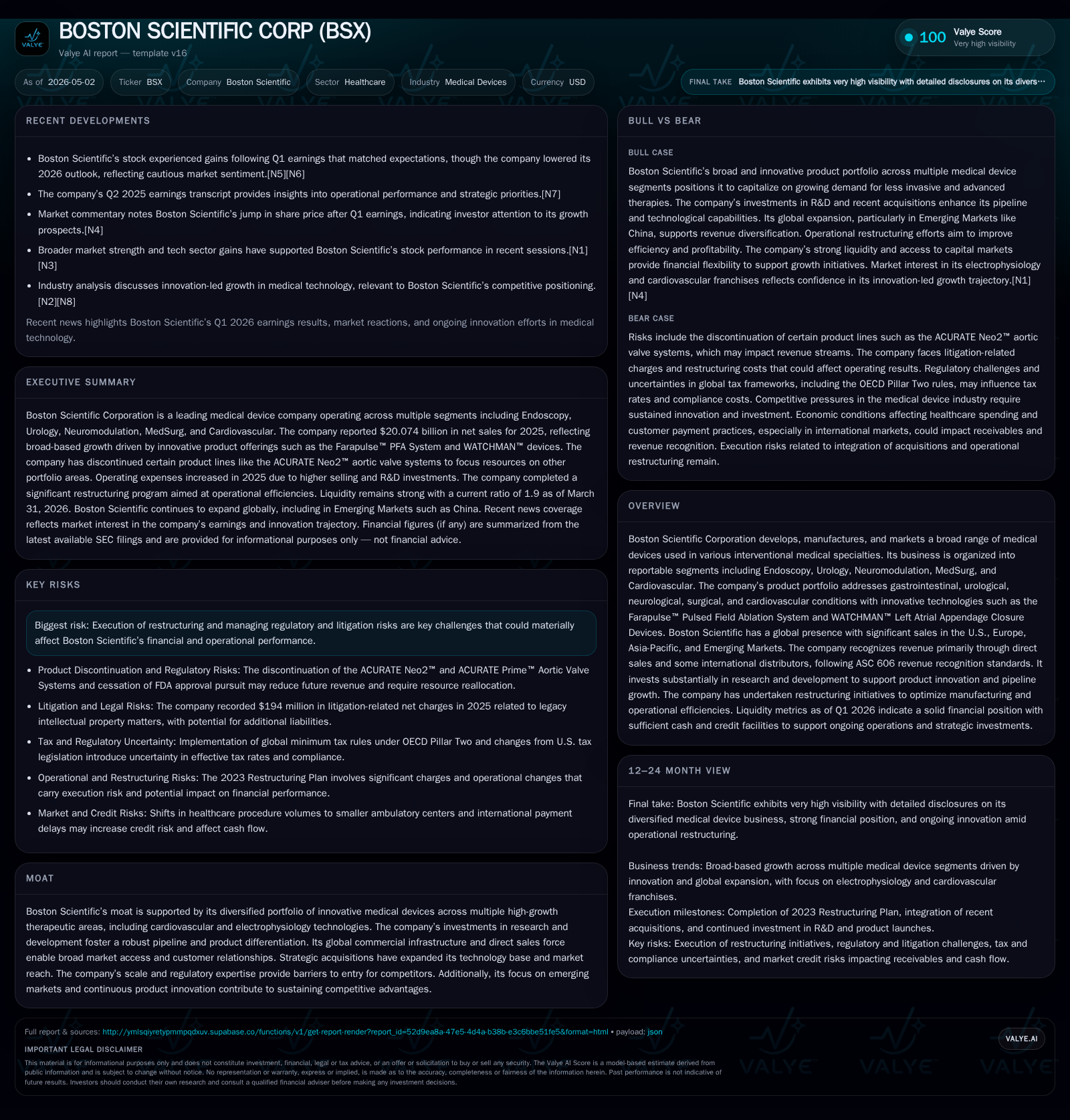
Boston Scientific outperformed expectations in Q1 2026, driven by strong organic and acquisition-related growth, particularly in Cardiovascular and Urology segments. The integration of Axonics and Penumbra enhances its technology base while restructuring initiatives improve operational efficiency. The company’s diversified portfolio, global sales infrastructure, and innovation pipeline position it well amid evolving healthcare dynamics despite legal and regulatory risks. Key milestones ahead include regulatory approvals and ERP rollout phases that will influence execution momentum.
Latest Quarterly Results Highlight Accelerated Growth
Boston Scientific Corp reported a solid first quarter ending March 31, 2026, with net sales growth surpassing expectations principally due to contributions from recent acquisitions such as Penumbra (closed January 2026) and Axonics (closed November 2024), alongside strong organic expansion in core franchises like the Farapulse™ Pulsed Field Ablation system [S2][S3]. The Q1 update included termination of the CEO’s insider trading plan signaling confidence in future performance [S2]. Currency impacts proved minimal in this period. The Cardiovascular segment notably drove top-line gains with double-digit growth supported by innovative electrophysiology devices [N2]. The company also raised near-term growth outlook underpinning reassessed investor expectations [N3]. These quarterly results mark a pivotal inflection point for Boston Scientific’s revenue mix, evidencing effective acquisition integration progress coupled with sustained demand in interventional specialties.
Business Model and Innovation Pipeline Underpinning Competitive Edge
Boston Scientific operates through diversified reportable segments—Endoscopy, Urology, Neuromodulation, MedSurg, and Cardiovascular—offering interventional devices targeting gastrointestinal, urological, neurological, surgical, and cardiovascular conditions [S1]. Revenue generation is primarily through direct sales channels backed by an expansive global commercial footprint complemented by distributor relationships outside the U.S., applying ASC 606 revenue recognition standards. Capitalizing on a robust R&D commitment (increased significantly in recent years), Boston Scientific continuously advances product pipelines including the Farapulse™ Pulsed Field Ablation system for atrial fibrillation ablation and WATCHMAN™ Left Atrial Appendage Closure Devices for stroke risk reduction [S13]. Acquisition-driven technology expansion—evident in integrating Axonics’ sacral neuromodulation solutions and Penumbra’s neurovascular devices—strengthens both product breadth and clinical relevance. This multi-therapeutic portfolio approach supported by regulatory acumen creates enduring barriers to entry against competitors.
Healthcare Industry Dynamics: Positioning in Cardiovascular and Beyond
Within the competitive medical device ecosystem—especially cardiovascular interventional therapies—Boston Scientific stands as a prominent player leveraging scale, global reach, and differentiated innovation [S1]. Its ability to navigate complex regulatory landscapes effectively permits timely product launches despite stringent FDA frameworks influencing approval timelines. Pricing power appears resilient owing to specialized technology offerings crucial to clinical outcomes. However, the capital-intensive nature of manufacturing high-tech devices coupled with supply chain intricacies imposes capacity constraints requiring ongoing operational diligence. Competitor firms like Johnson & Johnson emphasize similar electrophysiology spaces but face heightened pressure from Boston Scientific’s accelerated adoption curve of its pulsed field ablation therapies highlighted during Q1 [N9]. Geographic diversification into emerging markets further mitigates developed market cyclicality.
Growth Drivers: Acquisition Synergies, Emerging Markets, and New Technologies
Key catalysts fueling Boston Scientific’s expansion are multifaceted. The Axonics acquisition broadened capabilities in Urology with sacral neuromodulation devices addressing therapeutic gaps for urinary dysfunction [S1][S2]. Penumbra’s addition enhances neurovascular interventions—an area witnessing escalating procedural volumes globally [S2]. Emerging markets delivered double-digit growth (approximately 11–12%), reflecting focused expansion strategies exploiting demographic shifts and increasing healthcare infrastructure investments [S1]. Adoption of breakthrough technologies like Farapulse™, supported by strong clinical data for atrial fibrillation ablation over traditional cryoablation methods, drives procedural volume increases and pricing premium potential. Continuous reinvestment of acquisition synergies into R&D ensures pipeline vitality. Additionally, scaling WATCHMAN™ devices balances growth across cardiovascular rhythm management offerings.
Risks and Constraints: Restructuring, Regulatory Challenges, and Litigation Exposure
Boston Scientific faces execution risk related to a multi-year restructuring program initiated in 2023 aiming at global supply chain rationalization and cost efficiency improvements [S13][S14]. The exhaustion of restructuring charge exclusions under credit agreements signals diminishing cushion against associated charges going forward [S7][S11]. Regulatory scrutiny remains elevated given the complexity of novel device approvals plus various ongoing product liability claims notably around transvaginal mesh products [S5][S15][S16]. Intellectual property litigations introduce further uncertainty especially linked to patented technologies like Synergy™ stents [S15]. Although provisions for estimated legal liabilities are recorded conservatively ($242 million reserve noted at year-end 2025), significant adverse rulings could impair operating results or liquidity positions. Financial covenant compliance is currently solid but requires monitoring amid elevated leverage post-large acquisitions exceeding $1 billion qualifying as "Qualified Acquisitions" under credit facility terms that temporarily relax maximum leverage ratios [S7][S11].
Key Milestones Ahead: Execution Benchmarks and Market Signals
Critical forthcoming events include phased implementation of a global enterprise resource planning (ERP) system whose European deployment started August 2025 with further rollouts expected; these will reshape internal controls impacting financial reporting but promise long-term operational optimization [S1][S2]. Near-term regulatory milestones comprise pending FDA approvals for next-gen devices related to cardiac rhythm management which will influence procedural adoption trajectories. Management plans updates on guidance post-Q1 report spotlight ongoing confidence but underscore sensitivity to execution timing particularly on acquisitions’ full revenue contributions stabilization [S2][N3]. Tracking retention rates for newly integrated technologies as well as backlog metrics within high-growth units should serve as demand indicators. Monitoring litigation outcomes remains essential given their potential financial impact.
Financial Snapshot: Balance Sheet Strength and Liquidity Overview
Latest financial snapshot
| Metric | Value | Period |
|---|---|---|
| Cash & equivalents | $1453mm | |
| 2026-03-31 | ||
| Current assets | $8.7bn | |
| 2026-03-31 | ||
| Current liabilities | $4.6bn | |
| 2026-03-31 | ||
| Current ratio | 1.9x | |
| 2026-03-31 |
Source: SEC companyfacts cache [F1].
Boston Scientific maintains a solid liquidity position with $1.453 billion cash & equivalents and current assets totaling $8.684 billion against current liabilities of $4.571 billion providing a current ratio of approximately 1.9 as of March 31, 2026 demonstrating short-term financial resilience [F1][S2]. Total debt stands near $4.674 billion netting about $3.221 billion after cash adjustments reflecting prudent leverage management considering recent major acquisitions including Penumbra at over $1 billion consideration qualifying as Qualified Acquisitions under credit facility covenants [F1]. Recent refinancing actions detailed in filings support favorable debt maturity profiles mitigating near-term refinancing risks.
Disclaimer: This is research-only, informational analysis and not investment advice. It may include AI-generated interpretation and general industry context. Always verify important details using primary sources.

Comments