
FB Financial Corporate Update: Branch Network Synergies and Mortgage Segment Driving Growth Amid Market Headwinds
Latest quarterly results and stock repurchase plan renewal highlight FB Financial’s capital discipline and regional expansion strategies.
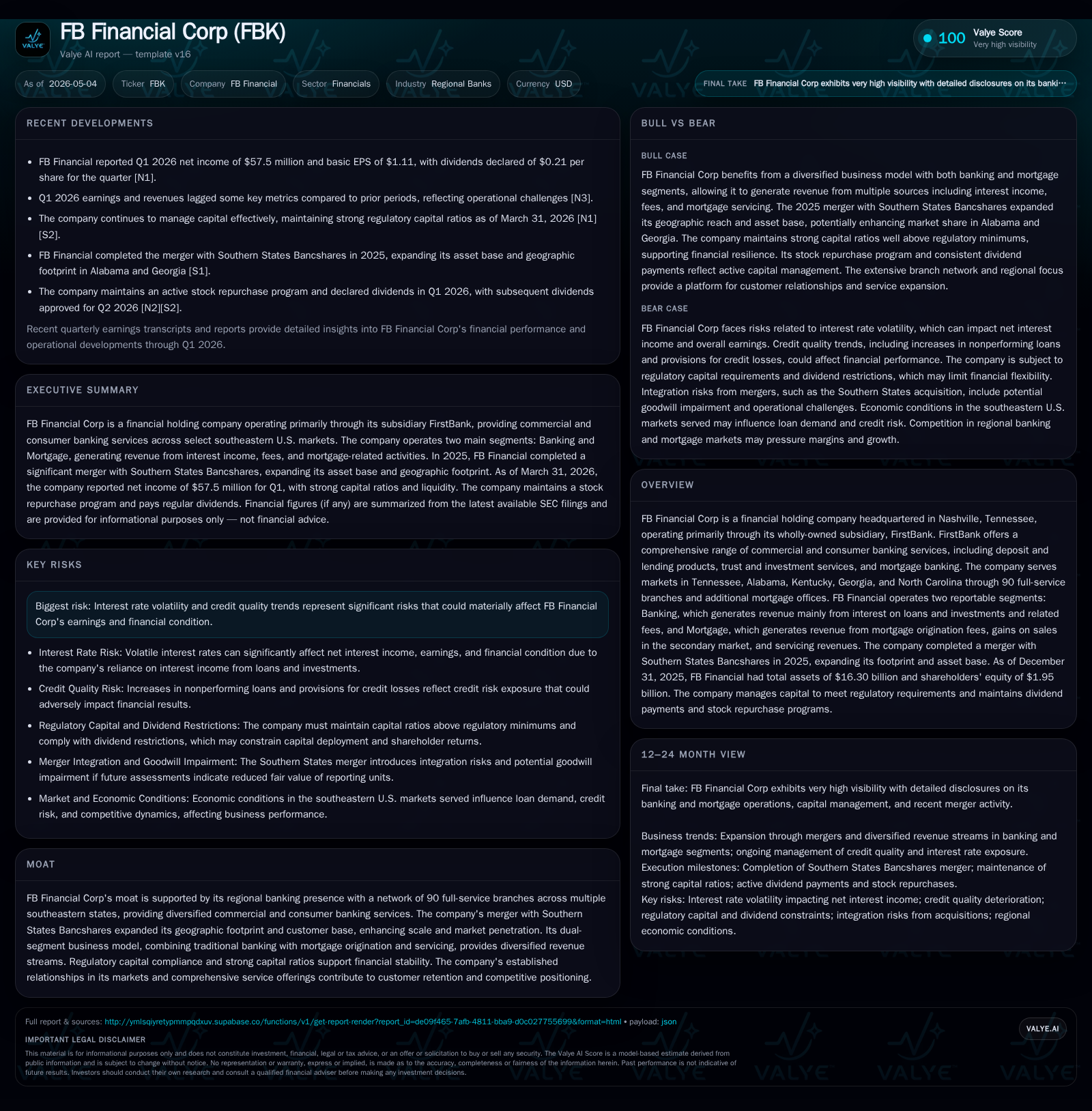
FB Financial Corp’s Q1 2026 filing reveals robust capital management with rising shareholders’ equity, ongoing dividend payments, and a renewed $175 million stock repurchase authorization. The company operates dual segments—Banking and Mortgage—with a broad regional footprint expanded by the 2025 merger with Southern States Bancshares. Strong regulatory capital ratios underpin dividend and buyback capacity while mortgage origination fees and commercial lending growth fuel near-term revenue. Risks remain from interest rate fluctuations and credit quality pressure but are mitigated by diversified revenue streams and conservative underwriting. Monitoring upcoming dividend declarations and merger integration progress will be key to assessing trajectory.
Latest Quarterly Operating Results Highlight Capital and Dividend Discipline
FB Financial Corp’s latest Form 10-Q for the quarter ended March 31, 2026, showcases sustained financial strength during a challenging banking environment [S2]. The company reported net income for the quarter of $57.5 million, contributing to a total shareholders’ equity of $1.97 billion as of quarter-end. Book value per common share increased modestly to $38.39 from $37.64 in December 2025.
Capital management remains a strategic priority; the bank subsidiary paid dividends totaling $35.8 million to the holding company in Q1, consistent with prior-year levels but elevated compared to early-2025 payouts under regulatory limits imposed by Tennessee banking laws and Federal Reserve Regulation H [S2]. Subsequently in April 2026, the Board renewed its stock repurchase authorization up to $175 million through mid-2027, underscoring confidence in the company's earnings outlook and balance sheet robustness [S3], [S24]. During Q1 alone, FB Financial repurchased shares worth $21.8 million.
This disciplined approach balances shareholder returns via dividends and buybacks without compromising regulatory capital buffers critical to maintaining the company’s well-capitalized status.
Business Model Overview: Dual-Segment Strength in Banking and Mortgage Services
FB Financial operates primarily through its subsidiary FirstBank which provides comprehensive commercial and consumer banking products across five southeastern states — Tennessee, Alabama, Kentucky, Georgia, and North Carolina — supported by a network of approximately 90 full-service branches plus specialized mortgage offices [S1].
The company's revenue streams derive fundamentally from two reportable segments:
Banking Segment: Dominated by interest income generated on an expanding loan portfolio that includes commercial & industrial loans (notably secured by business assets), residential real estate loans (both owner-occupied and investor-owned single-family mortgages), construction loans, lines of credit, and other consumer lending products [S1], [S27]. Fee-related income encompasses deposit services alongside loan fees.
Mortgage Segment: Generates revenues via origination fees on new loan production, gains realized from secondary market sales of mortgage-backed securities, plus servicing fees earned on retained servicing rights, [S1]. The robust mortgage business benefits from both organic volume growth across its footprint and heightened scale following last year’s Southern States Bancshares merger.
This diversified model partially cushions FB Financial from segment-specific volatility since commercial banking income tends to be more sensitive to economic cycles whereas mortgage fee revenues depend heavily on refinancing activity influenced by interest rate trends.
Competitive Position: Regional Branch Network and Strategic Acquisition Benefits
FB Financial's competitive moat largely centers on its entrenched regional presence across growing southeastern markets with physical accessibility via more than ninety full-service branches distributed strategically between urban centers and suburban/rural communities,[S1],[S21]. This facilitates deep client relationships spanning deposit gathering to cross-sell lending solutions enhancing customer stickiness vis-à-vis competitors.
The September 2025 merger with Southern States Bancshares materially expanded FirstBank’s asset base — including approximately $368 million in common stock issued as transaction consideration — bolstering market penetration especially within underserved adjacent markets while adding high-quality loan portfolios that complement existing book compositions [S1],.
In this competitive landscape characterized by a mix of regional banks targeting similar demographics alongside larger national players exerting digital convenience pressures, FB Financial leverages its integrated service model combining trust services with core banking offerings to build switching costs that help stabilize deposit bases amid fluctuating market conditions.
Regulatory compliance further cements competitiveness; maintenance of risk-based capital well above "well-capitalized" thresholds offers operational flexibility in dividend policy decisions while supporting lending capacity without incurring excessive regulatory constraints or reactive capital raises.
Growth Drivers: Mortgage Market Dynamics, Commercial Lending Expansion, and Repurchase Plan Impact
Several catalysts underpin FB Financial’s near-to-medium term growth prospects:
Mortgage Origination Momentum: The mortgage segment benefits from sustained consumer demand for home financing products amid cyclical refi waves driven by moderate rate shifts. Origination-related fees combined with servicing revenues provide higher-margin fee-based income alongside core net interest margins, [S2].
Commercial Lending Expansion: Loan growth is buoyed by the combined branch network enhanced through the recent merger. Cross-selling among geographically overlapping customer bases supports portfolio diversification across construction loans and owner-occupied commercial real estate lending sectors which historically display resilient credit metrics underpinned by tangible collateral [S2],[S27].
Share Repurchase Program: The April renewal authorizes up to $175 million in open-market share buybacks expected to increase earnings per share accretion over time while signaling managerial confidence in valuation levels amid volatile banking sector sentiment [S3],[S24]. Active repurchases also assist in offsetting dilution related to equity compensation granting practices.
Collectively these drivers contribute positively toward revenue stability despite intermittent margin compression risks introduced by market-wide interest rate uncertainties.
Risks and Watchpoints: Interest Rate Sensitivity, Credit Quality Trends, and Regulatory Constraints
Key risks merit ongoing attention:
Interest Rate Volatility: Rapid fluctuations affect net interest margins dependent on loan repricing lags versus funding cost adjustments. Prolonged inverted yield curves or sharp hikes could compress margins or curtail refinancing activity vital for mortgage fee revenues [S1],.
Credit Quality Pressures: While provisions increased notably in FY 2025—partially linked to acquired loan portfolios—nonperforming loans remain relatively contained around ~0.97% of loans held for investment as of year-end with classified loans slightly reducing to ~1.10%, reflecting prudent underwriting standards notwithstanding macroeconomic headwinds [S10]. Continued monitoring needed especially in commercial real estate exposures.
Dividend Restrictions: State banking regulations plus Federal Reserve Regulation H impose caps on dividends payable from the bank subsidiary up to its cumulative net income over current plus two prior years before needing approval. These safeguards may limit surplus cash transfers impacting holding company distributions although current management maintains payouts within limits ensuring regulatory compliance without capital exhaustion risks [S2], [S18].
Regulatory interactions remain foundational since failure to meet minimum capital requirements might trigger supervisory actions adversely affecting operations or growth ambitions.
Milestones Ahead: Dividend Announcements, Capital Adequacy Monitoring, and Integration Progress Post-Merger
Important near-term events that merit close tracking include:
Scheduled dividend declarations throughout remainder of fiscal 2026 providing insight into capital allocation priorities balancing shareholder returns versus organic growth funding needs.
Publication of updated regulatory filings detailing capital adequacy ratios confirming ongoing compliance with Basel III-inspired metrics including Common Equity Tier 1 (CET1) ratios that stood above minimums at Q1 close (~11.5%) despite acquisition-related goodwill buildup [S11].
Measurable progress integrating Southern States Bancshares assets such as cross-selling productivity enhancements within expanded loan/deposit franchises alongside operational synergies realization reducing overhead costs over medium term horizons.
These milestones will clarify trajectory against backdrop of broader economic uncertainty stressing regional banks.
Current Financial Snapshot: Capital Ratios, Liquidity, and Shareholder Returns
Latest financial snapshot
| Metric | Value | Period |
|---|---|---|
| Cash & equivalents | $1158mm | |
| 2026-03-31 | ||
| Total debt | $213mm | |
| 2025-12-31 | ||
| Net debt | $-945mm | |
| 2025-12-31 |
Source: SEC companyfacts cache [F1].
Capital adequacy metrics remain strong with total risk-based capital ratio at approximately 13.4% as of March quarter-end versus minimum well-capitalized threshold of 10%, complemented by Tier 1 leverage ratio above double the regulatory floor at ~10.4% providing significant cushion for contingencies or growth initiatives [S2], [F1]. Liquidity positions remain ample given over $1 billion in liquid cash equivalents supporting operational flexibility even amidst market shocks.
This analysis is based solely on documented operating data disclosed in the latest SEC filings up to May 4th, 2026 ([S1]-[S3]) supplemented by publicly available financial snapshot metrics ([F1]) without forecasting assumptions or subjective valuation judgments.
Disclaimer: This is research-only, informational analysis and not investment advice. It may include AI-generated interpretation and general industry context. Always verify important details using primary sources.

Comments