
Blue Biofuels Advances CTS Tech Amid Liquidity Pressures and Commercialization Challenges
The company progresses pilot operations and joint ventures targeting sustainable aviation fuel, constrained by financial liquidity and the need for commercial scale-up.
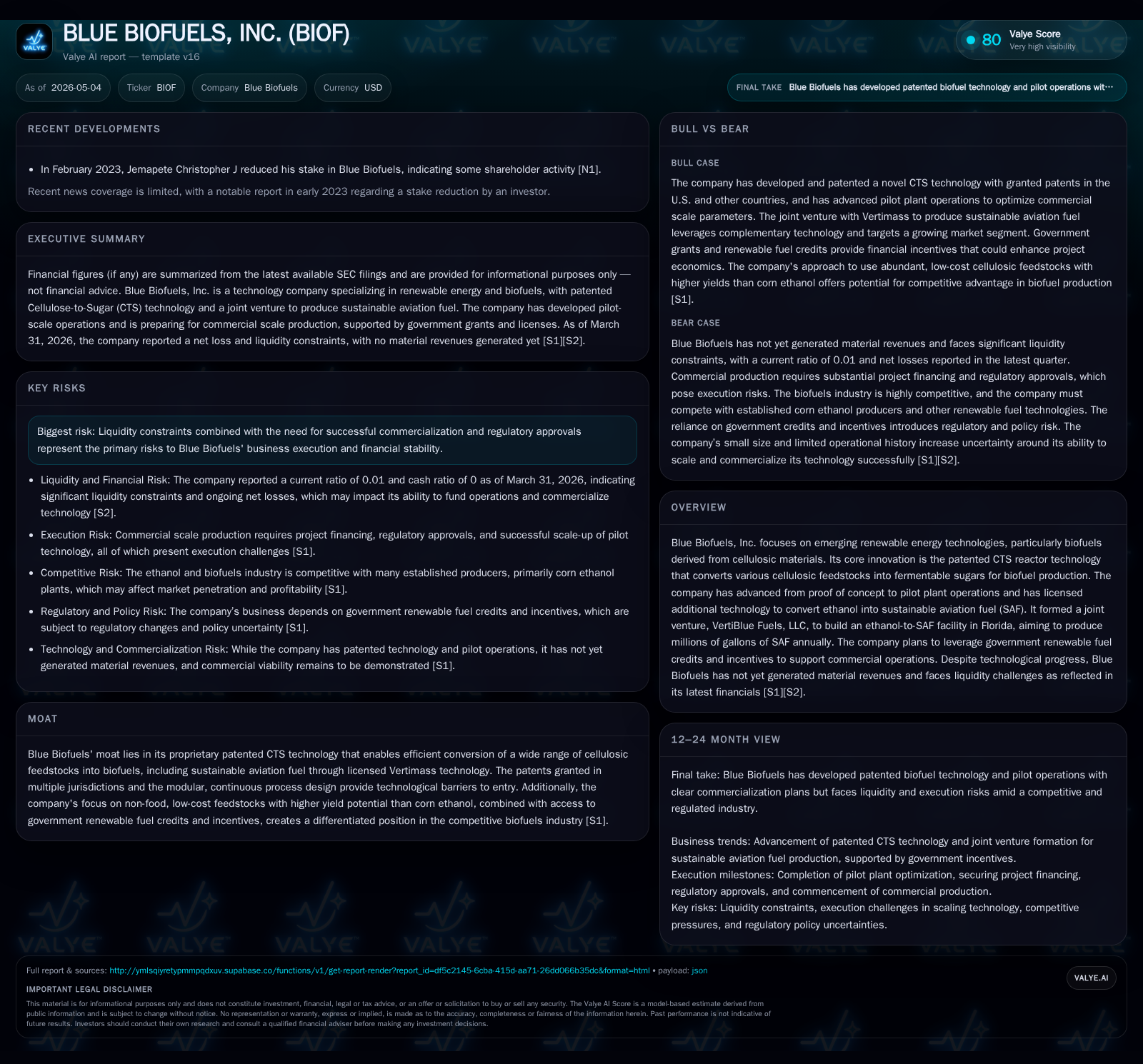
Blue Biofuels, Inc. has moved from technological proof of concept to advanced pilot plant optimization of its patented Cellulose-to-Sugar (CTS) process for biofuel production. It recently formed a joint venture to build an ethanol-to-sustainable aviation fuel (SAF) facility in Florida, aiming for multi-million gallon output. Despite these developments, the company remains pre-revenue at scale and faces severe liquidity constraints, with minimal cash and significant liabilities as of early 2026. Its competitive edge lies in its patented process enabling use of lower-cost, non-food cellulosic feedstocks and access to valuable renewable fuel credits, but successful commercialization hinges on securing project financing and regulatory approvals.
Recent Operating Update
Blue Biofuels' latest quarterly filing dated May 4, 2026 [S2], confirms progress in finalizing upscaling and optimization of its Cellulose-to-Sugar (CTS) process at the pilot plant stage. This milestone is critical as it defines operational parameters required to estimate costs and design full-scale commercial facilities. The company also highlights its joint venture with Vertimass — VertiBlue Fuels LLC — established in January 2024 to build an ethanol-to-sustainable aviation fuel (SAF) plant in Florida. Initial production targets are between 10 million to 25 million gallons per year with plans to expand towards approximately 70 million gallons annually using sugarcane ethanol initially before switching to cellulosic ethanol once CTS is operational at scale [S2][S8].
Despite these advances in technology maturation and JV formation aimed at integrating upstream cellulosic ethanol production with downstream SAF conversion (via licensed Vertimass one-step conversion technology), Blue Biofuels continues to face acute liquidity challenges. The March 31 balance sheet shows cash & equivalents under $9,000 against current liabilities over $3.1 million and a current ratio around 0.01 [F1]. This indicates severe working capital constraints that must be addressed through capital raises or project financing before commercial operations can commence.
Business Model
Blue Biofuels’ business centers on its proprietary patented CTS reactor technology which converts diverse cellulosic feedstocks — ranging from grasses like king grass to agricultural waste — into fermentable sugars. These sugars are then fermented into cellulosic ethanol that serves as feedstock for further conversion into various biofuels including ethanol itself, sustainable aviation fuel (SAF), and bio-gasoline [S1][S8].
Revenue generation prospects depend on three sequential value-creating steps: (1) producing fermentable sugars from low-cost non-food biomass using CTS; (2) fermenting sugars into cellulosic ethanol; (3) converting ethanol into higher-margin renewable fuels like SAF through licensed Vertimass technology. The company plans to monetize this value chain both through direct commercial plant operations—once funding is secured—and through technology licensing agreements or joint ventures domestically and internationally.
A key revenue driver lies in the substantial price premiums embedded in government renewable fuel credits such as D3 RINs for cellulosic ethanol (vs D6 RINs for corn ethanol) and D7 RINs for SAF. In addition, pursuing Clean Fuel Production Credits under section 45Z of the Inflation Reduction Act further enhances potential margins [S5][S7]. These credits serve as important incentives reflecting stricter environmental standards amid decarbonization trends.
Product quality-wise, the CTS patented system boasts a continuous mechanical/chemical process allowing precise reaction control that maximizes yield efficiency surpassing conventional batch enzymatic methods common in corn ethanol plants. This modular design implies scalable capacity with anticipated multiple CTS units per production site.
Industry Structure and Competitive Position
The US ethanol industry is well established but heavily reliant on corn feedstock—with roughly 200 plants primarily optimized for corn starch fermentation [S1][S7]. This creates commodity-like pricing pressure sensitive to corn-ethanol price spreads. In contrast, Blue Biofuels targets cellulosic feedstocks which are abundant, non-food based, cheaper per unit energy yield, and not subject to crop price volatility linked to food markets.
Blue Biofuels’ patented CTS process offers a technological moat protecting against new entrants by virtue of granted US patents plus applications across major international jurisdictions including Japan, Australia, Russia, Europe, Brazil, China, and African regional bodies [S1]. Their system’s advantage over standard enzymatic hydrolysis includes continuous throughput capability leading to potentially lower per-unit processing costs.
Furthermore, adoption barriers by incumbents remain substantial due to retrofit challenges at existing corn plants—highlighting licensing/JV opportunities for Blue Biofuels keen on international market entries with regional partners [S1][S8]. The joint venture strategy in Florida exemplifies vertical integration ambitions linking feedstock processing directly with SAF end-use fuel markets undergoing rapid growth driven by airline industry decarbonization efforts.
Growth Drivers
Key drivers supporting long-term growth include:
- Commercial scale-up: Success transitioning from pilot plant to full-scale operational plants is essential. Modular design facilitates stepwise capacity increases.
- Project financing: Securing capital either through equity raises or debt project financing will enable construction of first commercial facility.
- Regulatory approvals: EPA premarket approvals and compliance with federal/state regulations critical for bringing new renewable fuels online [S8].
- Renewable fuel credits: Realization of D3/D7 RIN values along with IRA Clean Fuel Production Credits materially improves economics.
- Feedstock supply agreements: Long-term contracts with suppliers of diverse cellulosic biomass reduce raw material cost volatility seen in agriculture commodities.
- Licensing & Joint Ventures: Expansion beyond own plants by licensing CTS technology or partnering internationally extends addressable market without full capital commitment.
- Market demand: Growing demand for sustainable aviation fuel amid airline sector emissions targets positions Blue Biofuels favourably.
Risks / Watchpoints / Growth Constraints
Several risks impose watchpoints on Blue Biofuels’ path:
- Liquidity constraints: Very limited cash reserves and very low current ratio reflect urgent need for new funding sources; inability to procure this risks operational delays or insolvency [F1][S2].
- Commercialization risk: Unproven transition from pilot scale yields uncertainty whether expected efficiencies translate at scale or require costly adjustments.
- Regulatory environment: Delays or failures obtaining EPA approvals or adherence to evolving environmental regulations represent bottlenecks.
- Technology adoption: Dependence on third-party licensing (Vertimass) introduces counterparty risk if agreements sour or terms change.
- Competitive pressures: Other firms investing aggressively in cellulosic biofuels or alternative decarbonization tech could erode pricing power or market share.
- Credit markets volatility: Government credits prices fluctuate based on policy changes + market supply-demand balancing impacting margins.
- Supply chain dependencies: Ensuring consistent quality + volume supply of suitable cellulosic feedstocks could challenge scale-up timelines.
What To Watch Next
Investors and stakeholders should monitor these key milestones:
- Announcements regarding securing project financing needed for constructing first commercial-scale CTS plant(s).
- Progress updates on EPA permitting specifically related to SAF production enabling regulatory compliance ahead of commercialization.
- Operational data releases detailing pilot-to-commercial parameters confirming targeted yields/cost reduction achievable at scale.
- First sales or signed off-take agreements signaling transition from development-phase to revenue generation.
- Development of further licensing deals or JV formations signaling strategic expansion plans domestically or abroad.
Financial Profile Snapshot (as of March 31, 2026)
Latest financial snapshot
| Metric | Value | Period |
|---|---|---|
| Cash & equivalents | $8665 | |
| 2026-03-31 | ||
| Current assets | $20216 | |
| 2026-03-31 | ||
| Current liabilities | $3mm | |
| 2026-03-31 | ||
| Current ratio | 0.01x | |
| 2026-03-31 |
Source: SEC companyfacts cache [F1].
| Metric | Value | Period Ended |
|---|---|---|
| Cash & Equivalents | $8,665 | |
| 2026-03-31 | ||
| Current Assets | $20,216 | |
| 2026-03-31 | ||
| Current Liabilities | $3,119,115 | |
| 2026-03-31 | ||
| Current Ratio | 0.01 | |
| 2026-03-31 |
The stark disparity between liquid assets and short-term obligations underscores critical liquidity concerns that constrain near-term execution capacity [F1]. Persisting operating losses detailed since prior annual reports reflect ongoing development-stage expenditures without offsetting revenues [F1][S1].
Conclusion
Blue Biofuels remains a technology-driven biofuels company navigating the challenging transition from innovation phase toward commercial manufacturing scale. Its patented Cellulose-to-Sugar reactor addresses key industry limitations around feedstock flexibility and efficiency offering a potentially differentiated proposition within the crowded ethanol market dominated by corn-based producers. The strategic integration into sustainable aviation fuels through JV partnerships strengthens its positioning amidst rising environmental mandates favoring low-carbon fuels.
However, financial strain is severe with minimal cash reserves confronting large liabilities highlighting a pressing need for capitalization events. Successful commercialization depends critically on navigating regulatory hurdles, proving cost-effective scalability of CTS technology beyond lab/pilot phases, accessing supportive government credit regimes sustainably priced over time, plus managing supply chain dynamics robustly post-launch. Monitoring capital raising outcomes alongside regulatory permitting progression will provide crucial insight into whether Blue Biofuels can fulfill its ambitious growth blueprint amid an increasingly competitive bioeconomy sector.
This analysis is based solely on publicly available information as of May 4th, 2026. It does not constitute investment advice but aims to provide an informative overview grounded in reported filings and industry context.
Disclaimer: This is research-only, informational analysis and not investment advice. It may include AI-generated interpretation and general industry context. Always verify important details using primary sources.

Comments