
Midland States Bancorp Consolidates Core Banking Focus After Equipment Finance Exit
Following a major portfolio divestiture, Midland States Bancorp strengthens its core banking operations and improves balance sheet stability.
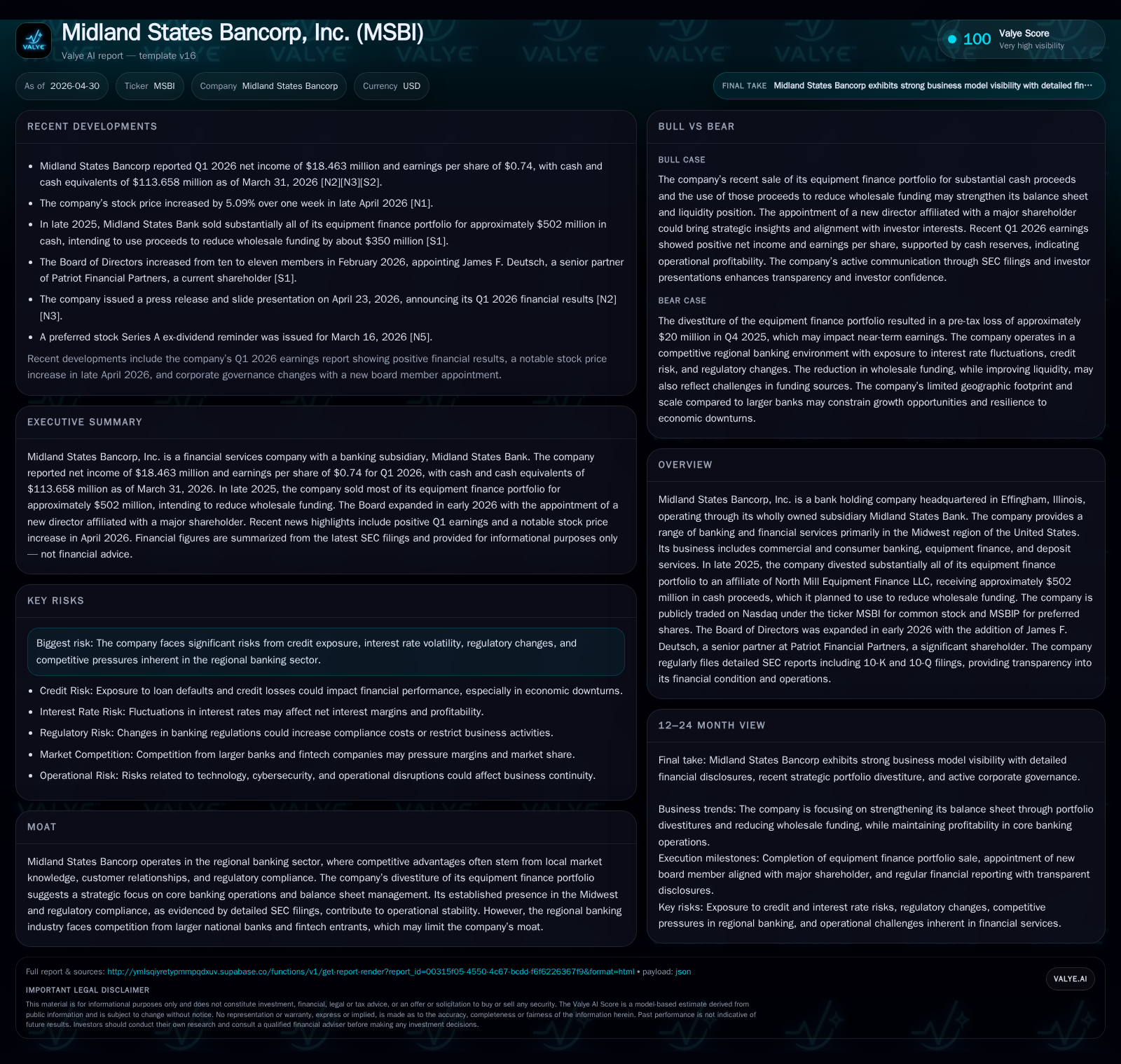
In Q1 2026, Midland States Bancorp completed the sale of nearly all its equipment finance portfolio, generating $502 million in cash proceeds. This strategic move enhances the bank’s focus on core commercial and consumer banking services in the Midwest and enables significant reduction in wholesale funding. The company’s strengthened liquidity position and refocused business model come amid competitive pressures from larger banks and fintechs, with growth hinging on commercial loan expansion and deposit gathering. Risks persist around credit quality, interest rate volatility, and regulatory demands, while forthcoming quarters will reveal execution on funding optimization and loan portfolio growth.
Q1 2026 Operating Update: Portfolio Divestiture and Balance Sheet Highlights
Midland States Bancorp’s latest quarterly filing dated April 30, 2026, confirms completion of a transformative strategic step initiated in late 2025: the divestiture of substantially all of its equipment finance portfolio to an affiliate of North Mill Equipment Finance LLC for roughly $502 million in cash proceeds [S2][S3][S5]. This transaction disposes of approximately $599 million in loans and leases previously outstanding under this segment (net of allowance approximately $565 million), effectively removing a material non-core business line from the company’s portfolio.
The near half-billion-dollar cash inflow was largely allocated toward reducing about $350 million in wholesale funding liabilities this quarter, signaling an explicit effort to deleverage the balance sheet and improve funding stability amid a challenging interest rate environment for regional banks [S5][N2]. Beyond financial engineering, governance shifts also occurred early 2026 with the addition of James F. Deutsch — a senior partner at Patriot Financial Partners, a notable investor — to the Board of Directors, underscoring shareholder engagement aligned with strategic repositioning [S26].
Quarterly operating results depict Midland navigating the immediate revenue headwinds from equipment finance exit by emphasizing its core commercial and consumer banking operations centered across the Midwest market. Deposit bases remained solid with modest commercial loan growth compensating for portfolio shrinkage elsewhere, as detailed by quarterly disclosures and analysts’ commentary on reported earnings [S2][N1].
Business Model Review: Services, Customer Segments, and Revenue Streams
Midland States Bancorp’s business model pivots on its wholly owned subsidiary Midland States Bank delivering comprehensive banking services mainly focused on regional commercial clients—ranging from small businesses to middle-market companies—and retail consumers within its Illinois-centered Midwest footprint [S1]. Historically incorporating equipment finance added diversification but created complexity; its divestiture realigns the bank toward traditional deposit gathering, loan origination, and fee income generated through service relationships.
Revenue mechanics rely heavily on net interest income derived from loan portfolios (commercial real estate loans, commercial & industrial loans, consumer installment loans) combined with fee-based income streams such as deposit account fees and ancillary financial services [S1]. Removing equipment finance reduces asset diversity but tightens focus on low switching-cost banking relationships driven more by local knowledge, personalized service, and entrenched connectivity with regional borrowers.
Post-sale liquidity enhancement bolsters Midland’s capability to fund organic loan growth via increased deposit outreach programs supported by community presence. While competitive pressures limit sustained pricing power particularly against national players boasting scale advantages or innovative digital platforms, Midland leans on embedded relationship economics to maintain client stickiness [S1][S6]. The stable deposit base supports funding cost management critical for sustaining net interest margins.
Industry Positioning: Competitive Set, Regional Advantages, and Market Challenges
Positioned as a regional bank headquartered in Effingham, Illinois, Midland contends with dual pressures: direct competition from nationally scaled banking institutions offering broad technology-enabled platforms; and emergent fintech entrants disrupting traditional intermediation with digital-first products targeting small business or consumer segments [S1][N5]. Its moat thus derives chiefly from deep Midwest market penetration coupled with attentive customer service frameworks that are less replicable by remote competitors.
Regulatory compliance remains an intensifying operational expense center as federal guidelines for midsize institutions evolve post financial crisis reforms. Maintaining robust risk management frameworks around credit underwriting standards is paramount given exposure concentrations inherent to lending within geographically constrained markets [S14][S15].
Market dynamics show mixed signals: while some loan demand has stabilized from previously cautious quarters amid macro uncertainty, deposit competition remains brisk as customers increasingly factor localized service against digital convenience offered elsewhere. Midland’s success hinges on balancing these forces without sacrificing capital efficiency or increasing risk profile beyond prudent thresholds.
Strategic Growth Drivers: Focus Areas Post-Equipment Finance Divestiture
The sale sharpens Midland’s strategic lens onto its core product sets—primarily commercial loans—and positions it to redeploy capital toward expanding these higher-margin lending activities leveraging improved balance sheet flexibility [S2][N4]. Wholesale funding reduction frees capital costs while simultaneously enhancing liquidity ratios beneficial under potential stress tests.
Growth initiatives also emphasize cross-selling bundled financial services including treasury management for business customers along with augmented deposit offerings designed to attract persistent balances at sustainable costs. Operational simplification following equipment finance disposal enables management to trim complexity-related expenditures enhancing overall efficiency metrics.
Further potential exists in deepening existing client relationships within the Midwest by leveraging proprietary knowledge of local industry sectors—agribusinesses, manufacturing SMEs—that depend heavily on tailored financing solutions rather than commoditized credit lines [N4]. These structural opportunities support a gradual scaling pathway distinct from fast-paced fintech disruptors yet aligned with traditional bank value propositions.
Risk and Constraints: Credit Exposure, Interest Rate Sensitivity, and Regulatory Environment
Midland remains exposed to credit risk concentrated in commercial loan portfolios subjected to cyclical downturns or sector-specific stress scenarios typical to regional economies [S14][S15]. Although the equipment finance exit removed a discrete risk layer associated with lease asset recoveries or residual value fluctuations, higher concentration risks persist elsewhere.
Interest rate volatility influences net interest margins critically; Midland must manage repricing mismatches between assets (loans) and liabilities (deposits or wholesale borrowings) especially after adjusting its funding composition post-divestiture. Unpredictable central bank policies could compress spreads or heighten refinance risks among borrowers.
Regulatory scrutiny is noted as growing in intensity requiring sustained investment in compliance infrastructure. New governance appointments signal responsiveness but also highlight external pressures mandating conservative risk appetites which may constrain aggressive growth undertakings under supervision standards.
Upcoming Catalysts and Execution Checkpoints for Midland States Bancorp
Key upcoming metrics include Q2 2026 earnings results that will illustrate whether wholesale funding reductions achieved early in Q1 translate into tangible cost savings or margin improvements [S2][S3]. Attention will focus on loan growth patterns—both originations volume and quality signals—to assess forward revenue sustainability relative to trimmed operational scope.
The bank’s ability to stabilize or enhance net interest margin through improved mix effects while controlling non-interest expenses post-equipment finance sale remains a central execution test. Additionally, monitoring integration effectiveness of governance enhancements such as the addition of new board members tied to significant shareholders will provide insight into strategic cohesion [N4].
Financial Snapshot: Liquidity, Debt Structure, and Profitability Metrics
Latest financial snapshot
| Metric | Value | Period |
|---|---|---|
| Cash & equivalents | $114mm | |
| 2026-03-31 | ||
| Total debt | $153mm | |
| 2026-03-31 | ||
| Net debt | $40mm | |
| 2026-03-31 |
Source: SEC companyfacts cache [F1].
A distilled view of Midland States Bancorp's recent liquidity position shows cash & equivalents at approximately $113.7 million balanced against total debt near $153.4 million as of March 31, 2026. The resulting net debt position stands around $39.8 million indicating manageable leverage levels following proceeds application from the equipment finance sale [F1].[Note: profitability data shows a net loss for full year 2025 totaling approximately -$124.3 million reflecting prior year challenges ahead of current strategic reset.]
This liquidity infusion paired with wholesale funding paydown enhances Midland's capacity for organic lending growth and provides ballast against volatile credit or interest rate scenarios going forward.
Disclaimer: This analysis is intended solely for informational purposes based on public SEC filings and related sources; it does not constitute investment advice or recommendations.
Disclaimer: This is research-only, informational analysis and not investment advice. It may include AI-generated interpretation and general industry context. Always verify important details using primary sources.

Comments