
System1’s AI-Driven RAMP Platform Faces Growth Pressure Amid Advertising Market Decline and Customer Concentration
A proprietary AI-powered digital marketing platform balances revenue shifts and debt reductions while navigating industry headwinds.
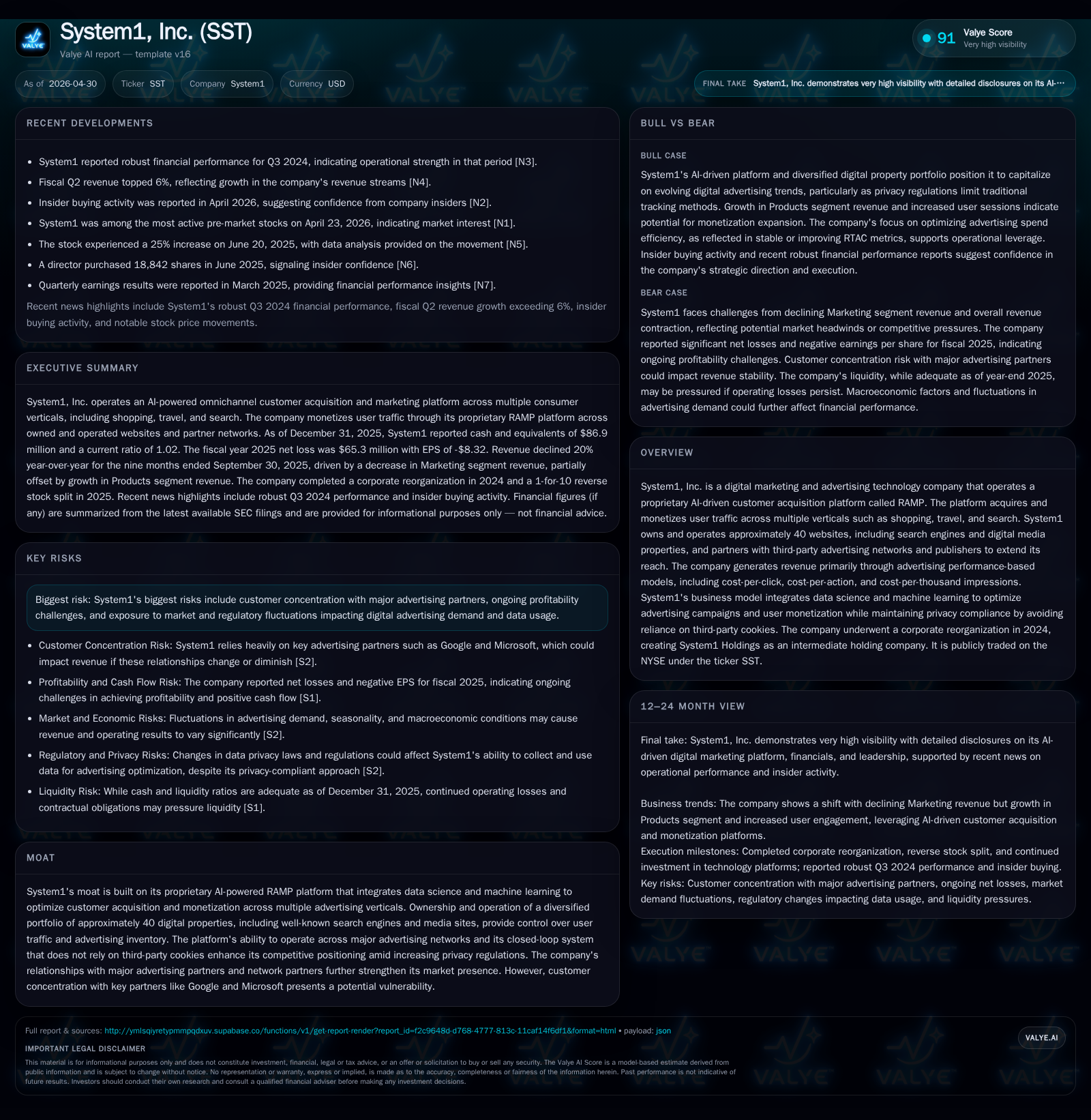
System1, Inc. operates a proprietary AI-powered customer acquisition platform, RAMP, which monetizes user traffic across owned websites and third-party partners in multiple verticals like shopping, travel, and search. The latest quarterly and annual SEC filings reveal a decline in overall revenue driven by a weakening advertising market, despite growth in its products segment fueled by increased site traffic. The company’s operating loss narrowed due to cost discipline and decreased interest expense after debt repayments. However, reliance on major advertising partners Google and Microsoft poses concentration risks. System1's financial position shows a high net debt load balanced by reasonable liquidity and ongoing investment in technology enhancements. Going forward, the company’s ability to diversify advertising partners, optimize RAMP’s efficiency without third-party cookies, and leverage owned digital properties will determine its path to sustainable growth.
Recent Operating Update: Q3 2025 Highlights
System1's latest quarterly filing on November 5, 2025 [S2] reveals significant shifts in the company’s revenue composition during broader advertising market softness. Total revenue for Q3 dropped by 31% year-over-year to $61.6 million with the Marketing segment experiencing a sharper contraction of 43%, reflecting reduced traffic acquisition costs (TAC) falling from $110.8 million to $84.0 million during the quarter. This decrease is partially offset by slight improvements in return on traffic acquisition cost (RTAC), rising modestly from 118% to 120%, indicating incremental efficiency gains in monetizing acquired traffic.
Conversely, the Products segment grew revenue by 8% driven primarily by a large increase in Products sessions — up about 111 million visits or roughly 24% — while maintaining stable revenue per session at $0.04 [S16], evidencing strong end-user engagement across owned internet properties like CouponFollow, MapQuest, and Startpage.
Cost of revenue decreased significantly due to lower advertising spend correlating with revenue declines; amortization expense related to owned technology platforms increased moderately reflecting ongoing investments [S16]. Operating loss narrowed to $15.6 million (-25% margin) from $21.8 million last year’s Q3 as System1 tightened general & administrative expenses alongside reducing interest expense following partial term loan repayments [S2].
Business Model: AI-Driven User Acquisition and Monetization
System1 makes money through digital marketing focused on customer acquisition powered by its proprietary platform called RAMP (Responsive Acquisition Marketing Platform). This AI-driven system optimizes user traffic acquisition and monetization through data science models that match consumer intent signals with appropriate advertisers on a performance basis—primarily cost-per-click (CPC), cost-per-action (CPA), or cost-per-thousand impressions (CPM).
The model relies on delivering high-intent users either directly through owned-and-operated websites or indirectly via network partners who send traffic to System1’s inventory for monetization [S14], [S21]. Ownership of approximately 40 websites (search engines, content media sites, utilities) allows System1 control over end-user experiences and advertising inventory supply enabling them to capture greater value compared with pure ad tech intermediaries.
RAMP integrates multi-channel campaigns spanning major platforms such as Google Ads, Meta/Facebook Ads, Outbrain native ads, TikTok advertising—covering roughly 40 vertical categories including shopping and travel—with continuous algorithmic optimization drive [S14]. Importantly, System1 has built its closed-loop system explicitly avoiding third-party cookies relying instead on first-party data signals from device types and organic search queries—addressing growing privacy regulation challenges.
Revenues are split into two reportable segments:
- Marketing: Direct user acquisition campaigns where System1 acts as principal owning the ad inventory risk.
- Products: Monetization of user visits across System1’s owned digital properties often via revenue-share arrangements where System1 acts as an agent.
Industry Structure and Competitive Position
System1 operates at the intersection of digital advertising technology and online consumer media—a highly competitive space dominated by large players like Google, Meta, Amazon Advertising alongside programmatic DSPs and native ad providers.
What differentiates System1 is its integrated AI platform overseeing both traffic acquisition costs and monetization; plus ownership/control over diversified proprietary web properties gives the company more direct access to consumer intent data than many intermediaries relying solely on third-party publisher inventory.
However, customer concentration risk remains material as Google and Microsoft constitute major advertising partners providing significant ad spend volume that underpins platform revenues [S2], making System1 vulnerable to shifts in these relationships or platform policies affecting advertiser demand.
The company's non-reliance on third-party cookies positions it favorably within an industry increasingly constrained by privacy laws such as GDPR/CCPA which have reduced efficacy of traditional behavioral targeting.
Growth Drivers
Several growth drivers underpin System1's future prospects:
- Expansion of Advertising Partner Network: Increasing integration of additional advertisers onto RAMP beyond dominant players could reduce concentration risk while boosting user acquisition volume.
- Product Diversification: Growth in Products segment through scaling web properties visits (products sessions increased +24% YoY Q3) without sacrificing monetization efficiency indicates strong market acceptance.
- AI & Data Science Enhancements: Continued investments in machine learning algorithms improve campaign bid optimization yielding higher RTAC trends even during lower spend environments.
- Privacy-Compliant Targeting: Leveraging first-party data helps maintain targeting effectiveness as cookie deprecation drives industry-wide disruption.
- Operational Efficiency: Cost controls evidenced by declining SG&A enable better leverage of fixed technology investments translating into improved margins when revenues stabilize.
Risks / Watchpoints / Growth Constraints
Despite promising technology and asset base advantages, several risks loom:
- Customer Concentration: Heavy reliance on top two partners for major advertising spend exposes earnings volatility if these relationships deteriorate.
- Market Cyclicality: Digital advertising budgets remain sensitive to macroeconomic conditions; slowdowns directly compress revenue opportunities given mostly variable-cost sales models.
- Profitability Challenges: Persistent operating losses indicate ongoing scaling costs or pricing pressure which necessitates profitable volume growth or structural cost improvements.
- High Leverage: Net debt stood near $173 million against cash of $86.9 million as of end-2025 [F1], creating financial flexibility constraints especially if earnings recover slowly or adverse credit conditions emerge.
- Regulatory Exposure: Changes in data privacy laws or restrictions that limit use of certain targeting signals could undermine RAMP’s efficacy despite current compliance stance.
- Limited Hedging: Absence of hedging against foreign exchange risk leaves international operations exposed though currently limited outside the US [S14].
What to Watch Next
Key milestones for investors following System1's progress include:
- Quarterly updates on Marketing segment recovery signaling ad spend normalization versus persistent declines seen through Q3/2025 [S2].
- Expansion announcements regarding new advertising partnerships integrated within RAMP indicating diversification away from Google/Microsoft dependency.
- Traffic growth trends on flagship owned/operated Sites especially within Products segment alongside potential increases in products revenue per session metrics.
- Debt reduction initiatives or refinancing moves that might improve capital structure flexibility amid current net leverage levels [F1].
- Management commentary addressing regulatory changes impacting targeting capabilities or shifts in competitive dynamics among endemic digital ad networks.
Financial Profile Summary
Latest financial snapshot
As of December 31, 2025 [F1], System1 reported: The balance sheet reflects meaningful debt load relative to cash but manageable current liabilities aligning closely with liquid assets providing short-term operational funding sufficiency [S6], [F1]. Interest expense reduced sequentially thanks to prior term loan repayments improving net income pressures somewhat though losses remain substantial given scale investments in technology & market development [S2].
Disclaimer: This report is for informational purposes only and does not constitute investment advice or recommendations. Readers should conduct their own due diligence before making any investment decisions regarding System1, Inc. The analysis herein strictly relies upon publicly available filings and disclosures provided up to April 30th, 2026.
Disclaimer: This is research-only, informational analysis and not investment advice. It may include AI-generated interpretation and general industry context. Always verify important details using primary sources.

Comments