
Boston Omaha Corp Advances Diversification with Asset Management Acquisition Amid Profitability Challenges
Recent filings highlight Boston Omaha's strategic expansion through acquisitions while navigating ongoing operating losses and governance complexities.
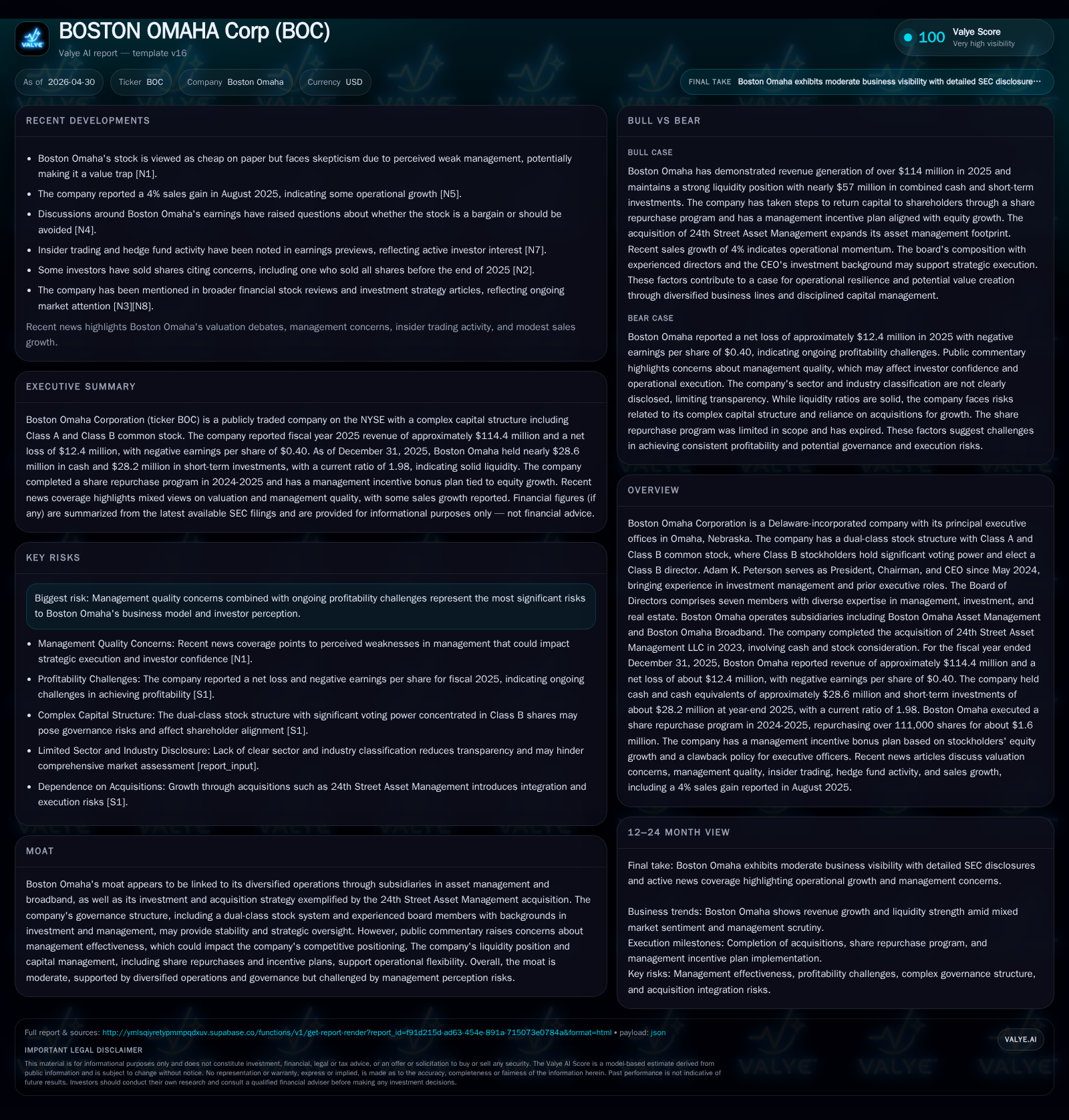
Boston Omaha Corporation extended its business model through a significant acquisition of 24th Street Asset Management, underscoring a diversification strategy centered on asset management and broadband subsidiaries. Despite revenue exceeding $114 million in 2025, the company reported a net loss driven by operational inefficiencies and integration costs. The dual-class stock structure and seasoned management team provide governance stability but raise concerns about potential management execution risks. Growth hinges on leveraging acquired assets and optimizing subsidiary performance amidst a competitive industry with moderate moat advantages.
Recent Operating Update
The latest quarterly filing from November 2025 provides the most immediate insight into Boston Omaha's operating status [S2]. The company maintains stable liquidity, holding approximately $28.6 million cash equivalents as of year-end 2025 [F1], alongside current assets of about $119 million against $60 million in current liabilities. This translates to a healthy current ratio of nearly 2.0, signaling sound short-term financial health [F1]. However, profitability challenges persist; the company recorded an operating loss exceeding $3.9 million and a net loss over $12 million for fiscal 2025 [F1]. These results suggest operational drag from either integration costs or underperformance within subsidiaries.
In an event filing dated March 2026 [S3], Boston Omaha issued a press release reporting full-year financial results consistent with the annual figures filed in April 2026 [S1], reaffirming the strategic emphasis on diversification through acquisitions.
Business Model
Boston Omaha operates as a holding entity engaged primarily through its subsidiaries Boston Omaha Asset Management (BOAM) and Boston Omaha Broadband. BOAM's business centers around managing alternative investment funds, including the recently acquired subsidiary 24th Street Asset Management LLC (acquired May 2023) [S4]. This acquisition broadens the company's exposure to asset management fees derived from gross profits interests and carried interest streams tied to fund performance.
The broadband segment focuses on providing internet services primarily in underserved rural markets, aiming to leverage technology deployment for growth opportunities. Revenue mechanics stem from recurring service fees paid by customers subscribing to broadband services coupled with asset management fees and incentive compensation linked to investment returns.
Revenue is influenced by volume (number of broadband subscribers), pricing strategies, contract structures within asset management (e.g., carried interest terms), and mix given the differential margin profiles between operating segments. Capital-intensive investments in broadband infrastructure may pressure near-term margins but are critical for long-term market positioning.
BOC's governance is distinctive due to its dual-class structure: Class B common stockholders control substantial voting rights at ten votes per share compared with one vote for Class A shares [S9]. This governance design consolidates decision-making power predominantly under the Class B holder, Magnolia Capital Fund LP managed by CEO Adam K. Peterson [S16]. Such structure offers strategic continuity but potentially constrains minority shareholder influence.
Industry Structure and Competitive Position
Boston Omaha straddles two distinct arenas — alternative asset management and rural broadband service — each with unique industry dynamics.
Within asset management, competition is intense among private equity and alternative fund managers vying for investor capital and delivering differentiated strategies that generate carried interest. The acquisition of 24th Street Asset Management signals an intent to deepen expertise and scale in this segment. However, scale benefits are tempered by concentrated fund concentrations and reliance on successful deployment of capital for favorable carries.
In broadband, structural demand is driven by persistent under-penetration in rural America where incumbent providers have left gaps. Boston Omaha’s niche lies in leveraging localized infrastructure investments supported by federal subsidies or public-private partnerships to capture these high-growth addressable markets. Competition includes both regional providers and national telcos expanding rural footprints. Success depends on network reach, service quality, pricing power amid limited alternatives, and regulatory compliance.
The company’s partial moat arises from this multi-industry diversification combined with experienced leadership overseeing cross-sector synergies. However, governance concentration and skepticism about management effectiveness dilute this advantage.
Growth Drivers
Several vectors could support Boston Omaha’s scaling trajectory:
- Acquisition Integration: The addition of 24th Street Asset Management broadens recurring fee base and associated profit streams; successful fund performance translating into carry distributions is key.
- Broadband Market Expansion: Increasing broadband penetration in geographically underserved regions can drive subscriber growth; leveraging government funding programs further aids scalability.
- Cross-Selling Opportunities: Potential exists for integrated offerings linking asset portfolio growth with broadband infrastructure financing or service models.
- Operational Efficiency Improvements: Streamlining subsidiary operations might help reduce the persistent operating losses reported.
- Capital Allocation Policies: Judicious share repurchase programs (recently completed) indicate focus on disciplined capital deployment aligned with shareholder value creation.
These growth avenues depend critically on effective execution amid competitive pressures and macroeconomic factors affecting capital markets activities.
Risks / Watchpoints / Constraints
- Management Quality Perceptions: Public commentary acknowledges risks attached to leadership effectiveness; decision-making concentrated under dual-class governance heightens scrutiny.
- Profitability Challenges: Sustained net losses raise concerns about scalability without dilutive financing or cost overruns.
- Industry Cyclicality: Asset management revenues linked to market cycles; downturns could reduce fee income adversely impacting earnings stability.
- Regulatory Environment: Broadband deployment subject to evolving federal/state rules; changes could impact subsidy availability or capital expenditure requirements.
- Integration Risk: Acquisitions pose integration hurdles potentially delaying expected synergies or causing diversion of resources.
- Liquidity Constraints: Although current ratios appear robust, the absence of disclosed recent debt refinancings calls for monitoring working capital sufficiency under stressed scenarios.
What to Watch Next
Key follow-up points include:
- Quarterly updates indicating movement toward profitability or margin stabilization within broadband operations or asset fees.
- Fund performance reports regarding carried interest realization affecting BOAM profitability.
- Announcements concerning new acquisitions or divestitures reflecting strategy refinement.
- Regulatory developments shaping broadband expansion economics or subsidy eligibility.
- Changes in senior management or board composition impacting governance dynamics.
- Capital market activities such as follow-on equity issuance or share buybacks beyond prior program expirations.
Financial Profile Summary
Latest financial snapshot
| Metric | Value | Period |
|---|---|---|
| Cash & equivalents | $29mm | |
| 2025-12-31 | ||
| Current assets | $119mm | |
| 2025-12-31 | ||
| Current liabilities | $60mm | |
| 2025-12-31 | ||
| Current ratio | 1.98x | |
| 2025-12-31 |
Source: SEC companyfacts cache [F1].
| Metric | Value (USD) | Period End |
|---|---|---|
| Revenue | $114,376,348 | |
| 2025-12-31 | ||
| Operating Income | -$3,928,147 | |
| 2025-12-31 | ||
| Net Income | -$12,427,540 | |
| 2025-12-31 | ||
| Cash & Equiv. | $28,624,064 | |
| 2025-12-31 | ||
| Current Assets | $118,935,064 | |
| 2025-12-31 | ||
| Current Liabilities | $60,173,164 | |
| 2025-12-31 | ||
| Current Ratio | 1.98 | Derived |
| Total Debt | ~$190,000 | Approximate* |
| Net Debt | Negative | Approximate* |
*Total debt data is best-effort from older point due to lack of current explicit disclosure [F1].
Despite solid liquidity positioning reflected by cash reserves exceeding debt balances substantially [F1], the negative net income underscores imperative focus on operational efficiency improvements going forward.
DISCLAIMER: This analysis is for informational purposes only and does not constitute investment advice or recommendations regarding the securities discussed herein.
Disclaimer: This is research-only, informational analysis and not investment advice. It may include AI-generated interpretation and general industry context. Always verify important details using primary sources.

Comments