
Old Republic International Advances Specialty and Title Insurance in Q1 2026 Amid Market Nuances
Old Republic International’s latest quarterly results show steady growth in specialty insurance premiums alongside a stable title insurance segment amid evolving investment conditions.
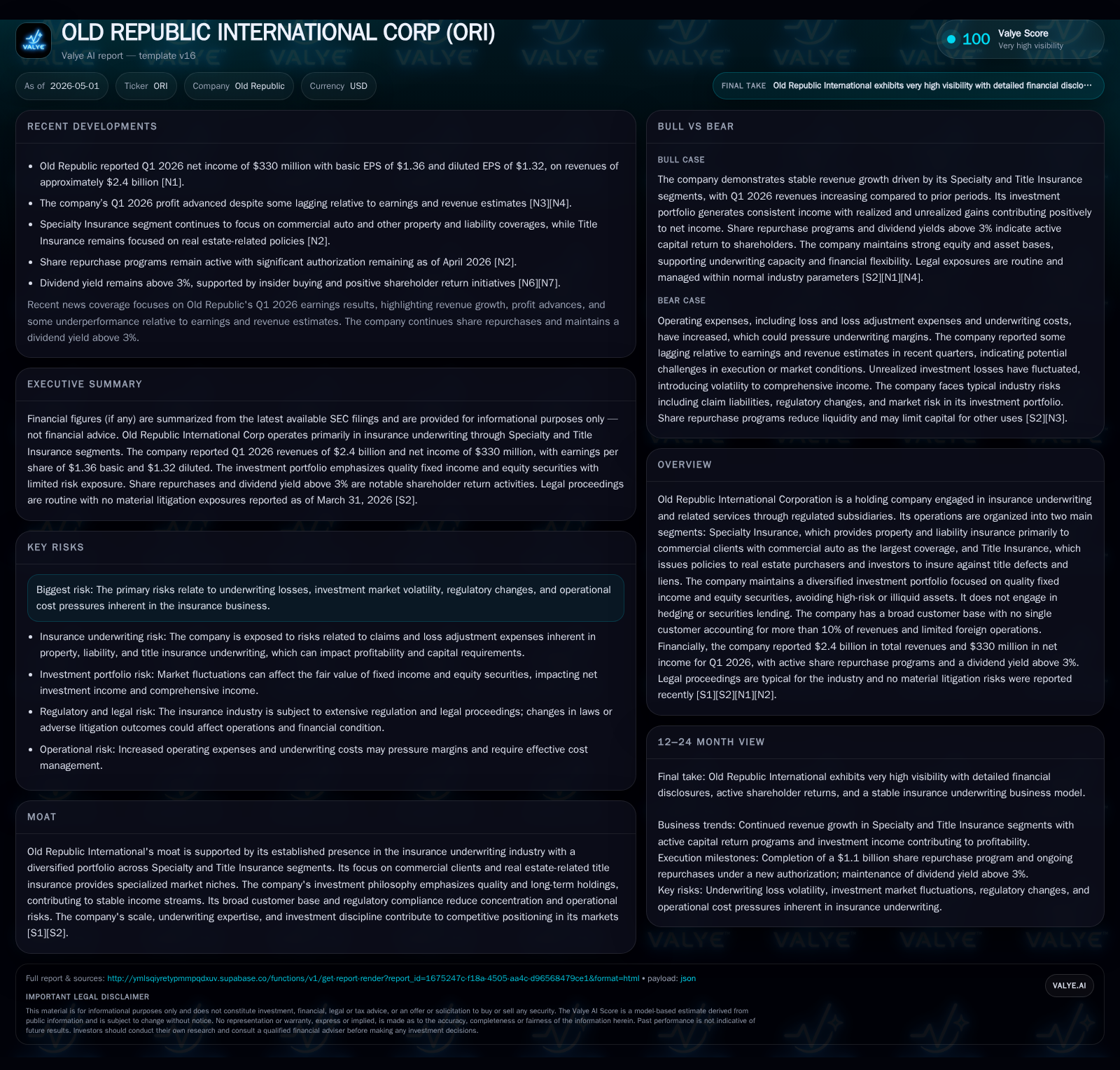
In Q1 2026, Old Republic International Corporation sustained growth momentum in its Specialty Insurance segment with net earned premiums reaching $1.29 billion, while its Title Insurance segment continued to provide reliable revenue streams. The company maintains a disciplined underwriting approach supported by a diversified commercial client base and a conservative investment portfolio weighted heavily toward quality fixed income securities. Competitive positioning benefits from regulatory compliance and scale within niche insurance markets, although risks from underwriting losses and investment market volatility persist. Going forward, key watchpoints include underwriting loss trends, regulatory developments, and the impact of capital deployment strategies.
Latest Quarterly Highlights: What Changed in Q1 2026
Old Republic International Corporation’s 10-Q filing dated May 1, 2026 reveals a continuation of steady performance across its two main operating segments: Specialty Insurance and Title Insurance. The Specialty Insurance segment’s net earned premiums rose to $1.29 billion for the quarter ended March 31, 2026, up from $1.23 billion in the comparable period prior year, underscoring resilient demand primarily driven by commercial auto insurance — its largest coverage line [S2]. Title Insurance maintained consistent premium generation reflecting ongoing real estate transaction activity.
Investment portfolio allocations reported were notably stable with about 85% invested in fixed income securities, comprising government/agency bonds and corporate debt instruments. Though the company disclosed some unrealized losses totaling approximately $71.8 million on fixed income securities as of March 31, 2026, these represent market fluctuations rather than realized impairments given their Level 2 fair value classification emphasizing quality holdings [S2].
Management commentary stresses continued discipline around underwriting profitability measured via the combined ratio metric. This includes periodic evaluation of loss experience to guide capital deployment between growth initiatives and underwriting margin preservation [S27].
Old Republic’s Business Model and Product Quality Overview
Old Republic's business model centers around its Specialty Insurance and Title Insurance segments operated through regulated insurance subsidiaries primarily serving U.S. commercial clients with limited foreign exposure [S1][S20]. Specialty Insurance delivers property and liability coverages with commercial auto accounting for roughly 42% of segment premiums as of late 2025; other offerings include workers' compensation, general liability, fidelity bonds, and surety indemnities. This mix provides diversification across risk types while targeting specialized coverage niches that benefit from underwriting expertise.
The Title Insurance segment issues policies that protect real estate purchasers and investors against defects or liens uncovered during searches of public land records — a critical risk mitigation service integral to property transactions [S1]. Revenue arises from fees charged during closings, naturally tied to home sales or refinancing activity but buffered by geographic spread.
Complementing underwriting activities is Old Republic’s investment philosophy favoring conservatism: maintaining investments predominantly in investment-grade bonds and established equity securities chosen for dividend stability rather than speculative gains. The avoidance of illiquid assets like private equity or hedge fund exposures reduces balance-sheet volatility linked to financial market turmoil [S2].
Customer concentration is low; no single client accounts for over 10% of revenue, limiting dependency risks. Policyholders benefit implicitly from dedicated regulatory oversight at state insurance departments that impose prudent capital requirements and operational standards enhancing stability [S20].
Competitive Setting Within Specialty and Title Insurance Segments
Old Republic operates within regulated insurance industries where barriers to entry are significant due to licensing requirements, capital mandates, and stringent compliance obligations enforced by states. This fosters a competitive environment favoring established players with scale efficiency and experienced underwriting teams.
The company leverages decades of underwriting expertise allowing calibrated risk selection especially in commercial sectors where pricing power depends on nuanced risk assessment rather than volume alone. Scale supports sustained capacity to write sizeable policy volumes avoiding concentrated risks.
In the Title Insurance business line—a domain with fewer direct competitors due to complex regulatory licensing—Old Republic benefits from entrenched relationships with real estate brokers, lenders, and closing agents forming distribution channels that are difficult for new entrants to replicate quickly [S1][S20].
Regulatory environments impose both constraints and protective moats; while they limit product innovation flexibility (e.g., rate filings must be approved), they also prevent predatory pricing or unvetted risk taking common among less-regulated financial services sectors.
Growth Drivers: Expansion Pathways and Market Dynamics
Several growth vectors underpin Old Republic’s outlook:
- Specialty Commercial Lines Penetration: Continued buildup of specialty portfolios such as commercial auto responds positively to improving economic activity levels supporting increased business vehicle use after pandemic disruptions [N4]. Acquisitions further augment footprint; notably pending Everett Cash Mutual acquisition widens specialty insurance capabilities once regulatory approvals complete [S1][N4].
- Real Estate Market Activity: The title insurance business tracks housing turnover rates plus expanding investor participation in residential plus select commercial real estate financing — sustaining moderate premium growth aligned with national home sales data trends despite macroeconomic uncertainties [N6].
- Operational Efficiencies Through Technology: Investment in digital platforms streamlines underwriting workflows and title searches enabling faster policy issuance reducing operational costs while enhancing customer experience.
- Stable Investment Income Streams: Conservative portfolio allocation offers predictable interest income flows supporting earnings stability even amid equity market fluctuations.
These drivers exhibit structural characteristics rather than cyclicality alone: commercial insurance demand is tethered to broader economic expansions influencing fleet renewals and liabilities whereas title insurance remains closely linked but not entirely correlated strictly with short-term housing cycles.
Risks and Constraints: Underwriting, Investments, and Regulation
Key risk factors reflect typical insurance industry dynamics compounded by current market factors:
- Underwriting Loss Volatility: Catastrophic events or spikes in claims frequency can degrade combined ratios suddenly impacting earnings visibility especially since margin incentives drive management focus on underwriting discipline [S27].
- Investment Valuation Pressures: Reported unrealized losses on fixed income portfolios reveal sensitivity to interest rate fluctuations; sustained elevated rates could pressure portfolio valuations further although holdings emphasize quality credits minimizing default risk indications [S2].
- Regulatory Compliance Costs: State-specific regulatory changes affecting reserve requirements or premium rate approvals may constrain pricing flexibility or increase cost burdens limiting profit margins.
- Market Competition: New market entrants or aggressive pricing strategies by peers could pressure premium growth or profit margins despite inherent barriers.
These factors require vigilant monitoring given they can influence capital deployment decisions—balancing growth investments versus reserve holding adjustments.
Forward-Looking Watchpoints: Guidance and Milestones
Upcoming indicators for scrutiny include:
- Combined Ratio Trajectories: Closer observation of quarterly shifts will reveal whether underwriting improvements are sustainable amidst evolving conditions particularly for commercial auto coverage lines.
- Claims Development Patterns: Frequency/severity trends offer early signals on loss reserves adequacy impacting near-term earnings adjustments.
- Acquisition Approvals: Regulatory clearance for Everett Cash Mutual deal is pivotal for segment expansion ambitions announced in recent quarters.
- Regulatory Environment Evolution: Changes at major operating states concerning premium ratemaking or capital rules must be tracked closely.
- Capital Return Programs: Execution pace of share repurchases under current $750 million board authorization reflects confidence in underlying cash flow stability supporting shareholder value initiatives [S16][N5].
Management disclosures paired with quarterly earnings releases will provide updated forward guidance shaping market expectations.
Financial Summary: Context from Latest Quarterly Results
Balance sheet strength is supported by conservative leverage with total debt modest relative to asset base per trailing data points [F1], supplemented by ample liquidity fostering strategic optionality amidst potential market volatilities.
This analysis synthesizes publicly filed SEC disclosures through early May 2026 alongside market reporting reflecting Old Republic International Corporation's strategic execution status without offering any investment recommendation or opinion.
Disclaimer: This is research-only, informational analysis and not investment advice. It may include AI-generated interpretation and general industry context. Always verify important details using primary sources.

Comments