
Northrim BanCorp Expands Specialty Finance After Sallyport Acquisition in Q1 2026
Northrim BanCorp's Q1 2026 results highlight operational momentum from its expanding specialty finance segment and stable regional banking franchise.
In the first quarter of 2026, Northrim BanCorp reported a modest increase in net income driven by higher net interest income and mortgage banking revenue, alongside continued growth in its Specialty Finance segment following the 2024 acquisition of Sallyport Commercial Finance. The company benefits from a strong deposit base as the third largest commercial bank in Alaska, leveraging local decision-making and a diversified product suite across three segments: Community Banking, Home Mortgage Lending, and Specialty Finance. While geographic concentration in Alaska’s real estate market presents credit risk, expansion into factoring and asset-based lending through Sallyport offers revenue diversification and geographic reach beyond Alaska. Going forward, sustaining deposit growth, managing credit quality amid local economic fluctuations, and integrating Specialty Finance operations will be key execution factors.
Q1 2026 Operating Results and Strategic Developments
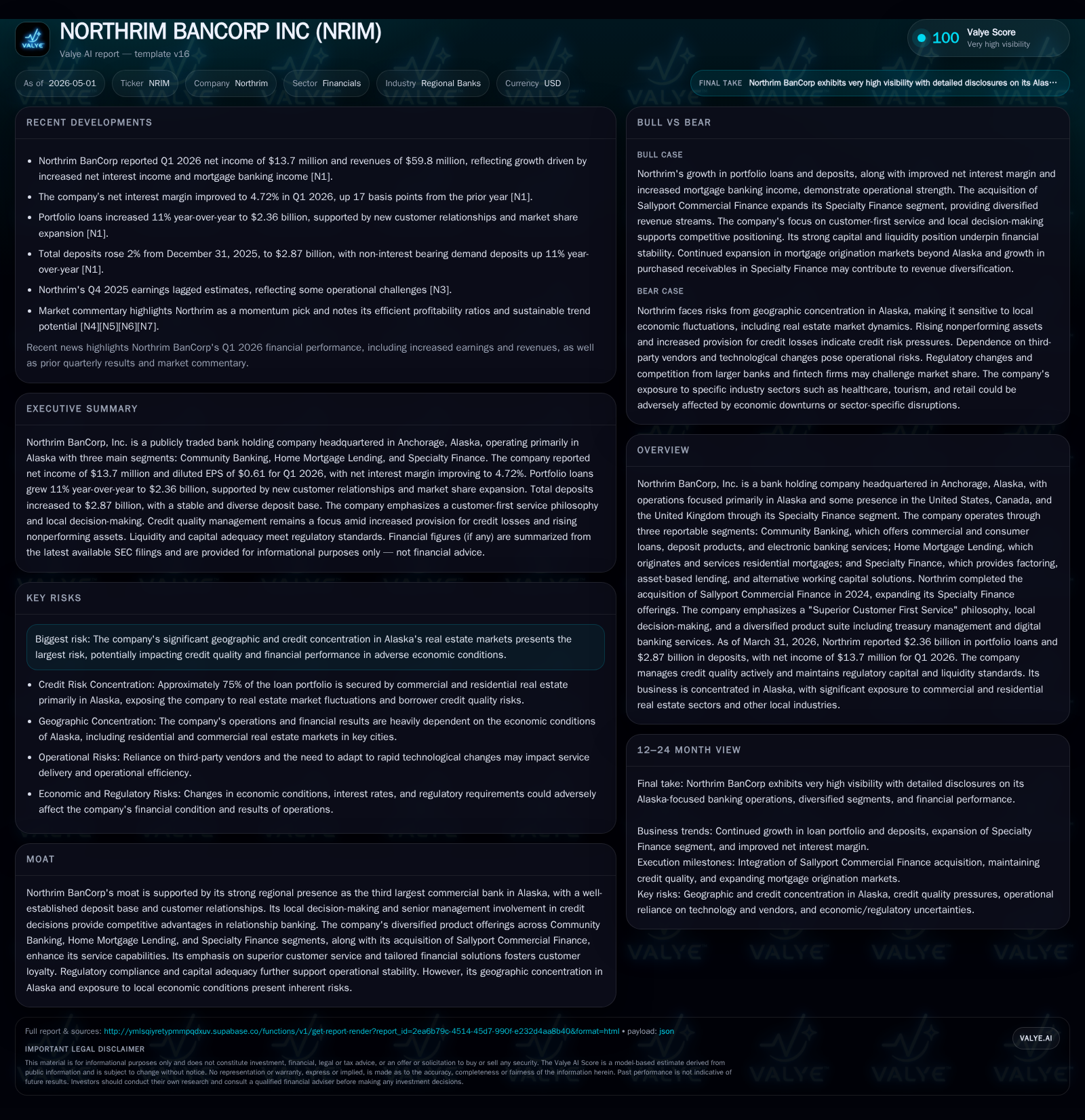
Northrim BanCorp’s first quarter filing (10-Q dated May 1, 2026) reveals sustained operating momentum marked by an increase in net income to $13.7 million ($0.61 EPS) compared to $13.3 million ($0.60 EPS) for Q1 2025 [S2][N1][N2]. This improvement was largely driven by a 17-basis point rise in net interest margin to 4.72%, reflecting expanding loan yields and controlled funding costs [S13]. Mortgage banking income also contributed positively alongside Specialty Finance growth.
Portfolio loans grew by approximately 11% year-over-year to $2.36 billion at quarter-end, fueled by new client wins and retention of internally originated mortgages [S13]. Deposits remained robust at $2.87 billion, up modestly sequentially, with an encouraging increase in non-interest bearing demand deposits to $826 million (29% of total deposits), underscoring a stable core funding base that supports liquidity resilience [S13][S27].
The Specialty Finance segment benefited directly from the October 2024 acquisition of Sallyport Commercial Finance, with average purchased receivables increasing appreciably versus prior-year levels ($132.2 million vs. $97.1 million) [S13][S15]. This segment expansion diversifies Northrim’s revenue outside its Alaskan footprint.
Operationally, Northrim also flagged higher provisions for credit losses consistent with some nascent deterioration within nonperforming assets—a trend consistent with rising real estate sector risk concentrations locally—as well as increased operating expenses tied partially to segment growth initiatives [S13].
Business Model and Segment Overview
Northrim BanCorp operates as a bank holding company headquartered in Anchorage with three reportable segments:
Community Banking: This includes traditional commercial and consumer lending products alongside deposit services across its network of 20 Alaskan branches. Revenue derives mainly from net interest income on loans funded by customer deposits plus fee-based treasury management services.
Home Mortgage Lending: Residential mortgage origination and servicing accounts for this unit’s core activity. Most loans are sold to secondary markets stabilizing capital deployment; some mortgages are held on portfolio enhancing earning assets.
Specialty Finance: Focused on factoring, asset-based lending, and alternative working capital products targeting SME clients across the US, Canada, and UK markets via the Sallyport acquisition completed in late 2024 [S1][S2].
Northrim highlights a "Superior Customer First Service" philosophy coupled with local decision-making authority allowing granular credit evaluations tailored geographically to Alaskan client needs—this creates switching costs that support customer retention [S1]. Digital offerings complement these traditional services enabling scalable electronic transaction capabilities.
Revenue mechanics primarily revolve around:
- Interest income on funded loans varying by volume and yield environment,
- Fee income from mortgage sales servicing and specialty finance receivable management,
- Depository funds generating low-cost liabilities that support leverage benefits,
- Mix shift potential through Specialty Finance contributing higher-yielding asset returns.
Margins benefit from sustained net interest spread improvements driven by rising loan yields outpacing deposit cost inflation according to recent quarter disclosures [S13].
Competitive Position within Alaska’s Banking Market
Northrim ranks as the third largest commercial bank in Alaska by deposit size with $2.8 billion as of end-2025 [S1]. This positions it as a prominent regional player competing against larger national banks with less localized presence.
The company leverages its entrenched community banking footprint combined with elevated senior management involvement in daily credit decisions creating a competitive moat via relationship banking advantages rarely matched by larger out-of-state institutions [S1]. High engagement enables rapid underwriting tailored to local market dynamics, essential for winning commercial accounts where personalized service is critical.
However, this strength creates geographic concentration risk; Alaskan economic volatility tied to resource-driven industries leaves loan portfolios especially susceptible to cyclical stress [S14]. Regulatory capital levels are comfortably above “well-capitalized” thresholds providing stability but also limit excessive risk-taking within local markets [S25]. Pricing power remains moderate given competitive pressures yet tempered somewhat by customer loyalty fostered through tailored solutions.
Specialty Finance Growth Catalyst: The Sallyport Commercial Finance Acquisition
The October 31, 2024 acquisition of Sallyport Commercial Finance introduced diversified specialty finance capabilities previously absent at Northrim [S1]. Sallyport delivers factoring services, asset-based lending solutions, and alternative working capital lines primarily targeting small- and medium-sized enterprises nationwide with international exposure via affiliates operating in Canada and the United Kingdom.
This move extends Northrim’s addressable market well beyond geographically concentrated Alaskan banking operations while adding high-yielding receivable financing assets that bolster overall return profiles [S15][S2]. Average balances at Sallyport increased notably since acquisition proving successful integration thus far.
Geographic expansion into cross-border markets helps mitigate inherent concentration risks endemic within Northrim’s Alaskan franchise while posing operational integration challenges typical of specialty lending verticals requiring specialized underwriting frameworks distinct from traditional bank loan portfolios.
Growth Drivers and Market Opportunities
Key levers supporting Northrim’s growth narrative include:
- Continued penetration in Alaska’s commercial banking scene supported by deep local knowledge facilitating organic loan book expansion,
- Mortgages generated via Residential Mortgage LLC channel supporting fee income through secondary market sales alongside select portfolio retention strategies,
- Rapid scaling opportunities within newly acquired Specialty Finance operations fueled by scalable alternative working capital products addressing underserviced SME segments,
- Enhancements within digital platforms improving customer experience thereby aiding retention rates; expanding treasury management uptake increases wallet share extracting greater value per customer [S2][S3].
Measured KPIs affirm these drivers: loan portfolio up ~11%, specialty finance balances rising strongly year-on-year offsetting flat-to-modest community segment loan trends; deposits remain elevated particularly non-interest bearing components signaling sticky relationships amid modest rate normalization effects on cost structure [S13][N1].
Macroeconomic tailwinds such as steady Alaska personal income growth (+4.4% annually) alongside moderate GSP expansion (~3.8% annualized YTD Q3 ’25) underpin local demand fundamentals albeit mild unemployment headwinds exist at ~4.8% seasonally adjusted versus US average lower at ~4.4% hinting caution over hiring dynamics [S2].
Key Risks and Operational Challenges
Northrim’s most pronounced risk pertains to concentrated exposure within Alaska's real estate markets where downturns could erode credit quality materially given significant weightings in commercial property lending [S14][S26]. Rising nonperforming loans (+25% QoQ increase reported) along with upticks in OREO assets raise potential provisioning needs that may limit near-term earnings upside [S13].
Additionally regulatory restrictions around dividend payments emanating primarily from the bank subsidiary constrain cash flow upstream limiting flexibility at holding company level particularly amid capital adequacy requirements designed to sustain “well-capitalized” status under FDIC/State rules [S11][S28]. Integrating heterogeneous specialty finance businesses across multiple jurisdictions adds complexity potentially diluting managerial focus or operational efficiencies if not carefully navigated [S14].
Near-Term Catalysts and Monitoring Points
Critical upcoming metrics warrant close observation:
- Quarterly deposit inflow trends post-inflation adjustments relevant given CPI increases are modest domestically—particular attention to non-interest bearing demand accounts provides early indicator of core funding stability [S27],
- Credit quality evolution especially nonperforming assets trajectory across all portfolios including Specialty Finance newly acquired units,
- Execution progress around cross-segment product rollouts leveraging Sallyport infrastructure enabling new working capital solutions,
- Regulatory filings highlighting shifts in capital buffers or dividend payment capacity which may foreshadow liquidity or balance sheet strategy tweaks.
These provide measurable checkpoints aligned closely with management’s articulated strategic priorities reflected in the recent quarterly disclosures that prioritize prudent growth balanced against maintaining regulatory compliance.
Financial Profile Overview
As of March 31, 2026, Northrim’s total debt stood at approximately $81.7 million, with net debt slightly negative at about -$10.5 million, reflecting cash and equivalents of roughly $92.2 million, indicating a strong liquidity position relative to debt obligations [F1]. The company’s capital adequacy ratios remain comfortably above regulatory well-capitalized thresholds supported in part by subordinated notes qualifying as Tier 2 capital [F1][S4].
Available liquidity is further supported by cash equivalents and access to credit facilities, providing flexibility to manage funding needs and potential deposit fluctuations [S27].
Discclaimer: This analysis is based exclusively on publicly filed SEC disclosures up to May 2026 supplemented by reputable news sources referenced herein. It does not constitute investment advice or recommendation but aims solely to present an informed perspective on Northrim BanCorp Inc.’s current business trajectory.
Disclaimer: This is research-only, informational analysis and not investment advice. It may include AI-generated interpretation and general industry context. Always verify important details using primary sources.

Comments