
Dawson Geophysical’s Niche Position Tested by Market Cyclicality and Operational Challenges
Recent equipment acquisitions, capital financing, and ongoing operating losses define Dawson Geophysical's current operational landscape amid oilfield services market headwinds.
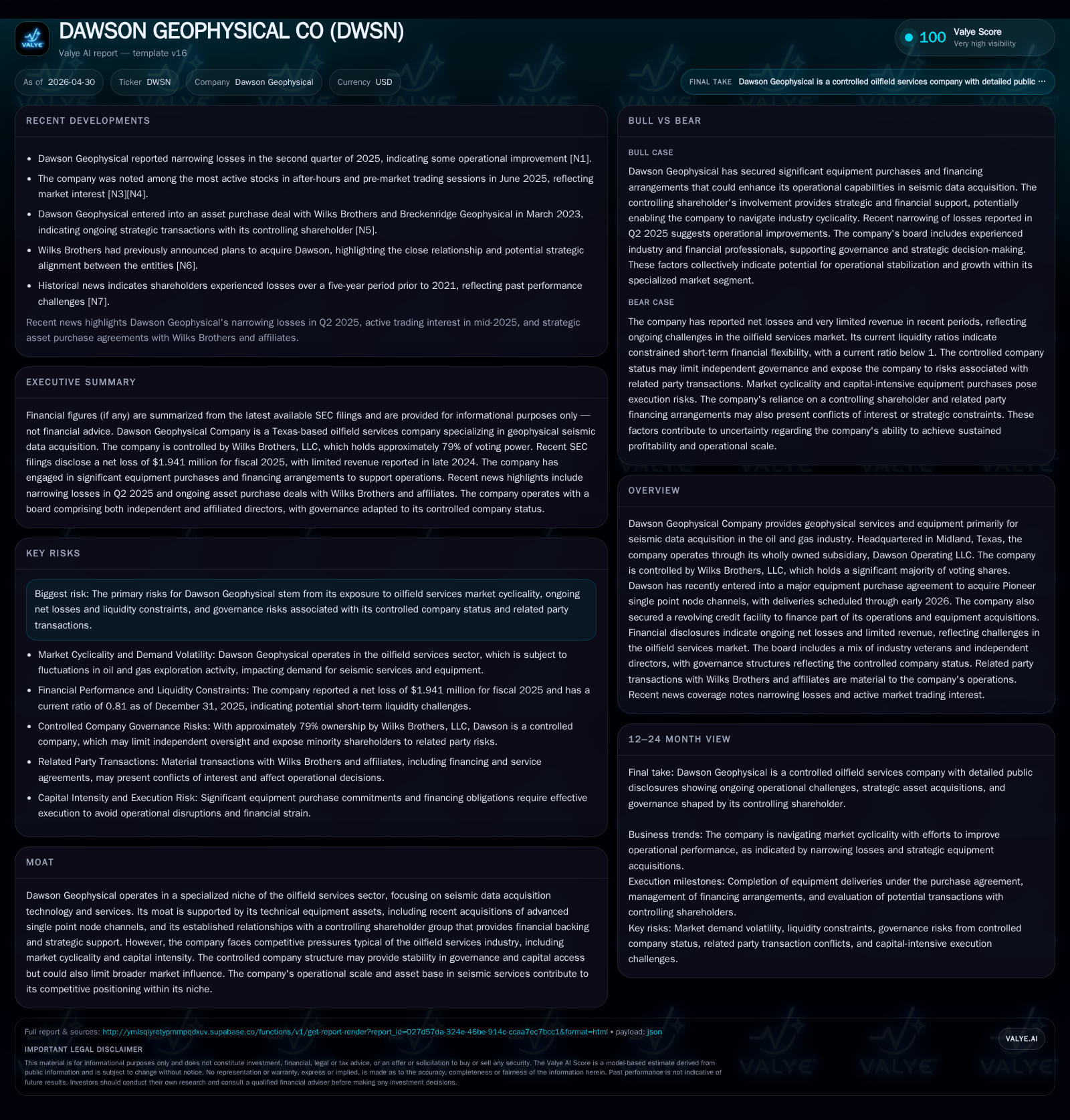
Dawson Geophysical Company’s latest quarterly filing reveals continued investment in advanced seismic acquisition technology financed through debt, highlighting the company's strategic focus on Pioneer single point node channels. Despite these capital moves, the firm faces liquidity tightness with a sub-1 current ratio and ongoing net losses, underscoring persistent challenges in the cyclic oilfield services segment. Controlled governance by Wilks Brothers offers financial backing but limits broader shareholder influence. Key growth depends on successful deployment of new equipment and improvements in oil & gas exploration spending.
Latest Operating Update: Insights from the Q3 2025 Disclosure
Dawson Geophysical's most recent quarterly filing dated November 13, 2025 [S2] anchors the near-term operational picture reflecting a company actively investing in its asset base despite ongoing operating challenges. Dawson completed key installments under an Equipment Purchase Agreement signed in August 2025 to acquire Pioneer single point node channels from GTC, Inc., with final equipment delivery scheduled by early January 2026 [S16]. This transaction, totaling approximately $24.2 million, was partially funded through cash upfront payments complemented by three separate promissory notes bearing an 8.75% fixed interest rate over a three-year term [S16].
This equipment acquisition underlines Dawson’s strategic priority to enhance its seismic data acquisition capability using advanced node technology—a critical differentiator in an increasingly competitive environment.
In addition to asset purchases, Dawson secured a $5 million revolving credit facility in October 2025 with Equify Financial to bolster working capital and finance asset acquisitions [S18]. The credit line carries a relatively high interest rate of 13%, signaling credit risk considerations associated with the company's financial profile. Scheduled monthly repayments began December 2025.
Operating results reflect ongoing headwinds: the company reported net losses continuing into late 2025 with cash balances modest relative to total liabilities [F1]. The current ratio as of December 31, 2025 stands at approximately 0.81, indicating current liabilities outpace current assets—a liquidity constraint that may limit operational flexibility [F1].
Recent event filings through March 2026 reaffirm the company’s focus on completing equipment delivery obligations while managing financial conditions within this challenging market context [S3].
Business Model & Product Differentiation in Seismic Acquisition
Dawson Geophysical operates primarily through its wholly owned subsidiary Dawson Operating LLC focusing on geophysical services centered on seismic data acquisition for oil and gas exploration [S1]. Revenue generation hinges on sales or leasing of technically sophisticated seismic acquisition equipment combined with services deploying this technology in upstream field environments.
The signature product line enhancement involves Pioneer single point node channels representing a step-change in seismic data quality and operational efficiency [S1], supporting precise subsurface mapping critical for exploration decisions.
Revenue mechanics depend heavily on upstream customers' exploration budgets; companies pay to access advanced geophysical surveys driving licensing or service contracts that can fluctuate dramatically with commodity cycles. This dynamic creates volatile volume demand but also imposes pricing pressure due to competitive alternatives and capital-intensive nature of seismic technologies.
As a controlled company under Wilks Brothers’ ownership (circa 79% voting control) [S29], Dawson benefits from strategic support and potential capital access but may face limitations in attracting broad investor engagement or negotiating power with third parties.
Industry Dynamics and Competitive Environment
The broader oilfield services sector—particularly seismic acquisition—exhibits marked cyclicality tied closely to global oil prices and production investment trends. Multi-year commodity downturns tend to suppress exploration spend reducing demand for geophysical surveys.
Seismic technology providers compete intensely on precision, durability, cost-efficiency, and service integration. Dawson's focus on advanced single point nodes aligns with industry trends favoring nodal systems over conventional streamer methods due to their survey flexibility and enhanced imaging capabilities.
Barriers include high fixed capital expenditures for equipment procurement alongside skilled personnel requirements. Supply chain constraints for specialized components can delay capacity expansion impacting booking momentum.
Capital Investments and Equipment Strategy
Dawson’s August 2025 multi-million-dollar agreement to purchase Pioneer nodes manifests a critical growth investment aiming at elevating its technological platform [S16]. The staggered delivery mechanism spreads contractual obligation over several months into early 2026 allowing operational ramp-up post-installation.
To fund these asset additions without immediate equity dilution, Dawson tapped secured promissory notes totaling $18.2 million supplemented by initial cash payments approaching $6 million [S16]. Concurrently securing a revolving credit note indicates ongoing working capital needs given stretched liquidity ratios [S18].
While these moves solidify technical capabilities improving competitive positioning, they increase financial leverage exposing the company to interest expense risk amid uncertain revenue escalation.
Successful integration of this new equipment will be pivotal for enhancing node utilization rates—a leading indicator for revenue growth potential within their seismic service offering.
Growth Opportunities Anchored in Technology Adoption and Client Demand
Growth drivers hinge substantially on elevated drilling activity fueled by improved commodity price environments incentivizing exploration budgets across key shale plays such as the Permian basin where management expertise resides [S1]. Increasing adoption rates of nodal seismic technologies represent structural opportunity for differentiation versus legacy solutions.
Backlog growth or pipeline expansions anchored by longer-term survey contracts provide visibility but remain sensitive to cyclical fluctuations. Strategic collaborations with operators or co-development initiatives could unlock deeper integration leading to higher retention metrics.
Operational KPIs like utilization efficiency of newly acquired nodes, repeat customer orders, contract renewals, and geographic expansion would be definitive markers of traction beyond episodic project wins.
Risks Centered on Market Cyclicality, Liquidity, and Corporate Governance
The chief risks orbit around pronounced upstream market cyclicality directly impacting seismic survey demand resulting in volatile revenues and persistent operating losses. The sizeable ongoing net losses intensify funding pressures requiring reliance on debt financing which elevates financial leverage risk given limited cash resources [F1].
A current ratio below unity evidences tight short-term liquidity necessitating careful working capital management especially during downturns or deferred project schedules [F1].
Governance-related risk emerges from the controlled company status where Wilks Brothers holds dominant voting influence potentially constraining independent board dynamics despite presence of some independent directors [S29]. Related-party business dealings heighten scrutiny over conflicts or minority shareholder protections.
Furthermore, market competition driven by rapid technological innovation demands continual R&D investments—non-trivial given constrained resources—which could erode margins if not effectively managed.
Catalysts and Near-Term Milestones to Monitor
Key near-term catalysts include monitoring completion timelines of the final Pioneer node delivery installment scheduled by January 2026 as per purchase agreement terms [S16], which signifies operational capacity buildout milestone.
Tracking quarterly earnings releases will be essential for updated guidance surrounding revenue growth trajectory, profitability improvement efforts, or changes in liquidity posture—especially any covenant compliance disclosures linked to outstanding debt facilities [S3][S2].
Potential transactions involving Wilks Brothers related parties could alter capital structure or operational scale depending on deal outcomes under evaluation by an independent special committee formed by Dawson's board [S23].
Incremental contract awards especially from active E&P operators committing to expanded seismic programs would serve as tangible demand signals supporting medium-term recovery narratives.
Financial Overview: Current Position and Capital Structure
Latest financial snapshot
| Metric | Value | Period |
|---|---|---|
| Cash & equivalents | $5mm | |
| 2025-12-31 | ||
| Total debt | $11mm | |
| 2025-12-31 | ||
| Net debt | $6mm | |
| 2025-12-31 | ||
| Current assets | $22mm | |
| 2025-12-31 | ||
| Current liabilities | $27mm | |
| 2025-12-31 | ||
| Current ratio | 0.81x | |
| 2025-12-31 |
Source: SEC companyfacts cache [F1].
| Metric | Value (USD) |
|---|---|
| Cash & Equivalents | $4.91 million |
| Total Debt | $11.32 million |
| Net Debt | $6.42 million |
| Current Assets | $21.84 million |
| Current Liabilities | $26.84 million |
| Current Ratio | 0.81 |
At fiscal year-end December 31, 2025, Dawson held just under $5 million in cash against total debt surpassing $11 million yielding a net debt position exceeding $6 million—the leveraged balance arising largely from recent equipment financing agreements consummated mid-2025 [F1,S16]. The current ratio below one highlights immediate liquidity pressure given current liabilities exceeding short-term assets necessitating efficient working capital deployment strategies going forward [F1].
Operating income remained negative at approximately -$1.66 million alongside a modest net loss approaching -$1.94 million illustrating ongoing difficulty turning top-line activity into profitable outcomes consistent with industry cyclic downturns typical of small-scale oilfield service providers [F1].
This analysis synthesizes Dawson Geophysical’s latest public disclosures highlighting its focused strategy around upgrading technical capabilities via sizeable asset investments financed through structured debt while grappling with sector headwinds manifesting as operational losses and liquidity challenges. The firm’s controlled governance offers stability but circumscribes broader market influence as it navigates a volatile oilfield services demand environment concentrated heavily around upstream exploration expenditure cycles.
Key execution points ahead are timely completion of Pioneer node deployments aligning with client adoption curves coupled with prudent liquidity management amid elevated leverage profiles. Sector cyclical risks remain paramount requiring focused monitoring of commodity price trends alongside contract pipeline health to contextualize revenue trajectory shifts going forward.
Disclaimer: This report is for informational purposes only. It does not constitute investment advice or recommendations regarding securities of Dawson Geophysical Company or any other entity.
Disclaimer: This is research-only, informational analysis and not investment advice. It may include AI-generated interpretation and general industry context. Always verify important details using primary sources.

Comments