
Essex Property Trust Builds on West Coast Strength with Q1 2026 Momentum
The latest quarterly filing highlights robust operational performance supported by Essex’s focused West Coast apartment portfolio and strategic property management.
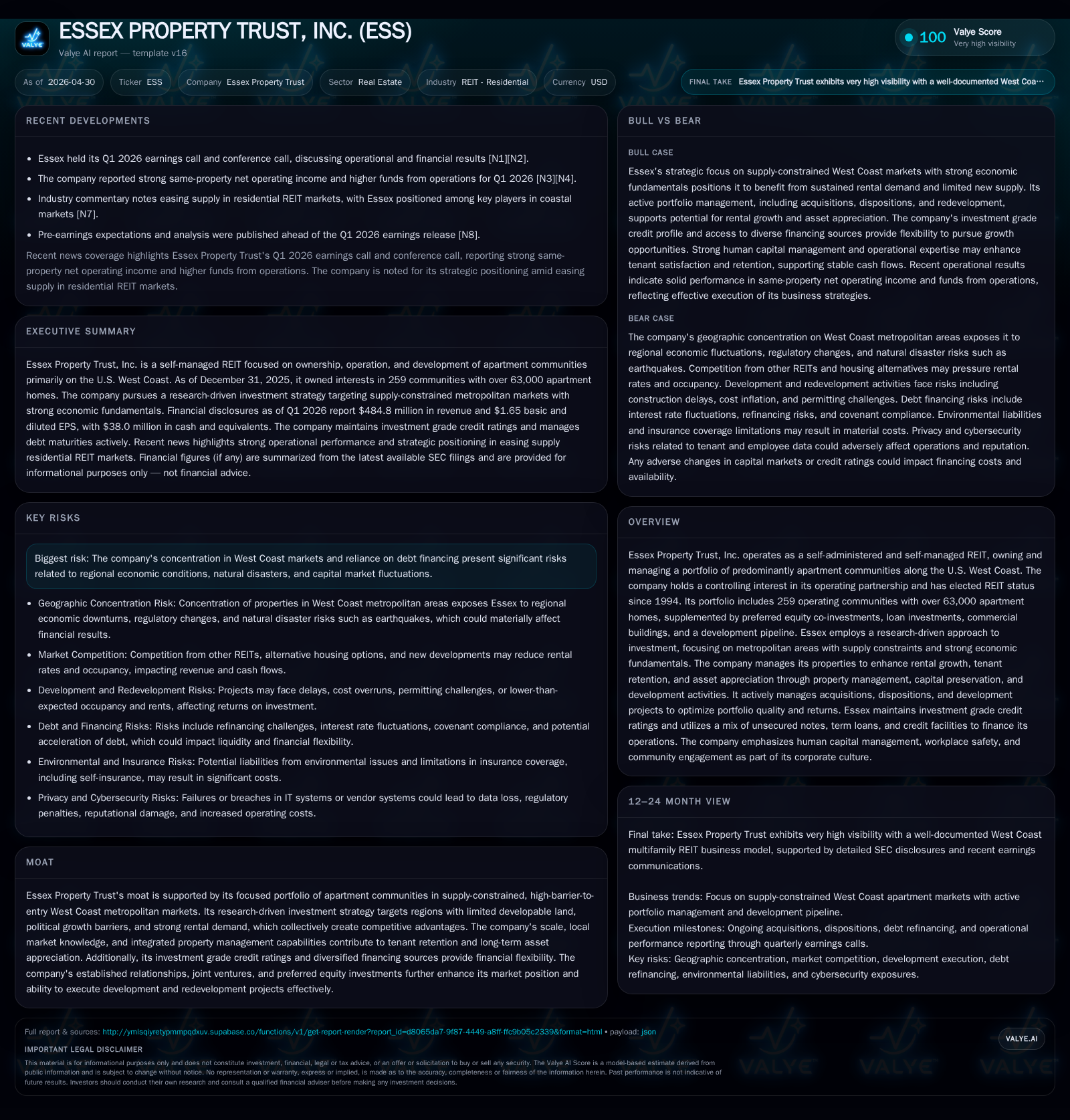
Essex Property Trust reported strong Q1 2026 operating results with same-property net operating income growth outpacing expectations, driven by constrained West Coast markets. Their self-managed REIT model, concentrated in supply-limited California and Seattle metros, underpins durable pricing power and tenant retention. Growth is fueled by active acquisitions, redevelopment pipeline, and inflation-indexed rents, balanced against regional concentration risks and debt exposure. Monitoring leasing velocity, rent renewal spreads, and development completions will be key near-term milestones.
Q1 2026 Operating Update: What Moved the Needle
Essex Property Trust’s Q1 2026 10-Q filing [S2] reveals continued momentum driven by same-property net operating income (NOI) gains outperforming expectations [N10][N4]. Despite broadly challenging macroeconomic factors for real estate sectors, Essex demonstrated robust rental rate increases alongside stable occupancy rates within its high-barrier-to-entry West Coast apartment communities. Fund from operations (FFO), a key REIT profitability metric, beat consensus estimates signalling operational strength [N11]. These results reflect effective asset management balancing rental growth with tenant retention amid constrained regional supply.
The subsequent event filing [S3] supplemented this view, confirming no material adverse changes or new risk disclosures. Market commentary highlights that demand for multifamily housing in California and Seattle metros remains structurally solid given limited new supply inflows and affordability pressures on home ownership alternatives [N12]. This dynamic supports Essex’s ability to implement inflation-adjusted rent escalations contributory to NOI expansion.
Business Model Deep-dive: Apartment Focus & Property Management Quality
Essex functions as a self-administered and self-managed REIT [S1], uniquely operating through its wholly controlled Operating Partnership owning its real estate assets. This integrated structure enables close oversight of property operations — from leasing to maintenance — fostering higher tenant satisfaction and retention levels critical to sustained revenue streams.
Its portfolio comprises approximately 63,077 apartment homes spread across 259 communities as of year-end 2025 [S1]. This scale allows operational efficiencies while their ownership extends beyond physical assets to preferred equity co-investments and selective commercial buildings enhancing income diversification. The company actively pursues development projects such as its current pipeline totaling over 500 units plus predevelopment efforts costing around $158 million incurred so far [S13].
By focusing exclusively on multifamily residential in supply-constrained coastal markets, Essex leverages superior pricing power versus competitors beholden to less differentiated geographic or asset mixes. The recurring revenue base is predominantly rental income derived from monthly leases with inflation linkage embedded via market escalations.
Competitive Moat Rooted in West Coast Supply Barriers
Essex’s competitive advantage hinges on meticulous market targeting: major metropolitan areas exceeding one million population combined with tangible supply constraints stemming from land availability limits, urban growth boundaries, environmental regulations, and complex permitting processes [S15]. Such factors render new multifamily housing developments costly and protracted compared to other US regions.
This intentional concentration generally includes Southern California (Los Angeles/San Diego), Northern California (San Francisco Bay Area), and Seattle metro areas where economic fundamentals support steady job growth and high median incomes fueling sustained residential demand [S15][F1]. Essex’s scale within these geographies amplifies its local market knowledge and enables more sophisticated data-driven investment decisions.
The company's strategy of prioritizing properties with attractive valuations while reducing exposure in overheated markets also preserves long-term portfolio quality and resilience.
Market Dynamics and Industry Structure Influencing Rent Growth
The coastal multifamily REIT sector is highly competitive but Essex's focus on higher-quality assets with superior amenities creates differentiation point capturing tenants seeking convenience, safety, and community features [S1][N12]. Lease durations are typically one-year terms exposing Essex to some cyclicality; however, rent adjustment capabilities coupled with active tenant engagement help mitigate vacancy risk.
Regulatory scrutiny around rent control remains a material consideration particularly in California where evolving legislation could cap rent growth or impose eviction limitations impacting cash flow predictability [S10]. While the company demonstrates compliance readiness and diversified portfolio risk metrics, any adverse policy shifts could introduce earnings volatility.
Technology adoption for leasing automation and resident services forms part of Essex’s operational priorities enhancing tenant convenience and facilitating lease-up velocity.
Key Growth Drivers Fueling Portfolio Expansion and NOI Uplift
Near-term growth is anchored in robust leasing velocity post-pandemic normalization evidenced by positive same-store NOI contribution augmenting margin expansion [S2][N10]. Incremental income streams emerge from new developments entering lease-up stages supported by targeted capital deployment into redevelopment initiatives upgrading existing communities.
Joint ventures expand capital deployment bandwidth allowing participation in larger or strategically located assets without full ownership risks [S29]. Acquisition activity remains disciplined but opportunistic focusing on repositioning underperforming assets or entering high-growth micro-markets within their operating footprint [S16].
Additionally, inflation-indexed rent increases embedded within lease contracts provide organic revenue escalation buffering cost pressures stemming from inflationary environments.
Risks and Constraints: Regional Concentration and Debt Considerations
Concentrating primarily along the West Coast exposes Essex to region-specific risks including economic downturns tied to tech sector volatility or natural disaster exposures such as earthquakes requiring ongoing mitigation strategies [S1][S10]. Rental regulatory uncertainty poses persistent challenges potentially constraining future pricing power.
On the financial front, the company holds cash equivalents of approximately $38 million as of March 31, 2026 [F1]. Historical net debt figures approximate $162 million based on best-effort data from 2011 [F1], suggesting cautious leverage monitoring is advisable given the absence of more recent debt disclosures.
Forward View: Milestones and Metrics to Track Next
Observers should focus on updated guidance for Q2 rents and occupancy rates reflective of ongoing leasing environment shifts announced in upcoming quarterly releases [S2][N7]. Progress updates on redevelopment completions feeding into NOI uplift schedules will validate mid-cycle execution capabilities.
Capital markets activity including debt refinancings or equity issuance will illuminate funding flexibility especially relevant should acquisition opportunities arise or if cost-of-capital conditions change adversely. Monitoring tenant retention rates alongside renewal spreads will act as early indicators for potential margin pressures or upside potential. Regulatory news affecting landlord economics across core markets warrants close attention given possible rapid shifts impacting forecast assumptions.
Current Financial Health Snapshot
As per most recent filings [S2][F1], Essex holds cash balances around $38 million supporting day-to-day liquidity. Unsecured credit facilities totaling $1.5 billion provide sizeable liquidity cushions with maturities extended through January 2030 underpinning capital access stability [S5]. Interest rate hedging arrangements partially offset variable cost exposures sustaining interest expense predictability.
This analysis is for informational purposes only based on SEC filings and public disclosures through April 2026. It does not constitute investment advice.
Disclaimer: This is research-only, informational analysis and not investment advice. It may include AI-generated interpretation and general industry context. Always verify important details using primary sources.

Comments