
Euroholdings Strengthens Product Tanker Focus with Strategic Fleet Expansion and Robust Dividend Policy
Recent quarterly results highlight Euroholdings' execution of its strategy to grow its tanker fleet while maintaining disciplined capital deployment.
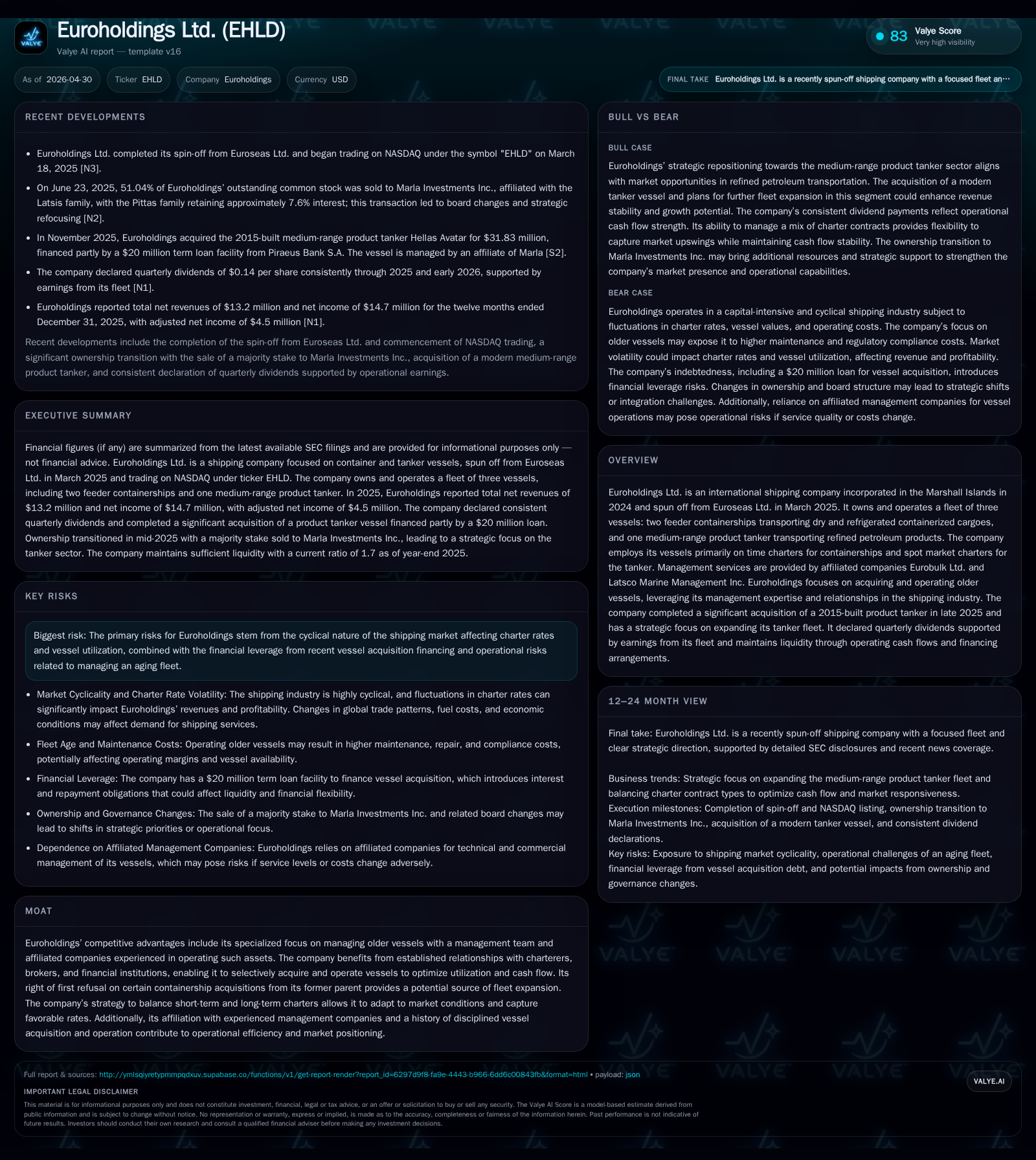
Euroholdings Ltd. reported strong financial performance for the year ended 2025, underpinned by the acquisition of a modern product tanker and steady charter rates for its vessels. The company operates a small but strategically focused fleet with an emphasis on medium-range tankers and feeder containerships, balancing time charters and spot market exposure to optimize revenues. Its operational expertise managing older vessels, combined with strategic acquisitions, positions it within niche shipping segments offering structural growth opportunities despite cyclicality in charter rates. Financially, Euroholdings maintains a moderate leverage profile aligned with capital-intensive fleet expansion needs, supporting ongoing dividend payments.
Recent Operating Update
Euroholdings Ltd.'s latest quarterly report for Q4 2025 [S2] reveals that the company continues to execute its strategy centered on expanding its product tanker presence while managing a compact fleet that includes feeder containerships. Total net revenues during Q4 reached $4.5 million with net income standing at $1.3 million ($0.45 per share basic and diluted). Adjusted EBITDA registered at $1.6 million reflects steady earnings from their mixed charter contract approach.
A defining event in this period was the November 2025 acquisition of M/T Hellas Avatar — a relatively modern medium-range (MR) product tanker built in 2015 with a cargo carrying capacity close to 50,000 deadweight tons — for approximately $31.8 million from an affiliated party [S2]. This purchase was partially financed via a $20 million term loan facility from Piraeus Bank bearing an interest rate margin over SOFR [S3]. The transaction underscores Euroholdings’ targeted growth in the product tanker segment viewed as structurally favorable amidst evolving global energy trade patterns.
Furthermore, consistent dividend payments reflect robust cash flow conversion from operations; the Q4 dividend declaration maintained the quarterly payout at $0.14 per share representing an annualized dividend yield close to 8% [S2]. This payout signals management’s confidence in earnings stability despite vessel aging and cyclicality inherent in shipping markets.
Maintenance activity also featured during this period as one feeder containership completed its intermediate survey and another underwent a special survey dry-docking finalized in early 2026 totalling expenditures near $0.6 million [S2]. Scheduled surveys are critical given Euroholdings’ strategic posture managing older vintage vessels averaging about 22 years old as of mid-2026 [S1].
Business Model Analysis
Euroholdings operates primarily as an owner-operator of older containerships and tankers acquired through disciplined transactions—spun off from Euroseas Ltd. in early 2025—and managed day-to-day by affiliated companies Eurobulk Ltd. (container vessels) and Latsco Marine Management Inc. (tanker vessels) [S1]. The business model's revenue mechanics hinge on earning daily charter hire fees; container feeders typically secure medium-term time charters providing cashflow stability whereas the product tanker operates mainly in the spot market capturing favorable short-term freight rate movements.
This dual-segment focus allows flexibility: containership employment mitigates utilization risks due to long-term contracts, while spot tankers benefit from potentially higher earnings during tight markets but imply greater volatility exposure [S1], [S21]. Euroholdings emphasizes selective investment in older tonnage leveraging its seasoned management expertise to maintain operating cost efficiency relative to peers more focused on modern fleets.
Revenue generation depends on three primary levers: vessel availability/utilization directly linked to drydocking cycles and mechanical reliability; achieved charter rates influenced by macroeconomic trade volumes and regional supply-demand imbalances; and vessel mix composition affecting average daily earnings per vessel (TCE rates). Cost elements comprise crew wages, maintenance & survey expenses—which escalate with vessel age—fuel costs when not passed through under contract structures, insurance premiums, management fees paid to affiliated service providers under multi-year agreements [S8], and financing costs stemming from debt incurred mainly post-asset acquisitions.
Euroholdings benefits strategically from a right of first refusal agreement on containership acquisitions from its former parent enabling opportunistic expansion consistent with core competencies [S20]. This contractual channel coupled with focused financial discipline anchors their fleet renewal pipeline.
Industry Structure and Competitive Position
The international shipping industry where Euroholdings competes presents structural dichotomies across segments: container feeder services contend with heavily fragmented markets characterized by intense competition among smaller operators servicing regional trades; whereas product tankers possess somewhat concentrated spot markets shaped by energy trade flows impacted by geopolitical events and regulatory shifts targeting cleaner fuels.
Euroholdings occupies niche positions in both sectors but distinguishes itself through specialization in operating mature assets efficiently—a competitive advantage underpinned by experience-loaded management teams capable of tightly controlling operating expenses despite aging platforms [N.A.: analysis based on S1 descriptions]. Affiliation with Eurobulk Ltd., certified under ISO quality standards for ship management, further enhances operational reliability contributing to consistent vessel utilization.
Their ability to calibrate charter arrangements between short-term exposure versus longer commitments provides tactical agility uncommon among operators fully committed to one model exclusively [S21]. Moreover, capitalization on established relationships within brokers network enhances access to favorable spots or time charters aligning fleet deployment with evolving global supply chains.
However, Euroholdings confronts structural limitations including vulnerability to cyclical downturns impacting charter rate levels across both containerships and tankers amid oversupply or demand contraction phases as observed widely across maritime sectors.
Growth Drivers
The key growth trajectories for Euroholdings rest on several pillars:
- Fleet Expansion Targeting Product Tankers: Building upon the recent acquisition of M/T Hellas Avatar—their first modern tanker unit—the company aims to increase its presence within this sector that benefits from structurally expanding demand linked to rising refined petroleum transport requirements globally [S2], [S21].
- Charter Mix Optimization: Leveraging time-charter contracts for container vessels ensures cash flow predictability while tactically utilizing spot contracts for tankers captures upside potential during market tightening periods.
- Selective Asset Acquisitions: Strategic opportunities derived from rights related to former parent container assets combined with opportunistic purchases informed by market cycles enable portfolio enhancement without compromising balance sheet prudence [S20].
- Operational Efficiency: Continuous improvement via contract management efficiencies through their related ship managers minimizes operating expenses enhancing net cash flow margins.
- Dividend Sustainability: A defined dividend policy targeting attractive yields fosters shareholder return visibility while indicating steady underlying cash generation supporting reinvestment capacity.
Collectively these drivers support both top-line scaling via incremental vessel additions accompanied by margin preservation through cost control mechanisms.
Risks / Watchpoints / Growth Constraints
Despite positive momentum several risks warrant consideration:
- Cyclicality in Charter Rates: Both container feeder volumes and refined petroleum shipping remain sensitive to macroeconomic variables including trade tensions, fuel price volatility, and geopolitical conflicts which might suppress earnings intermittently [S1], [S21].
- Aging Fleet Maintenance Needs: As vessels age beyond standard economic lives (approximate average age currently ~22 years), maintenance costs escalate requiring timely surveys/drydock visits—causing off-hire days reducing revenue-generating opportunities—plus capital investments pose cash flow pressure especially if multiple vessels require simultaneous servicing [S2].
- Leverage Levels: Total debt stood near $19.9 million as of December 31, 2025 against cash balances approximating $3.3 million yielding a net debt position around $16.5 million—implying moderate leverage given size constraints—but imposing cash interest obligations (~$100k annually) pegged initially primarily against Piraeus Bank loan backing tanker purchase necessitating continued operational profitability adherence per covenant compliance standards [F1], [S3], [S12].
- Market Competition: Larger shipping firms investing aggressively into newer modern fleets may offer superior economies of scale or better environmental compliance profiles potentially compressing older vessel utilization over time.
- Regulatory/Environmental Compliance: Increasing tightening on emissions norms could affect operational certification or driving capital requirements for retrofits especially significant for vintage container feeders demanding active capital reserve allocation.
- Shareholder Composition: Changes following significant ownership transitions such as the Marla Transaction whereby majority stock ownership transferred warrant monitoring regarding influence on governance decisions impacting growth strategy execution consistency [S20].
What To Watch Next
For ongoing assessment of Euroholdings’ trajectory key upcoming items include:
- Monitoring quarterly earnings releases that report TCE rates variations particularly for product tanker utilization where spot market dynamics dominate pricing power.
- Disclosure around incremental vessel acquisitions beyond M/T Hellas Avatar offering insights on fleet modernization pace aligned with stated strategic intent.
- Validation of dividend continuity or adjustments relative to charter market conditions acting as barometers for free cash flow sustainability.
- Updates on scheduled intermediate/special surveys influencing expected off-hire downtime impact assessments earmarked within liquidity planning frameworks.
- Progress reports on loan facility covenant adherence specifically maintaining minimum security coverage ratios (+120%) along with liquidity minima specific thresholds outlined under Piraeus Loan Facility terms [S12].
- Commentary relating to geopolitical developments influencing shipping lanes or energy transport volumes directly affecting spot rate environments particularly beneficial for tanker segment demand signaling.
Financial Snapshot (As of December 31, 2025) [F1]
Latest financial snapshot
FY End 2025 |
In summary, Euroholdings showcases solid execution progressing toward strategic goals articulated at spin-off formation—including portfolio concentration towards product tankers complemented by experienced operational stewardship over older containership assets amid cautious financial leverage management enhancing shareholder returns via dividends. Nevertheless, vigilance remains prudent regarding inherent industry cyclicality compounded with vintage asset maintenance demands requiring capitalization discipline alongside stringent liquidity vigilance supporting long-term sustainability prospects.
This analysis is based exclusively on publicly filed SEC documents up to April 30, 2026 ([S1]–[S28]) and company facts database records ([F1]). It does not constitute investment advice.
Disclaimer: This is research-only, informational analysis and not investment advice. It may include AI-generated interpretation and general industry context. Always verify important details using primary sources.

Comments