
Nabors Industries’ Revenue Growth Masks Rising Cost Challenges and Competitive Risks
Nabors’ Q1 2026 results reveal stronger revenues amid tightening margins, highlighting operational pressures alongside sustained commitment to advanced drilling automation and technology integration.
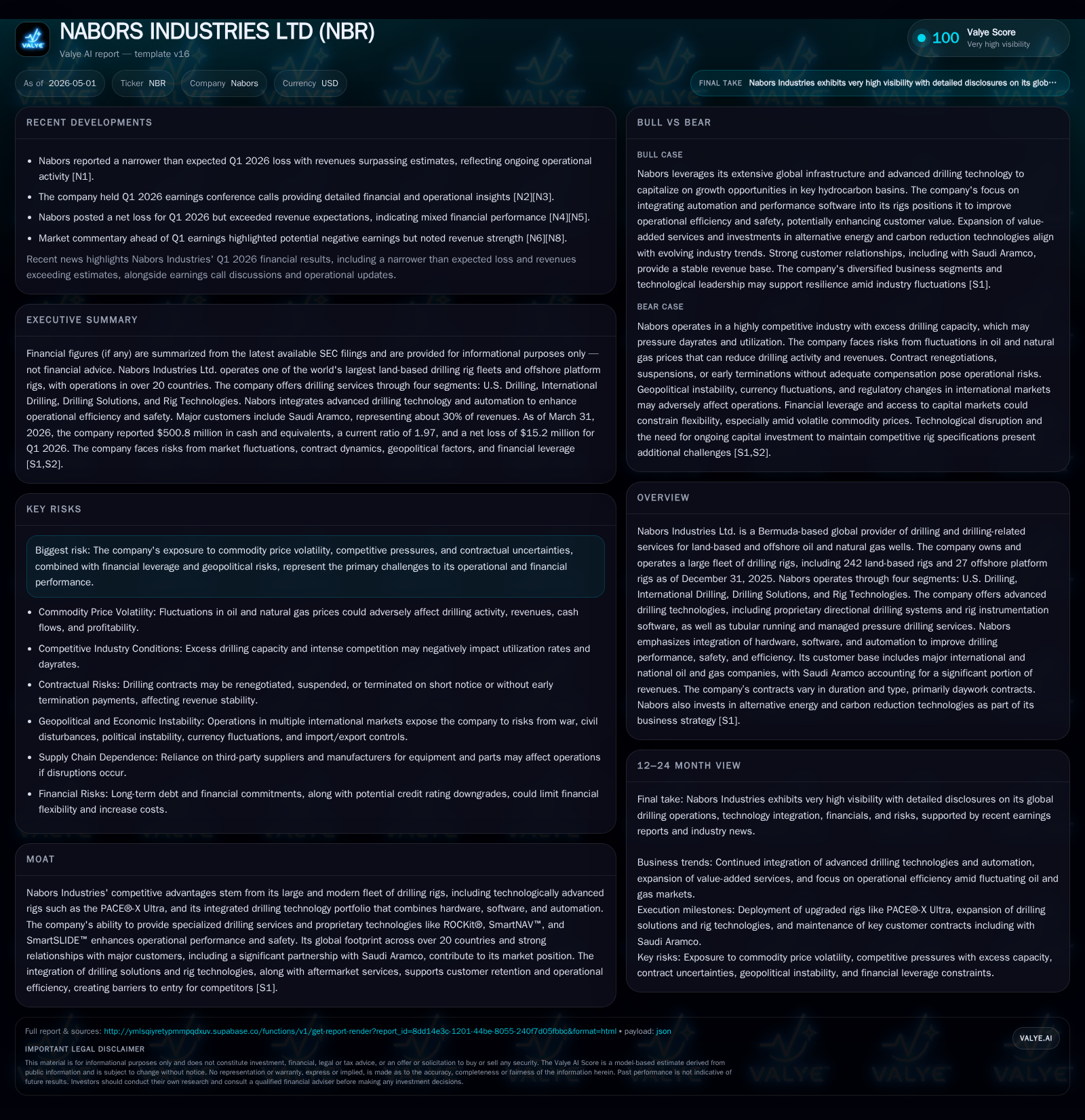
In the latest quarter ended March 31, 2026, Nabors Industries reported revenues that exceeded estimates despite narrower-than-expected earnings, reflecting persistent cost inflation and competitive pressures on dayrates and rig utilization. The company continues to leverage its scale and proprietary rig technologies such as PACE®-X Ultra and ROCKit® software to enhance operational efficiency and safety. However, commodity price volatility, contract uncertainty—especially with key customers like Saudi Aramco—and financial leverage remain headwinds. Growth is anchored in technology-driven service expansion and geographic diversification, but capital discipline and contract renewals will be critical monitors in the near term.
Latest Quarterly Operating Results and Near-Term Implications
Nabors Industries’ first quarter ended March 31, 2026, presents an intricate operational picture combining top-line revenue strength with margin compression [S2][N1]. Reported revenue surpassed consensus expectations driven primarily by the International Drilling segment’s stable rig activity and improved dayrates in select regions. However, earnings fell short due to rising input costs—ranging from labor to materials—and persistent inflationary headwinds affecting operating expenses. Notably, rig utilization rates reflected a modest stabilization relative to recent quarters but remain below historical peaks given ongoing market overcapacity challenges.
This duality in performance marks a microcosm of the broader upstream drilling services environment where pricing power remains constrained amid excess rig supply. Additionally, Nabors is contending with fixed cost structures that limit margin expansion when dayrates or utilization weaken unexpectedly. Yet importantly, the company continues to invest in technology integration initiatives designed to offset these pressures over time through efficiency gains.
Business Model and Service Offering Dynamics
Rooted in its latest 10-K filing dated February 13, 2026 [S1], Nabors operates across four core segments: U.S. Drilling, International Drilling, Drilling Solutions, and Rig Technologies. Its revenue model is multifaceted:
- U.S. & International Drilling: Provides land-based and offshore platform drilling rigs on a dayrate or contract basis to major oil & gas producers.
- Drilling Solutions: Offers specialized services including managed pressure drilling (MPD), tubular running services (TRS), as well as software-driven performance analytics.
- Rig Technologies: Comprises manufacturing and aftermarket support for drilling components (e.g., top drives by Canrig), robotic systems, and instrumentation software used across both internal fleet rigs and third-party operators.
Differentiation hinges on Nabors’ integrated offering that marries mechanical rig assets with proprietary automation platforms such as PACE®-X Ultra rigs—recognized for enhanced automation—and digital tools like ROCKit®, SmartNAV™, and SmartSLIDE™ which optimize directional drilling processes. These capabilities cater directly to customer demands for safer operations with reduced downtime amid complex drilling environments.
The company’s customer mix includes major national oil companies (NOCs) and international majors—with Saudi Aramco notably representing approximately 30% of consolidated operating revenues—a fact that amplifies both strategic partnership opportunities via their SANAD joint venture as well as concentration risk exposure [S12].
Competitive Positioning Through Fleet Scale and Technology
In a capital-intensive sector marked by cyclical spending patterns and excess capacity tension [S1], Nabors leverages one of the world’s largest land-based rig fleets totaling over 240 rigs complemented by 27 offshore platform rigs globally. This scale equips Nabors to serve diverse geographies while spreading operating leverage.
Crucially, fleet modernization efforts focus on embedding advanced tech features underpinned by significant R&D investment. Proprietary assets like the PACE®-X Ultra enable increased automation reducing manual intervention which can lower safety incidents and operational costs per foot drilled. Similarly, aftermarket services through Rig Technologies yield recurring revenue streams supporting customer retention via parts supply and service agreements—a substantial barrier against competitor encroachment.
Geopolitical breadth—operating across more than 20 countries including politically sensitive regions—provides both diversification benefits and risk exposures given regional instability or regulatory shifts that could impact licensing or contract continuity.
Growth Drivers Anchored in Technology Innovation and Market Expansion
Nabors’ growth thesis rests on several interlocking pillars:
- Technology Adoption: Expanding the footprint of automated drilling rigs paired with data-driven service layers enhances efficiency metrics that appeal strongly amid operator cost scrutiny.
- Emerging Market Penetration: Increasing exploration activities in less mature basins offer fresh contracts targeting regional NOCs seeking modern rig fleets without investing capex internally.
- Sustainability Initiatives: Although part of traditional energy upstreams still dominate revenue composition today, Nabors is developing emissions reduction technologies embedded within its equipment portfolio aiming at regulatory compliance clientele seeking greener credentials.
From a measurable standpoint, backlog growth linked to contracted rig days along with incremental bookings for managed pressure services act as leading KPIs signaling demand momentum. Ongoing refinancing or higher interest rates create financing cost risks given non-investment grade credit ratings [F1][S2][S15].
Fixed-cost nature of operations also limits ability to flex expenses downward rapidly during lower activity cycles compressing margins further.
Monitoring Points: Guidance, Utilization Trends, and Contract Renewals
Upcoming milestones warrant close observation:
- Management’s Q2 guidance updates will clarify demand trajectory particularly utilization shifts versus Q1 baseline levels disclosed during April earnings conference calls [S3][N2][N3].
- Progress on contract renewals—including those tied to largest customers like Saudi Aramco via SANAD joint ventures—will be critical for revenue stability given their outsized contribution [S12].
- Any indications regarding dayrate adjustments or capital expenditure pacing provide insight into margin outlook amidst inflationary environment.
Analysts should also watch third-party bidding dynamics for multi-well contracts which generally have better early termination protections compared to single-well engagements that carry elevated cancellation risk.
Financial Snapshot: Liquidity, Leverage, and Cash Flow Focus
Latest financial snapshot
| Metric | Value | Period |
|---|---|---|
| Cash & equivalents | $501mm | |
| 2026-03-31 | ||
| Total debt | $2.1bn | |
| 2026-03-31 | ||
| Net debt | $1649mm | |
| 2026-03-31 | ||
| Current assets | $1153mm | |
| 2026-03-31 | ||
| Current liabilities | $585mm | |
| 2026-03-31 | ||
| Current ratio | 1.97x | |
| 2026-03-31 |
Source: SEC companyfacts cache [F1].
A concise look at key balance sheet metrics as of March 31, 2026 captures financial positioning underpinning operational narratives [F1]:
| Metric | Value (in millions USD) |
|---|---|
| Cash & Equivalents | 500.8 |
| Total Debt | 2150.0 |
| Net Debt | 1649.2 |
| Current Assets | 1152.6 |
| Current Liabilities | 585.2 |
| Current Ratio | 1.97 |
This profile indicates reasonable near-term liquidity enabled by nearly $500 million cash reserves supporting working capital needs alongside sizable but manageable gross debt obligations consistent with capital intensive service operations. Overall cash flow generation hinges fundamentally on utilization trends tied closely to oil price trajectories but also benefits from gradual mix shift toward higher value-added services embedded in Nabors’ technology platforms.
This analysis relies solely on publicly filed SEC documents through May 2026 combined with recent news transcripts capturing management commentary around Q1 results. The narrative underscores a complex interplay between operational pressures driven by external market forces against an internal strategic emphasis on technological innovation aimed at sustaining long-term competitiveness in a challenging industry landscape.
Disclaimer: This is research-only, informational analysis and not investment advice. It may include AI-generated interpretation and general industry context. Always verify important details using primary sources.

Comments