
Entergy Texas Advances Infrastructure to Power Surging Data Center Demand
Latest quarterly disclosures reveal accelerated infrastructure projects aimed at accommodating explosive load growth from large-scale data centers amid regulatory complexities.
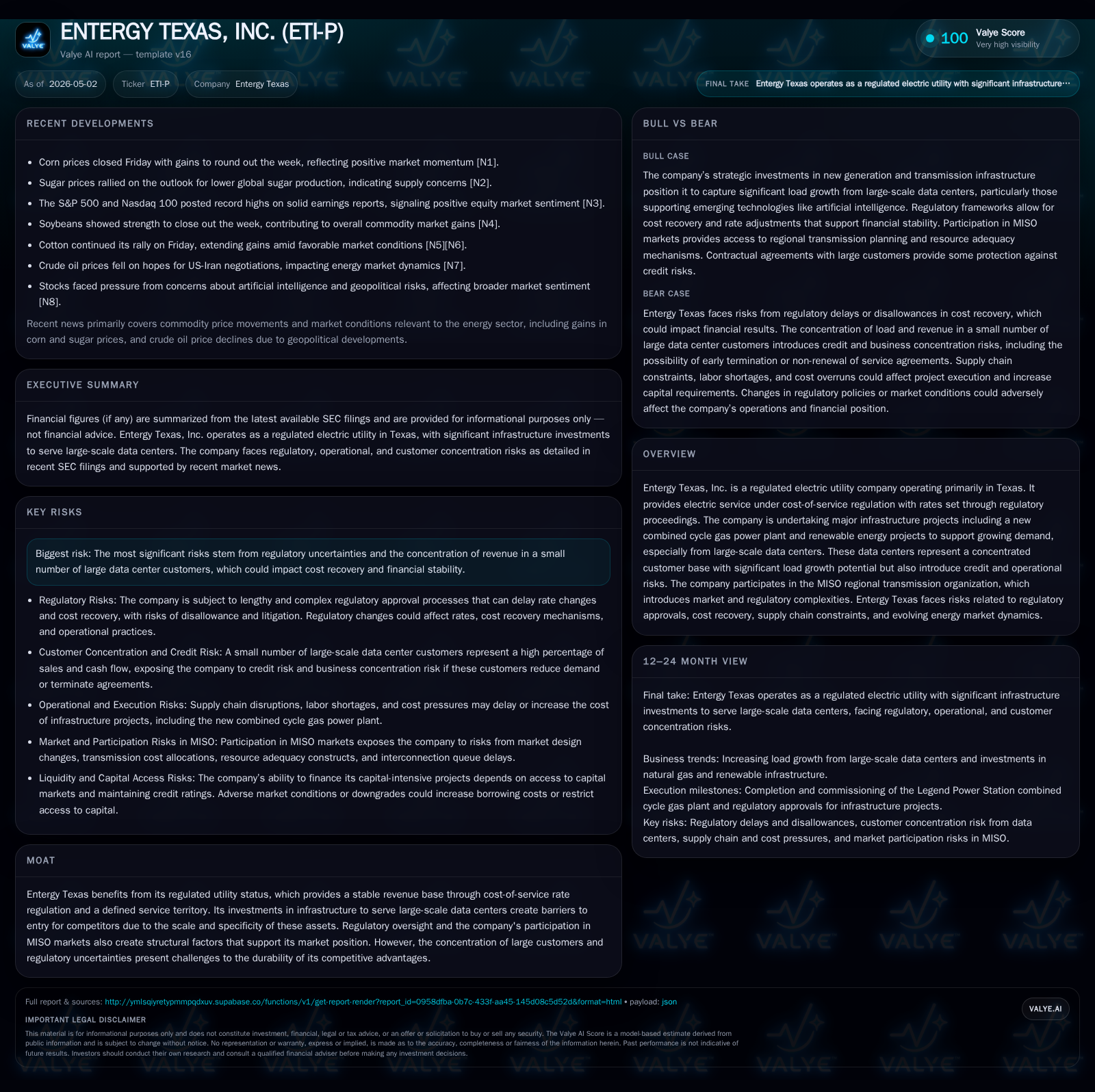
Entergy Texas’s Q1 2026 10-Q details meaningful progress in deploying a new combined cycle gas-fired plant and renewable energy assets to meet surging electricity demand driven by a concentrated cluster of data center customers. Operating within a cost-of-service regulatory framework and participating in the MISO regional transmission organization, Entergy Texas faces typical regulatory lag and approval risks that could affect cost recovery. The company’s strategic investments create significant barriers to entry, though customer concentration and evolving market rules pose risk. Near-term milestones include pending rate case determinations and project permitting outcomes critical for sustaining growth momentum.
Recent Quarterly Operating Update
The 10-Q filing dated May 1, 2026 ([S2]) reveals Entergy Texas is pushing forward with substantial infrastructure enhancements specifically targeted at power supply for large-scale data centers—a rapidly expanding segment within its service area. Notably, the company is progressing on construction of a new combined cycle gas-fired power plant intended to address the surging load requirements from these data hubs. This aligns with earlier disclosed strategic plans but signals tangible movement into execution phases, reflecting near-term increases in capital expenditures.
The April 29, 2026 8-K ([S3]) supplements this with management commentary reaffirming the critical need for these assets given contractually backed load growth from existing major data centers. These filings underscore that load growth from these customers significantly outpaces typical residential or commercial demand expansions, warranting expedited infrastructure development.
However, despite operational progress, these documents also highlight the persistence of regulatory hurdles—particularly relating to permitting timelines and eventual rate recovery processes. Regulatory filings necessary for cost recovery amid ongoing rate cases remain active, with outcomes expected to materially influence financial returns. The confluence of these factors situates Entergy Texas at an important juncture where operational execution must be tightly aligned with regulatory strategy.
Regulated Utility Business Model and Customer Landscape
Entergy Texas functions as a regulated utility under cost-of-service rate regulation ([S1]). The fundamental revenue mechanism involves setting rates through public utility commission proceedings designed to recover prudently incurred capital costs, operations and maintenance expenses, financing costs, and provide an allowed return on investment. This model provides a relatively stable revenue foundation while enabling infrastructure investment backed by regulatory approval.
Its customer base comprises largely residential, commercial, industrial segments but increasingly dominated by large-scale data center operators whose electricity consumption imposes unique load profiles. These data centers represent a small cohort of customers but are responsible for outsized incremental consumption growth. Their presence creates a significant amount of revenue concentration risk due to their scale alongside credit risk factors unique to their volatile economic environment ([S1]).
The heavy reliance on these customers forces Entergy Texas to calibrate operational focus towards ensuring reliability and sufficient capacity while navigating price negotiations and regulatory approval for associated investments. This creates an asymmetry in pricing power—cost-of-service ratemaking limits price flexibility yet allows full cost pass-through subject to prudence standards.
Competitive Position and Industry Dynamics in Texas Power Markets
Operating within the Midcontinent Independent System Operator (MISO) footprint adds complexity to Entergy Texas’s competitive environment (, [S1]). Participation in MISO’s regional transmission organization exposes Entergy Texas to wholesale market pricing dynamics such as capacity auctions, congestion management, and ancillary services markets which overlay traditional state-level regulation.
This dual exposure shapes planning processes since generation investment decisions must consider both regulatory approval certainty as well as wholesale market competitiveness. Additionally, competing utilities under different jurisdictional frameworks operate adjacent or overlapping territories which makes timely infrastructure expansion critical for maintaining service exclusivity.
Supply chain bottlenecks common across the utility sector—ranging from specialized equipment procurement delays to skilled labor shortages—pose execution risks that can defer project completion dates ([S1], ). These constraints stress the importance of tight project management practices.
Nevertheless, Entergy Texas enjoys structural advantages via its regulated status granting defined service territory protections and permitted rates of return. Its ongoing investments tailored toward supporting highly specific data center loads impose scale barriers deterring potential entrants, supporting its moat.
Growth Drivers: Data Center Load Expansion and Infrastructure Investment
Data centers are clearly the primary driver underpinning Entergy Texas’s near-term growth trajectory ([S2], [S3], ). These facilities require vast amounts of reliable electricity with predictable quality standards. The rapid build-out of hyperscale cloud computing hubs has created an inflection point where legacy infrastructure cannot meet demand.
Entergy Texas’s response is aggressive capital spending on new combined cycle plants supplemented by renewable generation projects intended to diversify fuel sources while meeting sustainability goals. Project milestones such as regulatory permitting clearance and construction progress dictate timing of new load-serving capability.
The high fixed-cost nature of these projects fosters switching-cost deterrents against alternative suppliers or self-generation solutions by customers. Contract structures typically include long-term commitments aimed at offsetting upfront capital recovery risk.
These dynamics collectively offer measurable KPIs: backlog of contracted megawatts under development; regulatory docket progress updates; capacity additions coming online; expanded contract terms or volumes with marquee data center customers.
Risks and Constraints: Regulatory Approvals, Customer Concentration, and Market Complexity
The principal risks articulated across filings relate heavily to regulatory uncertainties ([S1], [S2], ). Despite entering projects with prudently vetted assumptions on cost recovery, prolonged or unfavorable rate cases could impose delays (regulatory lag) or disallowed costs reducing earnings predictability.
Concentration risk remains salient given that a limited number of large data center customers represent a disproportionate share of volume growth. This specialty industrial exposure entails heightened credit evaluation challenges; any contraction or relocation decisions by these customers could materially impact cash flows (, [S1]).
Supply chain volatility may cause schedule slippages or cost inflation jeopardizing project economics. Participation in MISO complicates market exposure due to potential price caps or mitigation measures affecting non-regulated earnings components ([S1], ).
Operational complexity is elevated by the need to simultaneously coordinate generation availability with network reliability standards amidst fluctuating wholesale market conditions.
Near-Term Catalysts: Upcoming Regulatory Milestones and Demand Signals
Key events poised to shape Entergy Texas’s trajectory in the coming quarters include:
- Resolution of outstanding rate case filings with regulators impacting authorized returns and timing of cost recovery ([S2], [S3]).
- Permitting outcomes for critical generation assets—particularly the combined cycle gas plant—which will validate construction schedules ([S2]).
- Announcements regarding MISO capacity auctions relevant for entering formal commitments optimizing generation dispatch economics.
- Contractual amendments or expansions from anchor data center customers serving as leading indicators for volume growth sustainability.
- Monitoring supply chain deliveries and labor force availability reports crucial for assessing project execution timelines. These milestones offer tangible milestones by which performance can be gauged beyond broad industry trends.
This analysis emphasizes Entergy Texas’s dual challenge of scaling bespoke infrastructure rapidly while navigating a multifaceted regulatory environment balancing between cost recovery certainty and evolving market conditions. The firm’s strategy targeting specialized data hub demand positions it well in terms of structural competitive advantages; yet risks rooted in customer concentration and regulatory lag merit close attention going forward.
Disclaimer: This report synthesizes information from recent SEC filings overlaid with industry context relevant as of early May 2026. It does not constitute investment advice or recommendations.
Disclaimer: This is research-only, informational analysis and not investment advice. It may include AI-generated interpretation and general industry context. Always verify important details using primary sources.

Comments