
Camping World Faces Revenue Pressure and Shifting Consumer Preferences in Q1 2026
Q1 2026 results reveal ongoing challenges in demand dynamics and inventory management amid competitive RV markets.
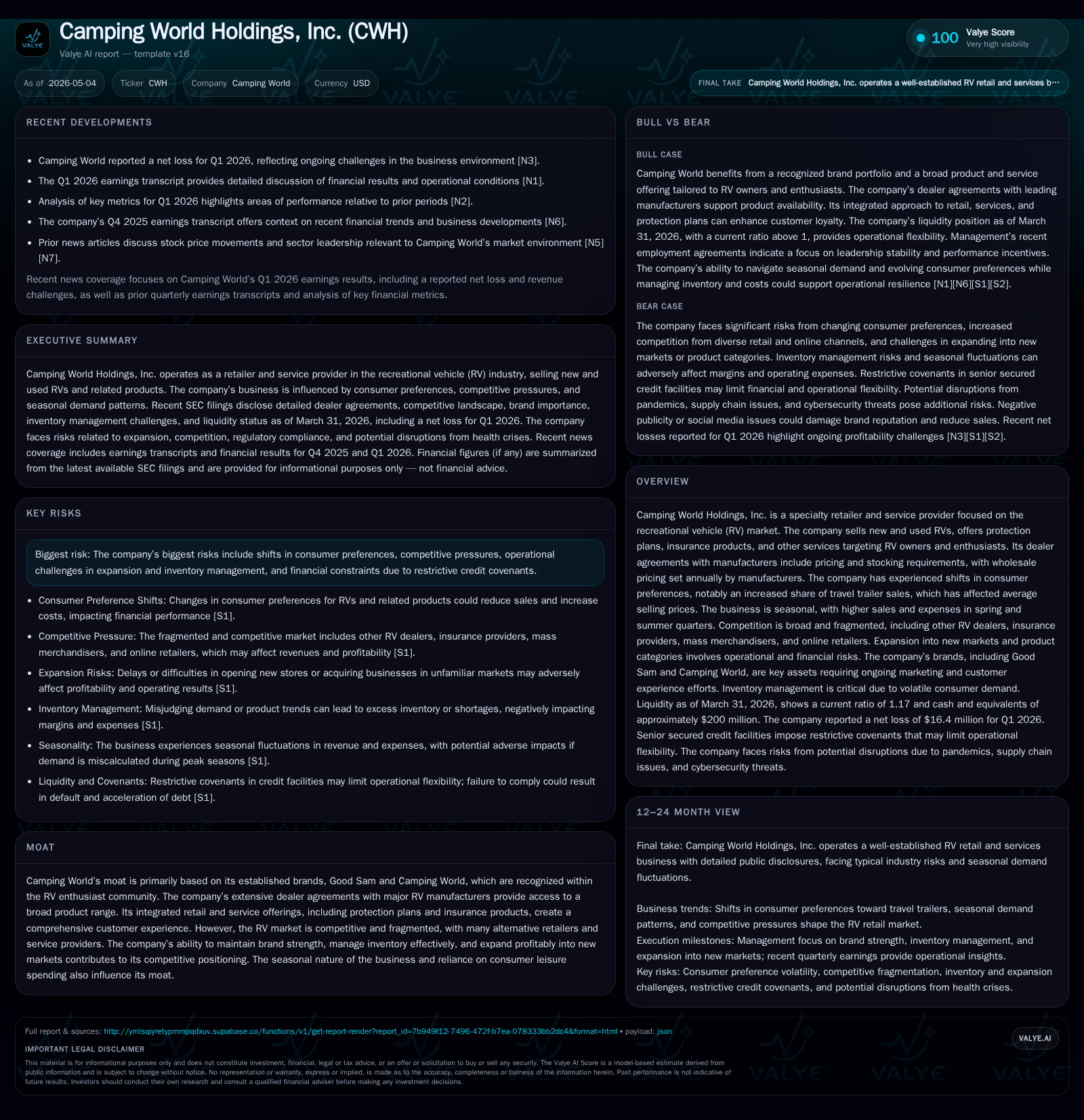
Camping World Holdings reported a Q1 2026 financial update marked by softness in revenue and continued pressure from changing consumer preferences toward lower-priced travel trailers. The company’s integrated dealer agreements, broad service offerings, and established brand presence support its market positioning but face challenges from seasonal cyclicality and intensifying competition. Growth prospects hinge on expanding active customer bases, navigating inventory risks, and carefully executing expansion strategies while managing restrictive debt covenants. Financial leverage remains elevated, underscoring the need for cash flow generation amid margin variability.
Recent Operating Update
Camping World Holdings filed its latest quarterly report for Q1 ended March 31, 2026 [S2], supplemented by a concurrent event filing on April 29, 2026 [S3]. These filings provide the freshest insight into near-term operational trends before considering broader annual context.
The company announced its first-quarter results revealing continuing headwinds. Q1 revenue fell short of expectations according to external commentary [N3], linked largely to subdued demand in its core RV sales segment. The firm posted a net loss during this quarter, indicative of lingering market softness and margin pressure [S2]. The earnings transcript [N1] highlighted the impact of an ongoing shift in consumer preferences away from more expensive motorhomes toward greater penetration of travel trailers.
This transition has been ongoing since before the pandemic but accelerated as Camping World noted that travel trailer units as a percentage of new vehicle sales rose from 62% in 2015 to approximately 79% by 2025 [S1]. This trend translates into a decrease in the average selling price for new vehicles by around 8% over that period despite inflationary pressures. The impact continued into recent periods with both average cost and selling prices declining through 2025 [S1].
Seasonality remains a defining characteristic of Camping World's revenue patterns. Historically, over half its annual sales are concentrated in the spring and summer quarters when leisure travel peaks [S7]. The company's cost base similarly escalates seasonally due to elevated inventory purchases and higher staffing needs at stores during peak months. As such, accuracy in forecasting demand is crucial; misjudgments risk excess inventory build-up or margin erosion.
Business Model
Camping World operates as an integrated specialty retailer servicing the recreational vehicle (RV) market. Its primary revenue streams arise from:
- Sales of new RVs under dealer agreements with major manufacturers who mandate wholesale pricing annually along with stocking levels and minimum advertised prices [S1].
- Used RV sales complemented by aftermarket services.
- Ancillary revenue from protection plans, insurance products, memberships via its Good Sam brand, parts, accessories, and service operations targeting the active RV lifestyle community.
This vertically blended approach seeks to capture value beyond initial vehicle sales through recurring memberships and ancillary service spend, leveraging the Good Sam membership ecosystem as a retention tool [S1]. Dealer agreements form a critical backbone but also confer vulnerability because manufacturer-determined pricing restricts flexibility. Any disruption or renegotiation could affect product availability or cost structures.
The company experienced some challenges managing inventory mix due to shifting consumer preferences impacting gross margins [S25]. It also exited non-core retail categories where demand did not justify inventory investment.
Customer acquisition and retention center on physical store locations augmented by e-commerce channels. Stores not only serve transactional purposes but act as community hubs supporting the lifestyle branding strategy which protects against purely price-based competition.
Industry Structure and Competitive Position
The broader RV market is fragmented with diverse participants ranging from specialized dealerships like Camping World to mass merchandisers and digital platforms offering competitive alternatives on price or service convenience [S13]. The market for services tied to RV ownership — insurance providers, aftermarket products — further dilutes concentration.
Camping World’s moat derives primarily from brand recognition via Good Sam and Camping World names ingrained within the RV enthusiast community. Extensive manufacturer relationships grant access to wholesale supply lines under favorable terms versus smaller competitors who lack such scale or contractual reach.
However, intense industry fragmentation means competitive advantage is guarded but fragile; margins can ebb due to price competition or consumer shifts toward alternative outdoor recreation spending [S9]. Regulations increasing complexity around vehicle emissions (e.g., CARB rules affecting diesel models) add operational hurdles impacting product portfolios regionally [S12].
Growth Drivers
Key avenues driving growth include:
- Expanding Active Customer Base: Increasing enrollments in membership programs like Good Sam which deliver high-margin recurring revenue streams tied to services such as roadside assistance or warranty plans.
- Geographic Expansion: Opening new retail locations or acquiring existing dealerships can increase market presence if executed with demographic insights ensuring store profitability [S16].
- E-commerce Growth: Enhancing online parts/accessories sales complements physical store sales providing omnichannel convenience.
- Product Mix Optimization: Adjusting inventory towards higher-demand or higher-margin merchandise aligned with emerging customer preferences could improve unit economics.
- Service Diversification: Broader offerings such as insurance products or repair services deepen customer wallet share securing stickiness beyond initial vehicle purchase.
This growth remains conditioned on balancing inventory investment carefully to avoid margin-damaging discounting during volatile demand phases.
Risks / Watchpoints / Growth Constraints
Several factors present operational risks:
- Economic Cyclicality: As discretionary spending drives RV purchases, downturns induced by job insecurity or higher interest rates may depress volumes sharply [S1].
- Inventory Management: Mistiming orders against consumer trends can generate costly excesses or shortages impairing profitability [S25]. The long lead times required for ordering vehicles intensify this risk.
- Competitive Intensity: Fragmentation invites price wars especially worsened if competitors adopt direct-to-consumer models challenging conventional dealership networks [S13].
- Expansion Execution Risk: Opening new stores demands navigating local approvals, real estate costs, staffing skilled personnel, plus aligning merchandise mix with local tastes – failures here can drain resources without commensurate returns [S16][S22].
- Seasonal Volatility: Overdependence on peak season tiers the business results unevenly across quarters complicating forecasting accuracy [S7][S8].
- Regulatory Changes: New environmental vehicle standards challenge stocking decisions especially for diesel-powered motorhomes facing bans in key states beginning model year 2024 onward [S12].
What to Watch Next
Investors and analysts should monitor several upcoming indicators:
- Quarterly revenue trends especially same-store sales performance reflecting consumer demand recovery or deterioration post-pandemic normalization.
- Gross margin trajectory influenced by product mix adjustments between travel trailers versus motorhomes alongside discounting trends.
- Active customer count changes within Good Sam memberships signaling strength in recurring business lines.
- Progress on planned store openings or acquisitions including greenfield sites alongside any announced divestitures of underperforming categories.
- Management commentary on supply chain disruptions or costs given ongoing logistics headwinds broadly affecting retail sectors.
- Impact assessment of regional regulatory changes on product offerings particularly in California’s large EV adoption context affecting diesel models.
While no explicit forward guidance was detailed in the filings reviewed, tracking these operational KPIs will provide directional clarity on Camping World's ability to regain stability amid evolving market dynamics.
Latest Financial Snapshot Summary
Latest financial snapshot
| Metric | Value | Period |
|---|---|---|
| Cash & equivalents | $200mm | |
| 2026-03-31 | ||
| Total debt | $1483mm | |
| 2025-12-31 | ||
| Net debt | $1283mm | |
| 2025-12-31 | ||
| Current assets | $2.7bn | |
| 2026-03-31 | ||
| Current liabilities | $2.3bn | |
| 2026-03-31 | ||
| Current ratio | 1.17x | |
| 2026-03-31 |
Source: SEC companyfacts cache [F1].
| Metric | Value (USD) | Period End |
|---|---|---|
| Cash & Equivalents | $199.8 million | |
| 2026-03-31 | ||
| Total Debt | $1.48 billion | |
| 2025-12-31 | ||
| Current Assets | $2.72 billion | |
| 2026-03-31 | ||
| Current Liabilities | $2.33 billion | |
| 2026-03-31 | ||
| Current Ratio | 1.17 | |
| 2026-03-31 | ||
| Net Debt | ~$1.28 billion | Approximation |
Camping World holds a sizable net debt position relative to cash balances highlighting reliance on liquidity management amid operating fluctuations.
Disclaimer: This is research-only, informational analysis and not investment advice. It may include AI-generated interpretation and general industry context. Always verify important details using primary sources.

Comments