
Citizens Financial Group Accelerates Digital Transformation Amidst Robust Q1 Earnings
CFG’s Q1 2026 results reveal momentum in key revenue streams, driven by digital adoption and disciplined execution across its Consumer and Commercial Banking segments.
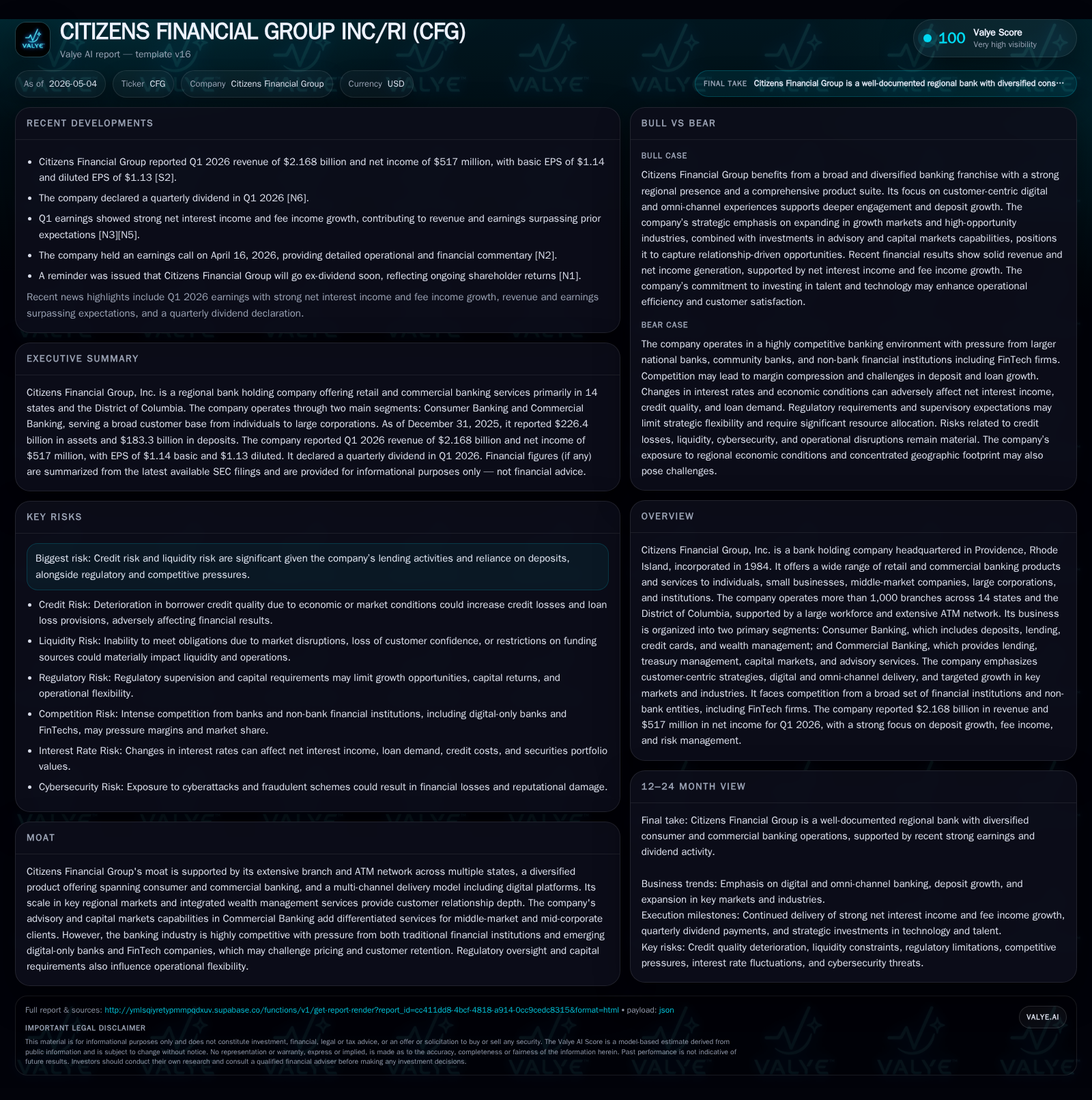
In the first quarter of 2026, Citizens Financial Group demonstrated solid net interest income growth supported by deposit expansion and sustained fee income. The company deepened its commitment to digital transformation and omni-channel delivery, enhancing customer engagement across its expansive regional footprint. CFG’s diversified business model, spanning consumer deposits and lending alongside commercial advisory and capital markets services, provides resilience amid intensifying competition from digital-first banks and regulatory pressures. Key risks remain concentrated in credit quality, regulatory compliance, and margin sensitivity to market rates. Upcoming milestones include monitoring loan portfolio performance, deposit trends, and digital platform rollouts as execution catalysts.
Latest Quarterly Operating Update: Signals from the May 2026 10-Q
Citizens Financial Group’s Q1 2026 filing dated May 4 reveals sustained operational strength anchored by net interest income (NII) growth fueled by higher loan balances and advantageous deposit pricing dynamics [S2]. Management attributed improved NII primarily to expansion in both consumer loans—including mortgages—and commercial lending activities which benefited from selective origination strategies amidst a complex rate environment. Fee income also showed positive momentum driven by enhanced advisory services within Commercial Banking and robust wealth management fee generation in Consumer Banking [N2]. Operating expenses reflected ongoing investments in technology modernization alongside disciplined cost control efforts.
Notably, CFG continued to experience stable deposit growth aligning with its goal of maintaining a reliable funding base predominantly composed of low-cost retail deposits. Credit quality indicators remained within manageable ranges despite lingering macroeconomic uncertainties affecting some borrower segments [S2]. This quarterly update affirms a trajectory of balanced growth with measured risk-taking.
Business Model Overview: Diversified Banking and Omni-Channel Delivery
Citizens Financial Group operates under a dual-segment framework encompassing Consumer Banking and Commercial Banking as primary revenue engines [S1]. Consumer Banking focuses on retail customers and small businesses across 14 states plus D.C., offering deposits, mortgage lending, home equity lines, credit cards, education financing products, and integrated wealth management solutions serving high-net-worth clients through Citizens Private Bank [S19][S23]. This segment's expansive physical footprint—around 1,000 branches including in-store locations—and a network of roughly 3,100 ATMs underscore CFG’s emphasis on omni-channel accessibility supported by national telephone service centers and increasingly sophisticated online/mobile platforms facilitating seamless transactions [S1].
Commercial Banking caters primarily to middle-market companies through specialized industry-led verticals covering commercial & industrial loans, commercial real estate financing, treasury management services including payments, foreign exchange hedging solutions, capital markets origination/underwriting, merger & acquisition advisory, and syndicated lending capabilities [S21][S24]. The segment's strategic focus is on relationship-driven advisory engagements that leverage deep sector expertise offering differentiated value compared to transactional banking competitors.
Collectively, CFG's dual segmentation enables cross-selling opportunities that amplify customer lifetime value while allowing product specialization aligned with diverse client needs. Revenue streams predominantly derive from net interest margin on loans funded principally via core deposits supplemented by fee-based services across wealth management and commercial advisory practices. The company’s workload management emphasizes skill-building initiatives aimed at nurturing workforce agility supportive of digital transformation goals outlined in recent filings [S1].
Competitive Positioning within Regional and National Banking Markets
CFG wields competitive advantages rooted in its extensive regional scale spanning New England through Midwest states with over 1,000 branches plus an entrenched ATM infrastructure—which remains a potent moat given ongoing consumer preference for physical access alongside digital convenience [S13]. The multi-state presence also allows targeted market penetration strategies focusing on pockets of growth aligned with demographic trends.
However, the banking landscape is increasingly pressured by fintech disruptors and digital-only challengers that leverage lean cost structures to undercut traditional intermediaries on pricing while offering strong user experience through technology-driven platforms [S13]. Despite these headwinds, Citizens offsets competitive threats through the integration of wealth management services embedded into consumer offerings creating switching costs among affluent segments not easily replicated by pure-play digital entrants. Moreover, the Commercial Banking segment cultivates long-term client loyalty via advisory-centric workflows involving capital markets guidance unavailable from non-bank competitors [S13].
Regulatory constraints also differentiate incumbents—CFG faces substantial supervisory scrutiny that can limit agility but simultaneously acts as a barrier against some less-regulated players attempting rapid scale without commensurate risk controls [S10]. Balancing margin compression amidst rising deposit beta—the tendency for deposit costs to rise following benchmark increases—is an ongoing competitive challenge amplified by broader interest rate volatility.
Growth Catalysts: Digital Innovation and Targeted Market Penetration
Central to CFG’s growth thesis is an accelerating push toward digital transformation designed to enhance efficiency while meeting evolving client expectations for frictionless experiences [S1]. Platform modernization efforts encompass upgrading core banking systems underpinning payment processing alongside enriched mobile app functionality supporting remote deposit capture, person-to-person transfers, and integrated wealth dashboards whose adoption rates have increased quarter-over-quarter per recent earnings commentary [N3]. These enhancements aim not only to boost customer acquisition but also drive retention via deeper engagement through personalized financial advice enabled by data analytics.
In tandem with technology investment is human capital development focused on cultivating a skills-based workforce prepared for future banking challenges—including talent acquisition supporting advisory capabilities within Commercial Banking’s mid-corporate verticals where complexity demands specialized knowledge [S1]. CFG targets industry sectors exhibiting favorable credit fundamentals such as healthcare services and technology-enabled businesses where tailored lending products can generate higher returns.
Geographic focus remains aligned with strengthening footholds in urban corridors exhibiting population growth complemented by selective expansion into underserved communities complementing sustainability goals detailed in corporate responsibility disclosures [S1][N9]. Wealth management integration continues to present cross-sell potential leveraging affluent client bases serviced via Citizens Private Bank.
Particularly notable is CFG’s multi-channel strategy blending physical branch experience for relationship-building along with scalable digital interfaces catering to routine transactional needs—this duality enables it to capture wider demographic segments than purely branch-dependent or exclusively digital competitors.
Risks and Constraints: Credit Exposure, Regulatory Environment, and Competition
Credit risk remains a paramount concern given CFG’s sizable loan portfolio diversified across residential mortgages, commercial real estate financing, small business loans, education finance products, and mid-market corporate lending [S10]. Inflationary pressures exacerbate repayment challenges for certain borrower cohorts due to increased funding costs passed onto customers potentially leading to higher delinquencies or loss provisions as underscored in the annual risk disclosures.[S10]
Regulatory oversight imposes continued compliance burdens restricting operational flexibility particularly around capital adequacy standards limiting dividend payouts or share repurchases which can influence investor sentiment over time. Supervisory agencies may mandate remediation actions thus diverting resources away from strategic priorities threatening execution timelines.[S14] These factors compound amid a competitive environment where non-bank fintech firms leverage lighter regulatory frameworks enabling aggressive pricing models eroding traditional revenue pools.[S13]
Interest rate fluctuations inject margin volatility risks where rising funding costs could compress net interest margins if asset yields do not adjust correspondingly; conversely slower loan demand amid higher rates may dampen volume-driven earnings growth.[S22]
Operational risks tied to cybersecurity vulnerabilities inherent in expanding digital platforms carry reputational ramifications that necessitate ongoing investments.[S14]
Legal exposures including litigation associated with lending practices persist as potential contingent liabilities demanding vigilant governance.[S10]
Forward-Looking Watchpoints: Execution Milestones and Market Dynamics
Investors should track several near-term indicators elucidating CFG’s trajectory—including:
- Deposit flow trends beyond Q1 2026 reflecting ability to retain low-cost funding cost effectively amid sector competition;
- Credit quality evolution monitoring non-performing loans or changes in loan loss reserves indicative of emerging stress;
- Progression of digitization measured against usage penetration rates for mobile platforms or new product uptake;
- Regulatory development updates especially any supervisory mandates impacting capital plans or acquisition opportunities;
- Earnings call commentary providing clarity on margin outlooks considering interest rate forecasts;
- Expansion milestones within targeted commercial sectors revealing client wins or pipeline depth. This suite of metrics will collectively evidence whether strategic investments yield profitable growth or signal emerging headwinds requiring course correction.[S2][N14][S3]
Financial Snapshot: Liquidity and Capital Structure in Q1 2026
As of March 31, 2026 end-of-quarter data shows Citizens Financial Group carrying approximately $12.26 billion in total debt against cash & equivalents near $4.07 billion resulting in net debt around $8.19 billion—a leverage posture consistent with prior levels reflecting steady balance sheet management aligned with liquidity objectives anchored by stable core deposits serving as the predominant low-cost funding source [F1][S2]. The company's funding profile remains well-diversified across retail deposit bases supplemented by secured borrowing programs including Federal Home Loan Bank advances facilitating flexibility under various market conditions [S5]. Contingency plans maintain emphasis on preserving availability lines ensuring readiness for potential stress scenarios impacting liquidity channels.[S15]
Capital cushions satisfy regulatory minimums while enabling planned dividend distributions confirmed during recent shareholder meetings evidencing confidence in cash flow generation capability.[S25][F1]
This analysis is based solely on publicly available information as referenced. It is intended for informational purposes without any recommendation regarding securities or investment decisions.
Disclaimer: This is research-only, informational analysis and not investment advice. It may include AI-generated interpretation and general industry context. Always verify important details using primary sources.

Comments