
Cogent Communications Faces Integration and Competitive Challenges Following Sprint Fiber Acquisition
The 2026 first-quarter report highlights ongoing operational pressures from the Sprint Fiber acquisition amid structural industry competition.
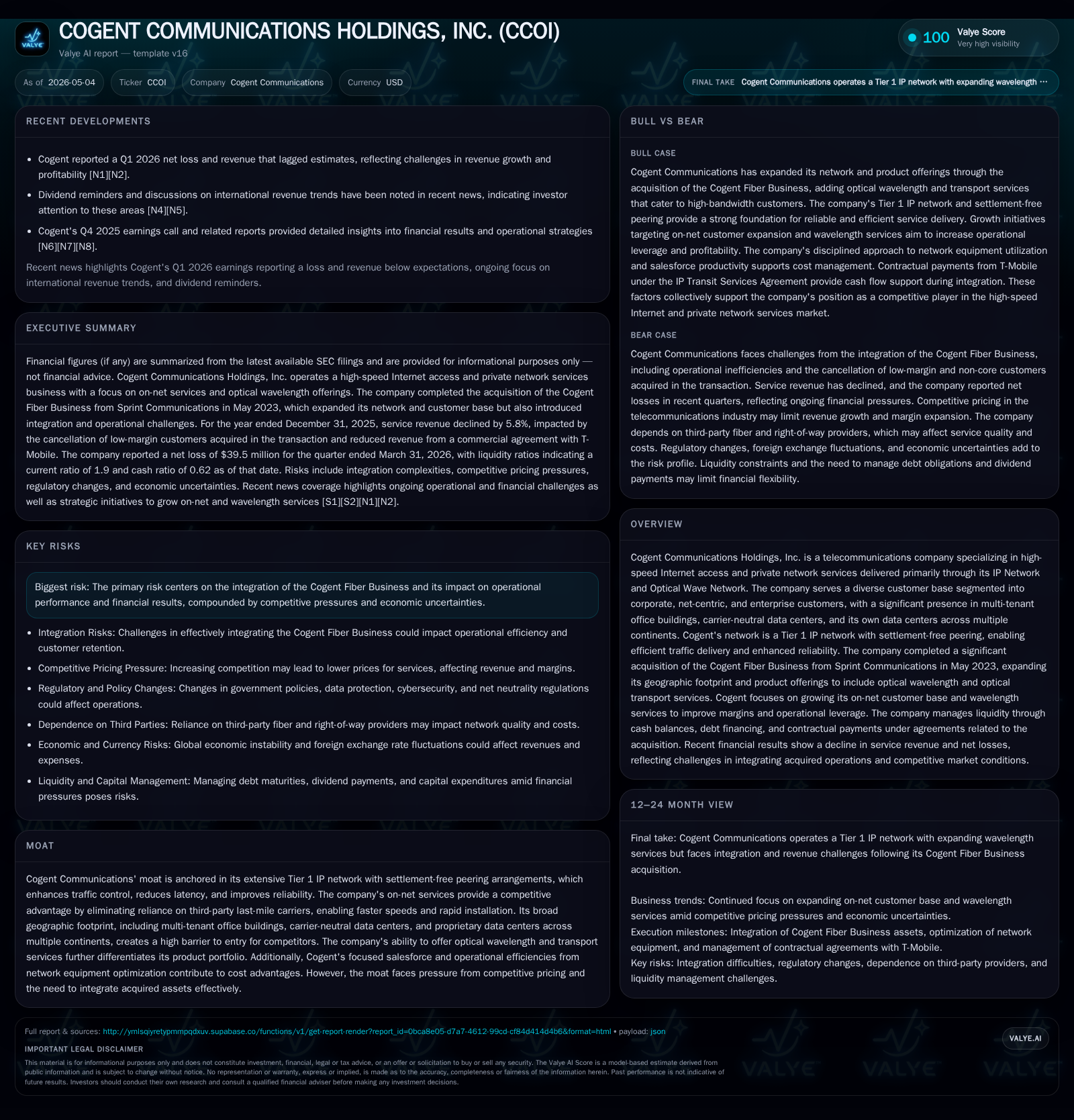
Cogent Communications Holdings, Inc. reported a challenging start to 2026 as integration of the Sprint Fiber Business continues to weigh on operational performance. The company’s core Tier 1 IP network and settlement-free peering remain key competitive advantages but face pressure from pricing competition and economic uncertainties. Expansion into optical wavelength services through the Sprint acquisition broadens product offerings but also adds near-term financial strain. Demand growth is tied to on-net building expansion and network utilization amidst evolving customer office occupancy trends. Financially, Cogent carries significant leverage with over $1.7 billion in debt, balanced by nearly $140 million in cash, maintaining a solid current ratio of 1.9.
Recent Operating Update: Q1 2026 Performance and Integration Progress
Cogent Communications Holdings, Inc.’s latest quarterly filing (10-Q dated May 4, 2026) confirms a continuation of operational challenges tied principally to integrating the Sprint Communications long-haul fiber assets acquired in May 2023 ([S2]). While no material risk factor updates were noted as of March 31, 2026, management is focused on reducing operating costs from the newly acquired fiber business segment, maintaining customer retention, and growing optical wavelength sales ([S18]).
Notably, no repurchases of common stock were executed during Q1 despite an available authorization balance of $105.8 million — reflecting cautious capital allocation in light of integration uncertainties ([S2]). A conference call accompanying the earnings release discussed these themes and emphasized strategic investments to boost Cogent’s on-net building presence to sustain revenue growth ([S3], [N3]).
Business Model: Network Services Anchored in Tier 1 IP Backbone
Cogent operates a Tier 1 IP network providing wholesale Internet transit, private network services, and now enhanced optical wavelength and transport solutions following its Sprint fiber acquisition ([S1], [S21]). Revenue is generated primarily by selling IP Transit Services to large enterprises, content providers, carriers, and multi-tenant offices.
The core Tier 1 IP network boasts settlement-free peering agreements that eliminate transit fees between major networks, supporting efficient traffic flow with low latency — a critical differentiator in broadband backbone services ([S1]). Revenue drivers include:
- On-net building connections that enable last-mile control — reducing reliance on third-party providers and facilitating faster customer installations.
- Volume of managed bandwidth usage charged through contracts; higher traffic translates into greater revenues.
- The mix-shift toward optical wavelength services leveraging long-haul fiber for dedicated connections generates incremental revenue with typically higher margins.
Margins are affected by network equipment costs, fiber lease expenses, and operational efficiencies. Optimization efforts focus on integrating Sprint assets into this model for cost control.
Industry Structure and Competitive Position
The telecommunications backbone sector remains highly competitive with numerous regional fiber providers and national carriers vying for enterprise and carrier business. Price competition is intense given commoditized bandwidth offerings outside proprietary network advantages.
Cogent’s competitive moat stems largely from:
- Its extensive Tier 1 IP backbone with settlement-free peering reducing transit costs.
- Growing geographic footprint covering key US metro areas where it owns or leases fiber connecting thousands of multi-tenant office buildings.
- Proprietary data centers and presence within carrier-neutral facilities enhance switch/connectivity options.
- Newly integrated optical wavelength products offering differentiated dedicated services beyond generic IP transit.
However, this moat faces erosion risks due to relentless price pressure from competitors leveraging alternative infrastructure or aggressive pricing strategies ([S1]). The market also demands consistent service quality upgrades aligned with technology evolution such as software-defined networking.
Growth Drivers
Cogent's growth trajectory hinges on several vectors:
On-Net Building Expansion
Increasing the number of buildings physically connected to Cogent's network reduces dependency on third-party carriers for last-mile access. The company added roughly 126 new on-net buildings in 2025 ([S27]), fueling potential for upselling bandwidth services.
Wavelength and Optical Transport Services
Leveraging the Sprint Fiber assets extends Cogent’s addressable market into high-capacity wavelength services demanded by cloud providers, data-heavy enterprises, and other carriers needing reliable point-to-point connections without capital expenditures for physical infrastructure ([S1], [S17]).
Customer Retention & Traffic Growth
Retaining existing customers—especially those acquired through the Sprint deal—and expanding their usage drives incremental cash flow improvements as integration cost savings progress ([S17]).
Market Recovery Post-Pandemic
With evolving office occupancy patterns affecting demand for enterprise connectivity linked to commercial real estate occupancy trends ([S27]). A partial return-to-office trend supports hybrid work infrastructure needs but uncertainty remains about full recovery pace.
Risks / Watchpoints / Growth Constraints
Key risks that could impact Cogent’s path include:
- Integration Execution: Combining Sprint fiber operations into Cogent’s platform involves operating cost containment challenges and revenue retention risks amid customer churn potential ([S1], [S17]).
- Competitive Pricing Pressure: Industry commoditization fosters margin compression especially if competitors aggressively cut prices or deploy new technologies faster.
- Regulatory Environment: Upcoming regulations affecting data privacy, net neutrality policies or required contributions (e.g., US Universal Service Fund) could impose added costs or constraints ([S1]).
- Economic Uncertainty: Global macro factors including recession fears may reduce enterprise spending while currency translation effects can impact international revenues ([S1]).
- Capital Structure Leverage: Cogent carries substantial indebtedness (~$1.59 billion net debt as of Q4 2025) which constrains flexibility for acquisitions or dividends if operational cash flow underperforms ([F1], [S26]).
What To Watch Next
Key monitors for stakeholders include:
- Progress metrics in reducing operating losses tied to the acquired Sprint fiber business over upcoming quarters ([N3], [S2]).
- Growth pace in optical wavelength service bookings reflecting market acceptance ([S1], [N3]).
- Expansion rate of on-net building connections signaling capacity buildout success ([S27]).
- Quarterly earnings releases revealing improvement or deterioration in free cash flow generation post-integration costs (26).
- Management commentary on competitive positioning amidst pricing pressure trends.[N3]
- Capital allocation decisions regarding dividend sustainability vs share repurchases given leverage levels ([S2], [F1]).
Financial Profile Snapshot (as of Q1 March 31, 2026)
Latest financial snapshot
| Metric | Value | Period |
|---|---|---|
| Cash & equivalents | $140mm | |
| 2026-03-31 | ||
| Total debt | $1730mm | |
| 2025-12-31 | ||
| Net debt | $1590mm | |
| 2025-12-31 | ||
| Current assets | $430mm | |
| 2026-03-31 | ||
| Current liabilities | $226mm | |
| 2026-03-31 | ||
| Current ratio | 1.9x | |
| 2026-03-31 |
Source: SEC companyfacts cache [F1].
*Total debt figure is best effort as per Dec ‘25 data; latest quarter-end figure not explicitly confirmed [F1] **Debt reported at calendar-year end per standard reporting periods [F1]
Despite heavy indebtedness resulting from the Sprint acquisition financing, Cogent retains moderate liquidity supported by nearly $140 million cash reserves and current assets exceeding current liabilities by nearly double ([F1]). Operating losses continue but are expected to moderate upon successful cost synergies realization.
Conclusion
Cogent Communications remains a key player in the wholesale internet connectivity space through its Tier 1 backbone with a growing strategic angle via optical wavelength services following its purchase of Sprint's fiber assets. However, integration complexity coupled with competitive intensity poses continual headwinds to near-term margin expansion. The company's ability to expand its on-net building footprint while successfully migrating customers to higher-margin wavelength offerings is critical for returning to more stable profitability levels amid broader economic uncertainties.
This analysis is based exclusively on publicly available SEC filings including Q1 2026 Form 10-Q [S2], Form 8-K disclosures [S3], annual Form 10-K filings [S1] through May 4th, 2026 data cutoff as well as corroborating recent earnings call transcripts [N3]. All financial figures adhere strictly to reported data points without extrapolation or forecast speculation under the provided policy constraints.
Disclaimer: This is research-only, informational analysis and not investment advice. It may include AI-generated interpretation and general industry context. Always verify important details using primary sources.

Comments