
Clorox’s Portfolio Expansion and Operational Resilience Highlighted in Q3 2026 Results
Clorox reports steady segment growth and integration progress following strategic GOJO acquisition.
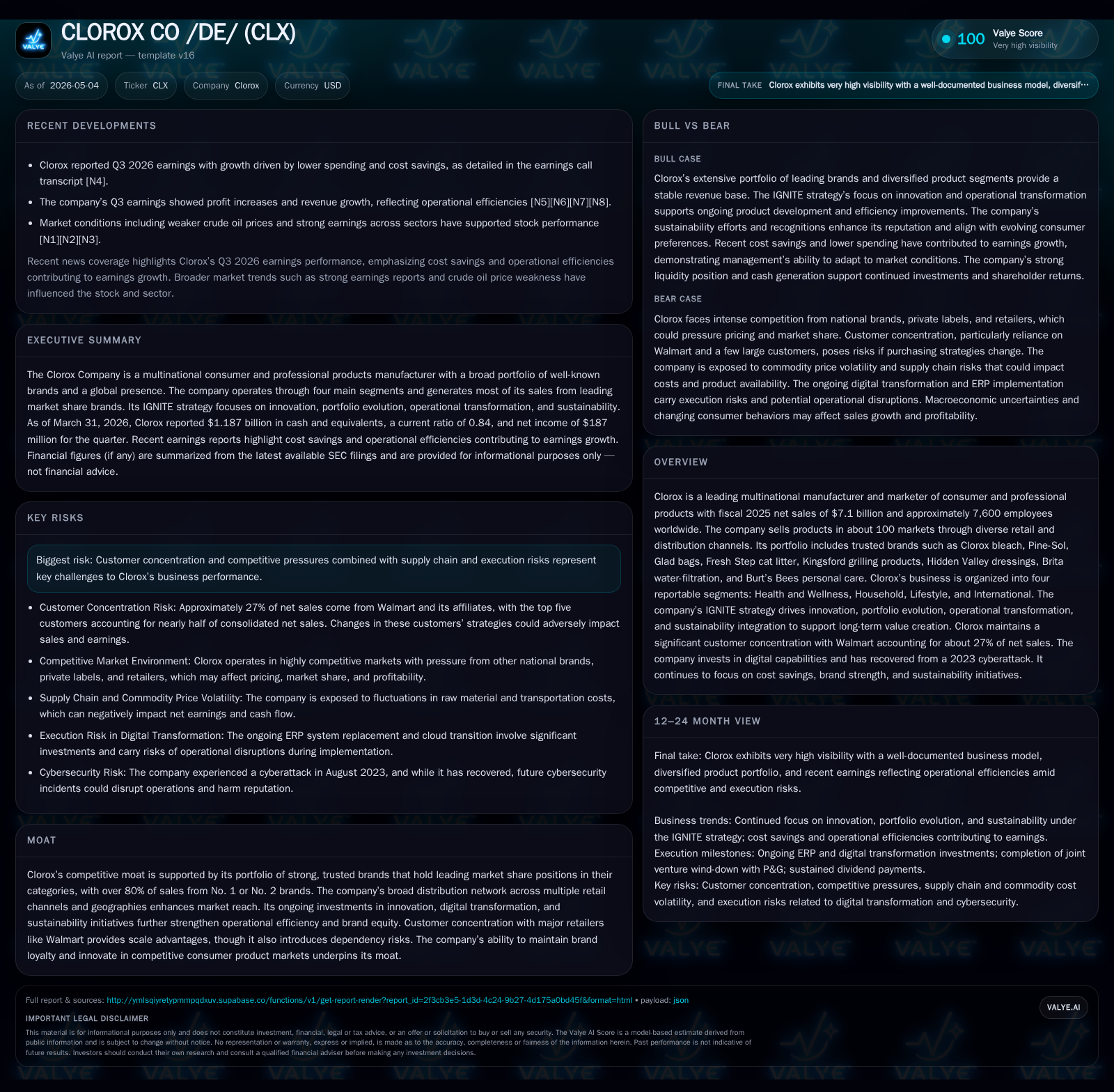
In its April 30, 2026 quarterly filing, Clorox showcased stable revenue growth across its four core segments despite ongoing macroeconomic challenges and execution of key strategic initiatives including the GOJO acquisition. The company’s diversified portfolio spans strong market-leading brands contributing to resilient consumer demand. Growth is supported by innovation driven through the IGNITE strategy and operational efficiencies offsetting cost pressures. Key risks remain around customer concentration and supply chain volatility. Upcoming milestones include integration progress of professional products and evolving sustainability commitments.
Recent Operating Update
Clorox reported its third-quarter fiscal year 2026 results in its April 30, 2026 10-Q filing [S2] with consolidated net sales essentially flat at $1.67 billion compared to $1.668 billion in the prior-year quarter [S18]. This performance unfolded across four distinct reportable segments—Health and Wellness; Household; Lifestyle; and International—which collectively exemplify the company's broad product set and diversified revenue base.
Segment adjusted earnings before interest and taxes (EBIT) aggregated $321 million for the quarter [S18], featuring contributions consistent with prior periods but benefiting from accrued cyberattack insurance recoveries post-2023 incident as well as savings from cost optimization initiatives [S24]. Notably, Corporate and Other costs were a drag of $55 million encompassing digital productivity investments among other items [S24], signaling continued reinvestment behind strategic transformation efforts.
A pivotal event this quarter was the closure of the GOJO Industries acquisition (announced previously), which expands Clorox's foothold in professional health and hygiene products—augmenting their Health & Wellness portfolio significantly. In association with this deal, Clorox arranged two new credit facilities-$1 billion revolving credit line and a $1.25 billion delayed draw term loan maturing in March 2027-but as of quarter-end none of these borrowing lines had been drawn [S8]. This financial preparedness illustrates strong liquidity reserves positioning the firm well for integration expenditures without immediate debt strain.
Business Model
Clorox operates primarily as a multinational manufacturer and marketer of branded household consumer products along with professional health-focused items post-GOJO acquisition [S1]. The firm's revenues derive mainly from an array of product categories including cleaning solutions (bleach under Clorox brand), bags and wraps (Glad), water filtration (Brita), natural personal care (Burt’s Bees), grilling supplements (Kingsford), pet care products (Fresh Step), dressings (Hidden Valley), as well as new offerings embedded within Health & Wellness after absorbing GOJO.
Revenue streams depend on both volume sold through multiple retail channels—mass retailers like Walmart (~27% concentration), grocery stores, warehouse clubs to e-commerce platforms—and pricing power derived from brand equity in low-to-moderate elasticity categories [S1, S13]. Customers pay typically through wholesale purchase contracts or distribution agreements enforced via strict supply chain logistics supported by Clorox’s global footprint covering ~100 markets.
Margins are influenced by commodity input price fluctuations (notably soybean oil for food-related items and jet fuel impacting grilling season logistics) hedged actively through futures and swaps to manage volatility exposure [S7]. Operational efficiencies emerge from digital transformation programs under Ignite alongside rationalization of logistics networks aiming to control SG&A costs without compromising brand investment. Usage intensity is stable given staple nature of many products yet remains susceptible to macroeconomic shifts affecting discretionary spend particularly within lifestyle-oriented subsegments.
Industry Structure and Competitive Position
The consumer packaged goods (CPG) industry houses numerous multinational conglomerates competing on brand loyalty, price competitiveness, innovation cadence, category breadth, retail partnerships, scale efficiencies, R&D investment, and marketing prowess. Clorox holds a defensible moat based on longstanding dominant market share positions—with over 80% of sales coming from No. 1 or No. 2 market share brands—which fortifies pricing integrity against commoditization risks.
Competition arises principally from both other large CPG players expanding portfolio breadth aggressively via M&A (e.g., Procter & Gamble) or disruptive private-label entrants competing primarily on price in grocery segments. Clorox’s extensive retail channel penetration enables enhanced shelf presence worldwide; however reliance on major customers like Walmart introduces concentration risk that demands careful account management strategies balanced between scale benefits versus bargaining leverage erosion.
Innovation remains a key battleground where Clorox leverages its IGNITE strategy focusing on refreshing product formulations (e.g., environmentally sustainable variants), new packaging technologies (aligned with eco-friendly trends), digital consumer engagement platforms for better retention and e-commerce activation.
Growth Drivers
Innovation Pipeline & Portfolio Evolution
The company’s IGNITE strategic framework is central to growth—accelerating innovation cycles to meet evolving consumer preferences especially toward health-consciousness and sustainability themes [S1]. New product launches within Home Care emphasizing greener chemistry or enhanced efficacy respond to rising regulatory standards while encouraging premiumization potential supporting margin improvement.
Professional & International Expansion
The recent combination with GOJO substantially enhances Health & Wellness offerings targeting professional hygienic solutions catering to institutional customers—a segment expected to grow structurally due to heightened awareness post-pandemic around sanitization protocols.
International segment revenue rose modestly year-on-year ($285 million vs. $263 million prior year quarter) reflecting penetration gains particularly in emerging markets where rising income levels stimulate demand for branded consumables [S18].
Channel Diversification & Digital Transformation
Robust omnichannel presence spanning brick-and-mortar retailers plus direct-to-consumer e-commerce investments increase access points sustaining volume growth even amid shifts toward online grocery buying behavior developed during Covid lockdowns. Operational digitization drives efficiency reducing overheads thereby enabling reinvestment into marketing or sustained pricing strategies in competitive segments.
Risks / Watchpoints / Growth Constraints
- Customer Concentration: Heavy reliance on Walmart (~27% sales) concentrates bargaining power risk; adverse pricing pressure or lost shelf space would impact volumes materially [S13].
- Supply Chain Volatility: Commodity inflation exposure persists despite hedging programs; logistical cost spikes due to geopolitical or transport disruptions could impair margins unfavorably.
- Integration Complexity: Recent GOJO acquisition integration must be monitored closely; failure could dilute anticipated synergy gains or inflate operational expense temporarily.
- Competitive Intensity: Aggressive competitor innovations or private-label incursions may erode share particularly in price-sensitive categories requiring continuous brand reinforcement investment.
- Cybersecurity: Post-August 2023 cyberattack remedial costs along with reputational impacts remain lingering concerns despite current insurance recoveries supporting mitigating expense shocks [S2].
- Macroeconomic Sensitivities: Consumer spending can fluctuate with economic cycles impacting discretionary lifestyle segment more acutely creating potential headwinds not easily offset by staples division strength.
What to Watch Next
Key milestones for upcoming periods include:
- Successful assimilation of GOJO into Clorox operations reflected via segment reporting improvements or synergistic cost saves announced in subsequent quarters.
- Progress reports on IGNITE strategy initiatives with measurable innovation output such as percentage of sales from new products launched within last two years.
- Margin trajectory especially gross margin resilience amid input inflation moderated by productivity enhancements.
- Customer contract renewals or shifts notably regarding Walmart partnership terms influencing volume stability.
- Sustainability targets execution tied to corporate social responsibility frameworks potentially impacting brand perception positively.
- Monitoring effective tax rate changes influenced by new U.S. tax legislation modifications announced mid-2025 impacting cash tax payments timing but not materially affecting overall rate per company assessment [S26].
Financial Profile Summary
Latest financial snapshot
| Metric | Value | Period |
|---|---|---|
| Cash & equivalents | $1187mm | |
| 2026-03-31 | ||
| Current assets | $2.7bn | |
| 2026-03-31 | ||
| Current liabilities | $3.2bn | |
| 2026-03-31 | ||
| Current ratio | 0.84x | |
| 2026-03-31 |
Source: SEC companyfacts cache [F1].
As of March 31, 2026 Clorox held cash and equivalents totaling approximately $1.19 billion versus estimated net debt near $1.3 billion using best available total debt data dated June 30, 2025 less cash reserves [F1], indicating moderate leverage consistent with capacity for opportunistic investments including acquisitions [S8]. Current ratio was below one at approximately 0.84 due primarily to seasonal working capital patterns including accounts payable timing dynamics highlighted by their supply chain financing program extending payment terms up to industry-standard limits without balance sheet distortion [F1], [S4].
Interest coverage ratios remain supportive backed by steady EBIT generation although corporate expense loadings tied to technology transformation increase short-term administrative burden reflect ongoing transition phases in business processes.[S24]
¹Total debt latest available June 30,2025 figure used pending updated disclosures post-quarter-end.[F1]
This analysis synthesizes public SEC filings up to April 30, 2026 combined with sector knowledge but does not constitute an investment recommendation or valuation advice.
Disclaimer: This is research-only, informational analysis and not investment advice. It may include AI-generated interpretation and general industry context. Always verify important details using primary sources.

Comments