
Baxter International Faces Operational Headwinds and Recall Challenges While Investing in Manufacturing Efficiency
Q1 2026 results reflect resilience amid Novum LVP recall impact and supply disruptions, with ongoing strategic manufacturing investments.
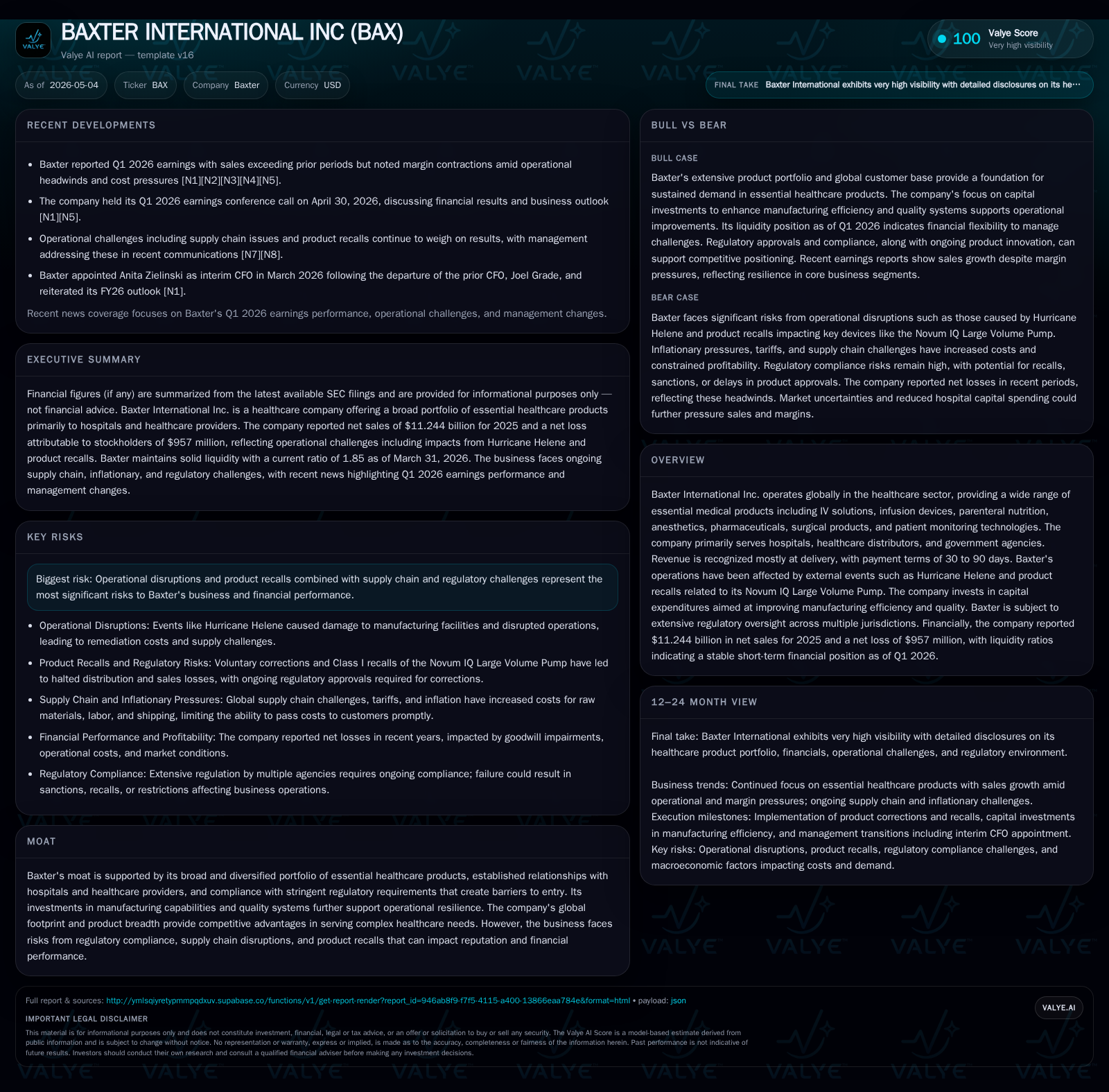
Baxter International’s latest quarter reveals a mixed picture: modest revenue growth despite significant operational challenges including a major voluntary recall of the Novum IQ Large Volume Pump and lingering effects from Hurricane Helene on IV solutions demand. The company continues to invest meaningfully in capital expenditures aimed at enhancing production efficiency and quality systems. Baxter’s broad healthcare product portfolio and extensive hospital relationships underpin its competitive moat, though regulatory scrutiny, product recall repercussions, and supply chain complexities currently weigh on near-term performance. Watch for progress on Novum LVP remediation and recovery in IV solutions demand as key indicators for growth potential.
Recent Operating Update
Baxter International’s Q1 2026 filing [S2] provides the most immediate lens into its operational health amidst challenging circumstances. The company experienced continued setbacks due to the voluntary recall and installation hold on its Novum IQ Large Volume Pump (Novum LVP), which has been out of routine distribution in the U.S. and Canada since mid-2025 due to safety concerns classified as Class I by the FDA. This has led to no meaningful sales from this product line during the period and necessitated accounting for $105 million in remediation reserves related to sales reductions, returns/exchanges, inventory write-downs, and contract asset impairments reported in 2025 [S1].
Additionally, earlier external shocks linger; notably after Hurricane Helene struck Western North Carolina in September 2024 causing damage and operational disruption at Baxter's North Cove IV solutions production site. The supply disruptions led some customers to adopt fluid conservation protocols reducing demand volumes for intravenous solutions—a staple revenue driver—signals that are expected to persist into the near term [S1]. Despite these headwinds, Baxter reported Q1 sales exceeding consensus estimates ([N2], [N4]), evidence of resilient end-market demand supported by other product lines.
Business Model
Baxter International operates within the critical care healthcare sector supplying hospitals, distributors, government agencies, and healthcare providers globally. Its revenue model is grounded primarily in the sale of essential medical products—intravenous solutions; infusion pumps (including alternatives like the Spectrum IQ pump); parenteral nutrition therapies; surgical hemostatic agents; anesthesia-related pharmaceuticals; respiratory devices; plus connected care digital diagnostic tools.
Sales are mostly recognized upon delivery with typical payment terms stretching from 30 to 90 days [S1]. Volume expansion can derive from increased hospital admissions or procedure volumes generating greater consumable usage; price mix improvements come through premium device adoption or geographic expansion; while contract renewals enhance revenue visibility.
Recent voluntary corrections affecting the Novum LVP stand as a critical business challenge since this infusion pump represented a meaningful portion of Baxter’s device portfolio. The replacement by Spectrum IQ pumps mitigates some exposure but does not fully offset lost Novum unit economics or customer trust.
Capital expenditures totalling over half a billion dollars in 2025 underscore a commitment to upgrading manufacturing efficiency, capacity scaling—particularly relevant given recent supply chain constraints—and quality system enhancements critical for regulatory compliance and reputational integrity [S1]. Such investments support long-term sustainable growth despite short-term cost pressure.
Industry Structure & Competitive Position
Baxter’s industry is characterized by high regulatory barriers due to stringent FDA approvals required for medical devices, injectables, and pharmaceutical formulations. These regulatory hurdles create a durable competitive moat as new entrants face steep costs and timelines for market penetration.
Its wide product portfolio across diverse clinical needs—from intravenous fluids fundamental to hospital care to sophisticated connected care patient monitoring technology—enables broad customer engagement within integrated hospital ecosystems. Long-standing relationships bolster switching costs. The company’s global footprint also allows it to serve emerging markets where healthcare infrastructure is developing.
However, competitors such as Becton Dickinson (BD), B. Braun Melsungen AG, Fresenius Kabi AG, Medtronic plc, among others contest fiercely in overlapping segments especially infusion pumps and injectable therapies. Innovation pace combined with reliability reputation shapes competitive dynamics.
Growth Drivers
Several structural factors underpin Baxter’s growth outlook:
- Aging Demographics & Chronic Disease: Global increases in aging populations drive greater hospitalization rates requiring supportive care products like IV solutions and nutrition therapies.
- Technological Integration: Demand rises for smart infusion pumps with connectivity features enabling dosage tracking and error reduction—areas where Baxter invests technology development.
- Emerging Market Expansion: Penetration into rapidly developing healthcare markets offers volume upside as infrastructure investments increase systemic spending.
- Product Portfolio Diversification: By expanding beyond traditional consumables into connected care systems (e.g., smart beds) Baxter tries to capture higher value-added service opportunities.
- Manufacturing Excellence Investments: Efforts towards operational optimization aim to improve margins through cost efficiencies while maintaining regulatory compliance standards necessary under increasingly complex global regulatory environments.
Risks / Watchpoints / Growth Constraints
- Recall & Product Safety Setbacks: The sustained impact from the Novum LVP recall highlights vulnerability inherent in device reliability issues including potential lasting erosion of brand confidence.
- Supply Chain Disruptions: External factors including weather events (Hurricane Helene) or global raw material shortages constrain production continuity affecting fulfillment capability.
- Regulatory Environment: Constantly evolving global rules necessitate rigorous compliance investments incurring financial burdens while threatening market access delays.
- Environmental Liabilities: Ongoing responsibility at several Superfund sites exposes litigation risk potentially impacting financial outcomes [S13][S14].
- Financial Leverage Levels: With net debt approximating $7.48 billion at end-2025 against $2 billion cash reserves [F1], leverage management remains pivotal especially if adverse events require incremental capital deployment.
What To Watch Next
Investors focused on execution should monitor several key milestones:
- Timetable updates on FDA clearance or launch of corrected Novum LVP versions or alternative pumps that can recapture lost share.
- Trajectory of IV solutions demand normalization post-Hurricane Helene-associated fluid conservation measures.
- Quarterly margin rebound driven by operational efficiencies or cost rationalizations following elevated remediation charges.
- Capital expenditure pacing indicating further capacity buildout or technology upgrades supporting growth ambitions.
- Updates on any litigation environment shifts related to environmental cleanups or historic compliance matters affecting reputational risk.
- Dividend declarations reflective of liquidity management strategy amid balance sheet leverage considerations given cash flow patterns noted through early 2026 filings [S3].
Financial Profile Summary (Q1/FY Metrics)
Latest financial snapshot
| Metric | Value | Period |
|---|---|---|
| Cash & equivalents | $2.0bn | |
| 2026-03-31 | ||
| Total debt | $9.5bn | |
| 2025-12-31 | ||
| Net debt | $7.5bn | |
| 2025-12-31 | ||
| Current assets | $6.8bn | |
| 2026-03-31 | ||
| Current liabilities | $3.7bn | |
| 2026-03-31 | ||
| Current ratio | 1.85x | |
| 2026-03-31 |
Source: SEC companyfacts cache [F1].
Liquidity appears stable with a comfortable current ratio exceeding typical safety benchmarks despite substantial gross debt levels ([F1]). Capital structure refinements such as refinancing efforts highlighted during 2025 reduce near-term maturity pressures yet keep leverage elevated relative to peers typical for highly acquisitive healthcare industrial firms pursuing scale objectives.
Disclaimer
This analysis is intended strictly for informational purposes reflecting disclosed company information without investment advice or recommendations.
Disclaimer: This is research-only, informational analysis and not investment advice. It may include AI-generated interpretation and general industry context. Always verify important details using primary sources.

Comments