
HF Sinclair's Q1 2026 Report: Operational Strength and Commodity Exposure Amid Industry Pressures
HF Sinclair's latest quarterly filing reveals robust earnings supported by refining operations and renewable fuels blending, while navigating commodity price volatility and regulatory demands.
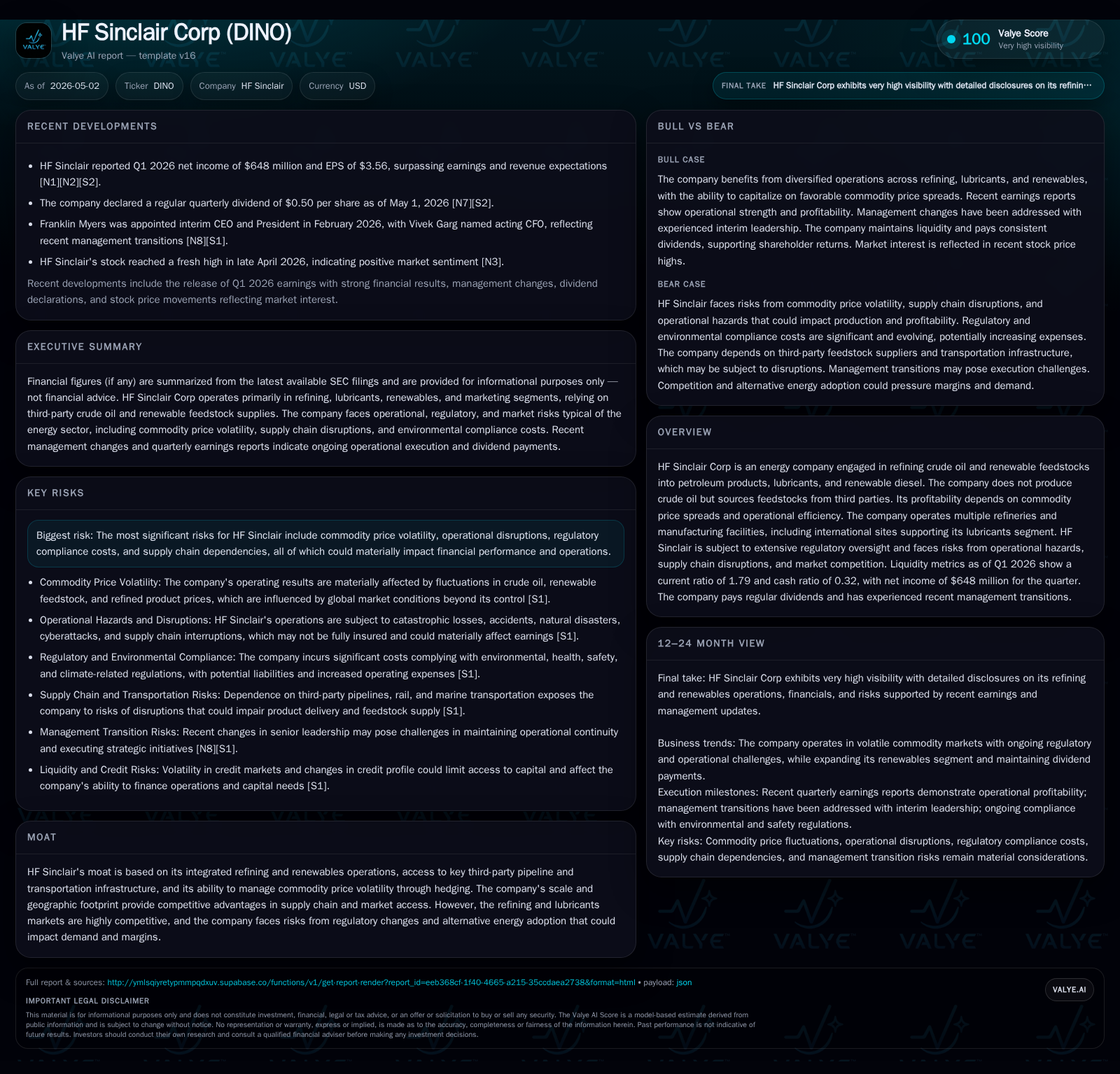
In its Q1 2026 10-Q filing, HF Sinclair Corp reported strong net income of $648 million, supported by operational efficiency and favorable commodity spreads. The company maintains a balanced liquidity position with a current ratio of 1.79, managing $2.8 billion in total debt against $1.15 billion in cash. HF Sinclair’s integrated refining and renewables business model leverages scale and geographic diversity but must contend with volatile feedstock costs, regulatory compliance, and growing competition from alternative energy sources. Key growth drivers include renewable diesel capacity expansion and optimized supply chain access, while risks center on commodity price swings, operational disruptions, and evolving environmental regulations. Upcoming developments to watch are capital allocation decisions and execution of strategic projects aligned with sustainability goals.
Q1 2026 Operating Update
HF Sinclair’s latest quarterly filing (10-Q dated May 1, 2026) anchors the current assessment of the company's operating performance and financial health [S2]. The company reported net income of approximately $648 million for the quarter ended March 31, reflecting sustained profitability driven by operational efficiencies and favorable market conditions for refined products [F1][S3]. Liquidity metrics remain robust with a current ratio of 1.79 supported by $1.15 billion in cash against total debt of $2.8 billion as of quarter-end; net debt stands near $1.65 billion [F1].
This strong cash position coupled with manageable leverage offers HF Sinclair flexibility during continuing commodity price volatility inherent to the refining sector.
Management declared a regular quarterly dividend of $0.50 per share alongside announcing this financial snapshot, signaling ongoing shareholder returns despite industry cyclicality [S3].
No material changes were noted in risk factors compared to the prior annual filing cycle ending December 31, 2025—confirming continuity in exposure to commodity risk, regulatory complexity, operational hazards, and competitive pressures that shape performance outcomes [S2].
Business Model Overview
HF Sinclair operates as an integrated midstream-to-refined products player focused on converting crude oil and renewable feedstocks into petroleum products including gasoline, diesel fuels, specialty lubricants, and renewable diesel [S1]. Unlike upstream producers, HF Sinclair does not engage in exploration or production; instead sourcing all feedstocks from third-party suppliers.
Revenue generation relies heavily on the spread between crude feedstock costs and product selling prices—a classic crack spread dynamic highly sensitive to global oil market fluctuations.
The company's revenue mechanics involve contracted or spot purchases of crude oil or bio-feedstocks paid upfront or on delivery terms; then processing these through refineries where volume throughput (capacity utilization), yield optimization (product mix), pricing shifts in intermediate/final products, and hedging activities drive margin outcomes.
Economies of scale play a critical role in cost efficiency: HF Sinclair manages multiple refinery assets strategically located across the United States with select international facilities supporting its lubricant operations.
Moreover, HF Sinclair has invested in renewable diesel production capacity targeting growing demand for low-carbon fuels driven by governmental regulations incentivizing emissions reductions in transportation fuels—a key structural growth vector within its portfolio.
Fee-based revenues also arise from logistics services tied to pipeline access rights or product distribution contracts—adding diversification beyond purely commodity-dependent earnings.
Industry Structure & Competitive Position
The refining sector is capital-intensive with significant barriers related to technological expertise, environmental compliance requirements, pipeline connectivity, retail distribution networks, and economies of scale.
Competition stems from major integrated oil companies with upstream interests who benefit from vertical integration offsets versus pure play refiners like HF Sinclair which rely on third-party feedstock procurement.
HF Sinclair’s moat is characterized by:
- Geographic diversification that mitigates regional feedstock or product market disruptions,
- Integration between traditional refining operations and renewables blending capabilities,
- Access to key pipeline infrastructure enabling efficient inbound feedstock receipt and outbound product shipments,
- Operational excellence programs enhancing throughput efficiency and yield conversion,
- Hedging programs designed to shield earnings volatility related to raw material price swings,
- Established lubricants segment providing stable cash flow streams.
Nevertheless, the company faces increasing headwinds as alternative energy adoption gains traction globally challenging demand growth for conventional petroleum products over medium-to-long term horizons.
Growth Drivers
Renewable fuel mandates such as U.S. Renewable Fuel Standard (RFS) obligations underpin expanding demand for renewable diesel produced from bioderived feedstocks—a segment where HF Sinclair has focused capital deployment efforts [S17].
Operational improvements focusing on refinery utilization rates offer upside leverage when product cracking margins widen favorably—controlled maintenance schedules and supply chain resilience further enhance throughput stability.
The ability to flexibly source feedstocks including discounted heavy crude or bio-feedstocks strengthens margin capture opportunities relative to competitors lacking such versatility.
Strategic initiatives addressing ESG commitments may unlock new markets or partnerships while positioning HF Sinclair amid tightening emissions regulation landscapes potentially limiting competitor access or imposing higher exit costs on less compliant peers.
Risks & Watchpoints
Commodity price volatility remains paramount risk given direct dependence on fluctuating crude oil costs versus product price spreads driving profitability. Hedging mitigates but cannot fully eliminate this exposure [S10].
Operational risks include potential catastrophic losses or unplanned outages at refineries or pipelines that could disrupt production volume significantly impacting financial results [S1].
Regulatory compliance burdens continue rising around environmental laws—including carbon emissions caps, fuel content mandates, pipeline integrity requirements enforced by PHMSA—and failure results in fines or operational restrictions adversely impacting earnings [S5][S6][S9].
Supply chain dependencies subject HF Sinclair to vendor nonperformance risks that could elevate input costs or limit raw material availability constraining production levels [S7].
Labor relations pose additional risk as portions of workforce are unionized; strikes or labor shortages can impact productivity or increase costs [S15].
Finally, recent executive management transitions introduce execution risk during governance handoff periods affecting strategic decision making pace or capital allocation discipline [S28].
What to Watch Next
Investors should monitor HFS’s progress on renewable diesel capacity expansions consistent with regulatory-driven demand growth forecasts.
Execution efficiency on planned capital projects aimed at enhancing refinery yields and sustainability targets will be pivotal for margin expansion prospects.
Quarterly updates about feedstock sourcing economics relative to crack spread movements will offer insights into near-term earnings volatility drivers.
Further disclosures concerning regulatory compliance outcomes or pipeline safety initiatives could materially affect risk perception.
Capital allocation decisions—especially regarding dividends versus share repurchases—in response to evolving cash flows will signal management confidence levels regarding sustainable profitability.
Inventory levels and hedging activity disclosures will provide clarity on how HFS balances upside participation against downside protection amid persistent commodity cycles.
Disclaimer
This analysis is based solely on publicly available filings as identified without any speculative projections beyond documented data points. It does not constitute investment advice or recommendations but serves as an informed overview grounded in disclosed operational facts.
Latest financial snapshot
| Metric | Value | Period |
|---|---|---|
| Cash & equivalents | $1148mm | |
| 2026-03-31 | ||
| Total debt | $2.8bn | |
| 2026-03-31 | ||
| Net debt | $1652mm | |
| 2026-03-31 | ||
| Current assets | $6.4bn | |
| 2026-03-31 | ||
| Current liabilities | $3.6bn | |
| 2026-03-31 | ||
| Current ratio | 1.79x | |
| 2026-03-31 |
Source: SEC companyfacts cache [F1].
Disclaimer: This is research-only, informational analysis and not investment advice. It may include AI-generated interpretation and general industry context. Always verify important details using primary sources.

Comments