
SL Green Realty's Strategic Capital Moves and Leasing Momentum in Q1 2026
SL Green executed an amended credit facility and achieved record leasing occupancy in Manhattan office properties during Q1 2026.
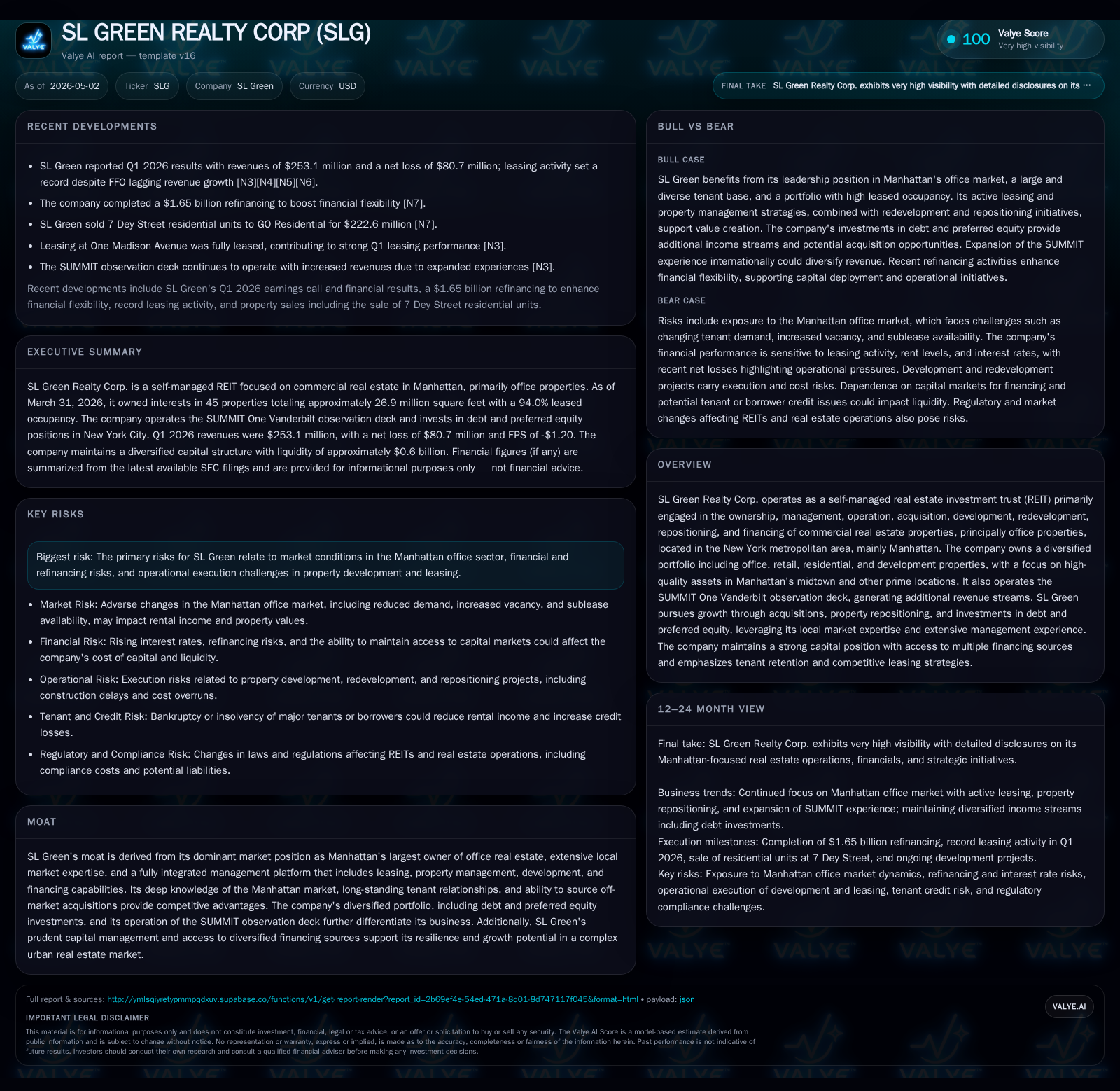
In the first quarter of 2026, SL Green Realty Corp. enhanced its financial flexibility with a newly amended $1.25 billion revolving credit facility extending to 2030-31 and maintained robust leasing momentum, pushing the weighted average leased occupancy of its Manhattan office portfolio to 94.3%. The company’s integrated platform continues to leverage its dominant market presence, high-quality asset base, and diversified revenue sources including office rents and the SUMMIT One Vanderbilt observation deck. While refinancing risks exist, SL Green's prudent capital structure and local market expertise position it well amidst evolving Manhattan office market dynamics.
Q1 2026 Operational Highlights and Capital Update
SL Green Realty Corp.’s latest quarterly filing dated May 1, 2026 [S2] reveals significant developments underscoring both operational strength and enhanced financial flexibility. As of March 31, 2026, the company had lifted the weighted average leased occupancy across its Manhattan commercial portfolio—comprising primarily office properties—to an impressive 94.3%, marking a notable increase from the previous year's occupancy figures. This was achieved amid record leasing volumes flagged during the Q1 earnings call [N2][N3], spotlighting continued tenant demand even as broader market headwinds persist.
Capital management also saw material progress with SL Green entering into an amended and restated credit facility on March 18, 2026 (the “2026 Credit Facility”) [S2]. The facility includes a $1.25 billion revolving credit line maturing June 2030 with two automatic six-month extension options to June 2031, reflecting a strategic extension of liquidity duration amidst uncertain capital markets. Additionally, the facility accommodates a $300 million Term A Loan set to mature in May 2027. This action effectively lengthens debt maturity profiles compared to prior facilities amended in December 2021 and demonstrates proactive refinancing execution.
Cash balances remained stable at $338.6 million at quarter-end versus $337 million one year prior [S2], underpinning steady liquidity while net cash used in operating activities was offset by significantly increased cash inflows from financing activities driven by new borrowings. These moves provide SL Green with capital room to support ongoing redevelopment projects and capitalize on growth opportunities.
Business Model: Integrated Manhattan Office REIT Platform
SL Green operates as a self-managed REIT concentrated predominantly on high-quality commercial real estate within Manhattan’s core office submarkets [S1][S2]. The company generates revenue primarily through leasing rents from office tenants supplemented by retail leases, residential units within select properties undergoing repositioning or development, and alternative streams such as preferred equity investments alongside operating the SUMMIT One Vanderbilt observation deck—a unique experiential asset adding diversified income outside traditional rent rolls.
This vertically integrated platform encompasses property acquisition, asset management including leasing and property operations, development/redevelopment capabilities focused on adding value through repositioning older assets or developing new space, and financing activities including debt/equity structuring [S1]. Synergies arise from controlling multiple facets of the value chain locally in the tightly competitive New York metropolitan real estate market.
High tenant retention levels combined with long lease durations help stabilize income flows while ongoing capital expenditures target enhancing building appeal to drive rental growth [S1][S2]. The company also utilizes an extensive third-party broker network to augment in-house leasing efforts ensuring broad tenant outreach.
Competitive Advantages in the Manhattan Commercial Real Estate Market
SL Green commands a defensible moat rooted in its scale as Manhattan’s largest owner of office real estate [S1]. With over approximately 24 million square feet under ownership across consolidated and unconsolidated properties primarily situated in midtown Manhattan—the highest-value commercial district—the firm enjoys substantial market share enabling control over prime assets.
The company's dominant presence translates into superior tenant relationships borne from deep local expertise accumulated over decades. Its integrated platform spanning leasing through finance enables swift transaction execution including sourcing off-market deals inaccessible to smaller competitors [S1][S2]. The inclusion of the SUMMIT One Vanderbilt observation deck further diversifies revenue while enhancing overall tenant/stakeholder engagement beyond typical landlord offerings.
Geographic concentration is both a strength—allowing focused management—and a risk given localized economic cycles but historically Manhattan's commercial real estate sustains premium valuation relative to other U.S. markets owing to its global business hub status.
Strategic Growth Drivers: Leasing Momentum and Asset Repositioning
Leasing performance constitutes SL Green’s principal growth driver demonstrated by lease upticks reflected in Q1 occupied rates reaching roughly 94.3% for core commercial assets [S2]. Record high leasing volumes documented during earnings call [N2][N3] underscore cyclical recovery but also reflect structural resilience as flexible work arrangements increasingly settle into hybrid models demanding quality space.
The firm's active redevelopment pipeline—including repositioning older office buildings into modernized assets—fosters rent roll expansion via improved tenant appeal supporting rental rate increases over subsequent leasing cycles [S2]. Moreover, high tenant retention stems from proactive management programs leveraging leasing expertise coupled with accommodating lease expirations flow manageable for renewals rather than abrupt vacancies [S1].
Additional lease renewal spreads are expected based on upfront investments in capital improvements matching shifting tenant preferences toward sustainable buildings with cutting-edge amenities—a trend increasingly critical within environmentally conscious corporate tenants.
Risks and Operational Constraints in a Complex Urban Market
Primary risk exposures for SL Green stem from factors tied directly to Manhattan’s office sector dynamics which remain susceptible to both cyclical downturns and structural shifts post-pandemic including persistent remote/hybrid working adoption that could temper long-run space demand [S1]. Lease rollover timing notably coincides with refinancing milestones posing refinancing risk especially for the $300 million Term A Loan maturing May 2027 requiring attention given current credit markets [S2].
Operational execution risks cluster around timely completion of redevelopment projects where delays or cost overruns could weigh upon projected returns [S1]. Tenant credit risk remains elevated versus pre-pandemic norms but high-credit-quality tenant mix partially mitigates this exposure.
An additional challenge is maintaining pricing power amid greater sublease availability putting pressure on new leasing terms; however SL Green’s prime asset quality partly shields it compared to lower-tier competitors.
Near-Term Watchpoints: Leasing Performance, Refinancing Activities, and Market Conditions
Key forthcoming milestones center on quarterly leasing updates indicating whether recent momentum sustains or slows amid evolving economic conditions [S2][N3]. Leasing spread outcomes across forthcoming renewals will clarify rental growth prospects potentially impacting Funds Available for Distribution (FAD) metrics reported using non-GAAP adjustments detailed by SL Green [S3].
Refinancing activity warrants close monitoring around term loan maturities within next year-plus horizon; successful proactive extensions or refinancings would reduce short-term liquidity pressures while poor capital market access could elevate refinancing costs or constrain funding capacity.
Additionally anticipated residential condominium sales conversions within repositioned properties serve as incremental capital recycling possibilities noted through dispositions agreements executed recently [S2]. Expansion possibilities for the SUMMIT brand internationally also represent longer-term diversification vectors deserving observation.
Financial Overview: Capital Structure and Liquidity as of Q1 2026
As per the Q1 filings dated May 1, 2026 [S2][S3], SL Green retained healthy liquidity facilities highlighted by cash plus restricted cash around $338.6 million at period end versus nearly flat year-on-year balances approximating $337 million prior period balances. Total consolidated debt was reported at roughly $4.77 billion consisting predominantly (86%) of fixed rate instruments with limited variable rate exposure (~13.9%) after considering offsetting variable rate preferred equity investments that partially hedge interest expense volatility.
The amended credit structure features a sizable revolving credit facility sized at $1.25 billion maturing June 2030 with extension rights out to June 2031 plus staggered term loans creating staged amortization schedules reducing lumpiness risks inherent in large bullet repayments [S2][S16]. Interest expense reflects current borrowing costs based on spreads over Term SOFR adjustable per prevailing credit rating conditions allowing some interest rate variability tempered by derivative use.
Operating cash flows utilized during Q1 were negative driven mostly by investing activities funding redevelopment projects ($692 million net cash used) but offset by financing receipts largely from additional borrowings totaling just over $712 million boosting liquidity for capital deployment programs [S2]. These factors demonstrate how investment activity currently outpaces operational cash generation necessitating reliance on access to capital markets—a characteristic consistent with growth-focused REIT strategies.
This analysis is based solely on publicly available information sourced from recent SEC filings including Form 10-Q (May 1, 2026), Form 8-K (April 16, 2026), Form 10-K (February 17, 2026), and corroborated company news transcripts without offering investment advice or price forecasts. Readers should consider risks related to sector cyclicality inherent in commercial real estate markets when interpreting this overview.
Disclaimer: This is research-only, informational analysis and not investment advice. It may include AI-generated interpretation and general industry context. Always verify important details using primary sources.

Comments