
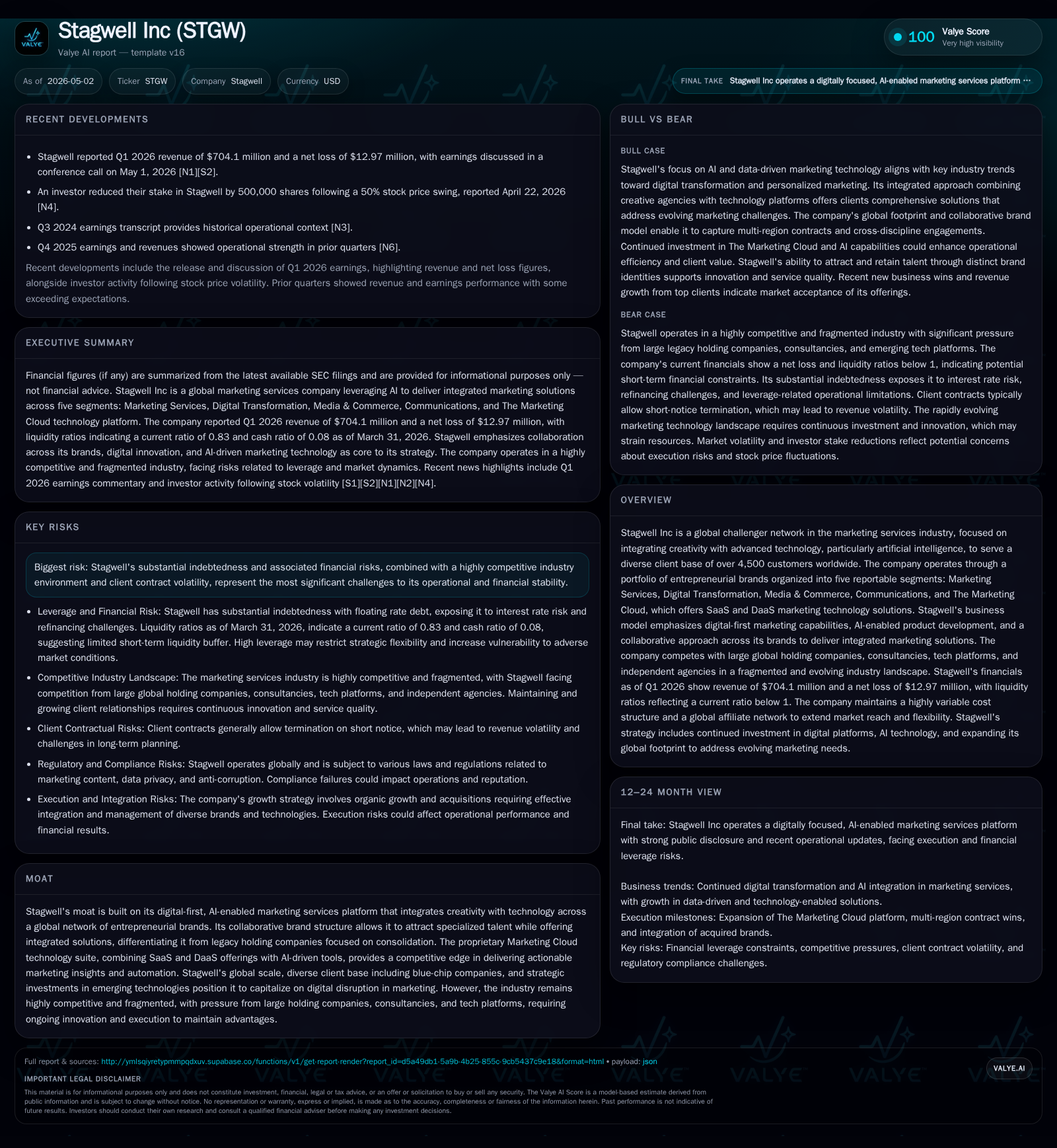
Stagwell's Q1 2026: Digital Growth Focus Tempered by Financial Leverage and Competitive Pressures
Stagwell Inc.’s latest quarterly results underscore its strategic bets on AI-enabled marketing services amid prevalent industry challenges and financial constraints.
In its Q1 2026 filing, Stagwell Inc. demonstrated continuing investment in digital transformation and AI-driven marketing technology, sustaining growth opportunities despite competitive headwinds and macroeconomic sensitivity. The company’s operational model blends entrepreneurial brands across diverse marketing service lines, with an expanding Marketing Cloud SaaS/DaaS platform that differentiates it in a fragmented marketplace. However, its heavy debt load and economic exposure present ongoing risks to execution and financial flexibility. Market demand drivers align with secular shifts toward integrated digital marketing and AI adoption, while watchpoints include client retention, margin stability, and capital structure management.
Recent Operating Update
Stagwell Inc.'s 10-Q filing for Q1 2026 [S2] along with the earnings release dated April 30, 2026 [S3] reveal the company advancing its strategic transition towards AI-enabled digital marketing services. The quarter underscored steady operational execution with continued client demand growth across core verticals despite broader market headwinds. While the full financial details for Q1 are summarized in the earnings release [N1][N2], the narrative focuses on efforts to drive integrated offerings across its portfolio of over 4,500 global clients.
A notable recent event was bolstering its Digital Transformation segment through acquisitions such as Wavelength Strategy [S1][S12], expanding advocacy-focused digital advertising capabilities combined with SKDK's political consultancy. This enhances Stagwell’s cross-brand integration potential.
Further, Stagwell’s commitment to The Marketing Cloud—a proprietary suite combining SaaS and DaaS solutions leveraging AI-driven automation—is a focal point of growth investment [S1][S12]. These technology assets address marketers’ increasing demand for instant data-driven insights and content creation tools.
Business Model
Stagwell operates a complex yet cohesive business model centered on providing comprehensive marketing services by harnessing a portfolio of entrepreneurial agencies grouped into five reportable segments: Marketing Services; Digital Transformation; Media & Commerce; Communications; and The Marketing Cloud [S1][S29].
Revenue generation is primarily fee-for-service based from clients spanning Fortune 500 companies like Google, Amazon, Nike, Apple, P&G, and Salesforce. These fees cover creative campaigns, media buying, brand research, experiential events, public affairs consulting, and subscription-based technology licensing via The Marketing Cloud.
Client relationships are typically contractually flexible with relatively short termination windows common in the advertising industry. This necessitates constant innovation and performance delivery to maintain client loyalty [S1]. Pricing power relies heavily on proven ROI from AI-augmented solutions and integrated multi-disciplinary offerings delivered at scale.
Operationally, Stagwell maintains a highly variable cost base emphasizing at-will employment to adapt quickly to shifts in client demand or macroeconomic shocks [S9]. Digitally focused engineering centers in lower-cost regions (Latin America nearshore; Egypt, India offshore) underpin platform development while controlling costs.
Industry Structure and Competitive Position
The marketing services landscape remains highly fragmented with stiff competition from entrenched global holding companies (WPP, Omnicom), consultancies expanding into marketing (Accenture Interactive), tech platforms encroaching on media buying (Google Ads), as well as independent niche agencies [S1].
Stagwell positions itself as a challenger network that integrates creativity with advanced technology — chiefly artificial intelligence — creating a digitally native alternative to legacy conglomerates whose portfolios often suffer from overlapping functions and slower innovation cycles.
Its moat derives from combining entrepreneurial agility with scale benefits across regional operations, enabling participation in large multi-region contracts exceeding $10 million annually [S1]. Proprietary tools from The Marketing Cloud add defensibility through SaaS/DaaS revenue streams that blend analytics with actionable marketing insights powered by AI.
However, competitive pressures are intense given the pace of technological change and the need for continuous investment in emerging capabilities such as AI content generation or real-time analytics. Entrants like consultancies benefit from deep client relationships while tech platforms offer unparalleled ad inventory access.
Growth Drivers
Digital Capability Investments
Stagwell’s primary growth engine involves deepening its suite of digital products under The Marketing Cloud umbrella [S12]. By offering AI-powered research automation, content creation tools, and communications management software for marketers' self-service use cases alongside agency-led projects, it aims for increased wallet share within existing clients plus acquisition of new customers seeking advanced MarTech solutions.
Geographic Expansion & Global Affiliates
Acquisitions targeting international markets (e.g., Create Group in MENA region) complement organic expansion [S21]. A global affiliate network exceeding 70 partners allows local talent inclusion without heavy upfront capital costs while qualifying targets for future acquisitions enables measured scaling.
Cross-Brand Integration & Large Client Wins
Developing tightly integrated offerings across multiple segments addresses evolving client demands for full-funnel marketing services extending beyond traditional silos. This strategy has driven approximately 16% year-over-year revenue growth from top-100 clients [S5]. Securing multi-disciplinary contracts with blue-chip global marketers supports higher average client spend.
Emerging Technologies & AI Applications
Continued enhancement of AI capabilities positions Stagwell favorably to exploit secular shifts towards data-driven personalized marketing. Its ability to deliver both creative excellence paired with cutting-edge tech tools is key amid increasing digital disruption.
Risks and Watchpoints
Financial Leverage Constraints
As of March 31, 2026, Stagwell carried total debt near $1.44 billion against cash reserves around $115 million resulting in net debt roughly $1.32 billion [F1]. Its current ratio under 1 (0.83) signals liquidity tightness [F1]. This indebtedness exposes Stagwell to refinancing risks especially amid rising interest rates due to predominantly floating-rate credit facilities [S6][S7][S8]. Such leverage restricts agility in pursuing opportunistic investments or weathering downturns.
Macroeconomic Exposure Affecting Client Spend
Revenue is vulnerable to economic cycles impacting discretionary marketing budgets [S4]. Inflationary pressures can increase labor costs faster than fees can be raised tightening margins. Prolonged uncertainty may cause clients to delay or reduce marketing expenditures impacting top-line growth.
Client Contract Volatility & Competition Losses
Short notice termination rights compel continuous performance excellence. Client churn linked to management changes or competitor poaching remains an inherent risk [S11]. The fast-evolving market landscape requires continuous innovation investment or risk relevance erosion.
Regulatory Complexity & Data Privacy Rules
Global operations face varied legal regimes governing advertising content as well as stringent data privacy laws impacting digital marketing approaches [S17]. Compliance failures could hinder operational freedom or invite fines damaging reputation.
Talent Retention Challenges
The company depends heavily on key personnel including CEO Mark Penn [S17], alongside creative technologists dispersed worldwide. Retention difficulties can jeopardize quality delivery at scale.
What To Watch Next
Stagwell’s near-term execution markers include:
- Quarterly bookings trends relative to prior periods signaling sales momentum.
- Cross-segment synergy capture effectiveness driving incremental revenues/cost savings.
- Commercial traction of Marketing Cloud SaaS/DaaS platforms measured by subscription uptake or renewal rates.
- Refinancing activity or debt reduction efforts improving liquidity posture amid macro uncertainties.
- Margin stabilization or improvement evidence considering inflationary cost pressures.
- New multi-region contract awards confirming appeal among large global marketers.
- Retention metrics for key clients particularly top-100 accounts indicating relationship strength.
Financial Profile (Latest Snapshot)
Latest financial snapshot
| Metric | Value | Period |
|---|---|---|
| Cash & equivalents | $115mm | |
| 2026-03-31 | ||
| Total debt | $1440mm | |
| 2026-03-31 | ||
| Net debt | $1325mm | |
| 2026-03-31 | ||
| Current assets | $1215mm | |
| 2026-03-31 | ||
| Current liabilities | $1469mm | |
| 2026-03-31 | ||
| Current ratio | 0.83x | |
| 2026-03-31 |
Source: SEC companyfacts cache [F1].
| Metric | Value | Period |
|---|---|---|
| Cash & Equivalents | $114.9 million | |
| 2026-03-31 | ||
| Total Debt | $1.44 billion | |
| 2026-03-31 | ||
| Net Debt | $1.32 billion | |
| 2026-03-31 | ||
| Current Assets | $1.22 billion | |
| 2026-03-31 | ||
| Current Liabilities | $1.47 billion | |
| 2026-03-31 | ||
| Current Ratio | 0.83 | |
| 2026-03-31 | ||
| Revenue (TTM) | $2.91 billion | |
| 2025-12-31 | ||
| Operating Income | $159 million | |
| 2025-12-31 | ||
| Net Income | $29 million | |
| 2025-12-31 |
Liquidity tension indicated by a sub-unity current ratio places emphasis on efficient working capital management going forward; meanwhile operational profitability remains solid but constrained by economic factors affecting client spending patterns [F1][N2][S2].
This analysis summarizes public SEC filings alongside recent news coverage as of May 2026 without investment opinions.
Disclaimer: This is research-only, informational analysis and not investment advice. It may include AI-generated interpretation and general industry context. Always verify important details using primary sources.

Comments