
Linde Plc’s Strategic Growth and Margin Expansion Drive Industrial Gas Leadership
Linde’s Q1 2026 results reflect strength in pricing, volume growth, and operational efficiency amid a complex global industrial gases market.
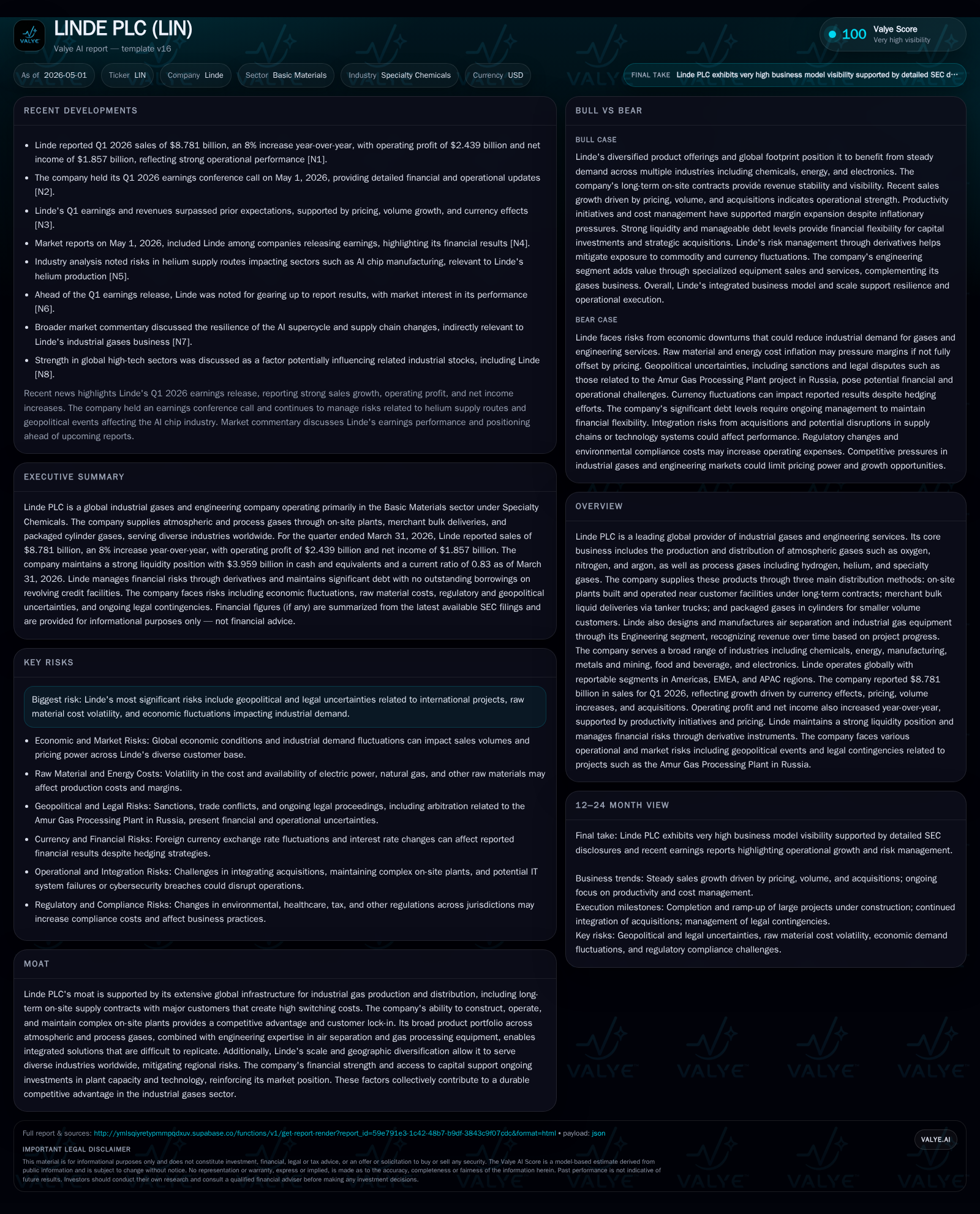
In its latest quarterly filing, Linde Plc reported an 8% revenue increase driven by currency tailwinds, higher pricing, modest volume gains from new projects, and acquisitions. Adjusted operating margins expanded to 30%, highlighting effective cost management despite inflationary pressures. The company’s integrated business model, anchored by long-term on-site contracts and engineering services, supports stable cash flow and strong competitive positioning. Growth is expected to be fueled by ongoing contract price realization, volume expansion from project startups, and synergy from engineering backlog execution, while risks from raw material costs and geopolitical challenges remain relevant pillars. Linde’s balance sheet shows healthy liquidity with $3.96 billion in cash against net debt of approximately $15.9 billion as of March 31, 2026.
Latest Quarterly Operating Update: Sales Growth and Margin Performance
Linde Plc's first quarter of 2026 marked an 8% increase in sales to $8.78 billion compared to Q1 2025, primarily reflecting favorable currency translation effects that added roughly 5 percentage points to growth due to Euro strength versus the U.S. dollar [S2][S6]. Higher prices contributed an additional 2% lift through successful contract renegotiations across industrial sectors with embedded cost pass-through clauses that shield against energy cost volatility [S4]. Volume expansion was relatively modest at +1%, spurred mainly by start-up contributions from newly commissioned projects rather than broad demand acceleration [S4][N1]. Acquisitions further contributed around +1% growth as Linde expanded its packaged gases footprint especially in the Americas [S4][S18]. Notably, the Engineering segment contracted slightly (-1%) reflecting the natural timing variability inherent to large project deliveries [S4].
Despite upward cost pressures lifting cost of sales by 9%, operational discipline coupled with productivity initiatives enabled adjusted operating profit margins to improve slightly to 30.0% of sales from roughly flat the prior year period [S6][N3]. This displays Linde’s capacity to offset inflation through pricing and efficiency gains—a critical indicator given ongoing commodity cost inflation globally.
Business Model Overview: Integrated Industrial Gases and Engineering Solutions
Linde operates principally as a producer and distributor of atmospheric gases such as oxygen, nitrogen, argon, alongside process gases including hydrogen and specialty helium blends [S1]. Revenues stem from three core distribution methods: (1) on-site plants strategically located at or near customer facilities governed by long-term contracts that create sticky revenue streams; (2) merchant bulk liquid deliveries transported mostly via tanker trucks servicing localized demand points; and (3) cylinder-packaged gases aimed at smaller volume or infrequent end users [S1][N8].
Complementing these offerings is the Engineering segment focused on designing and manufacturing air separation units (ASUs) and other complex equipment integral to industrial gas production [S1]. In this segment revenue is recognized over time aligned with project progress milestones—a cadence that introduces periodic variability distinct from the stable supply side.
The tight integration of supply capabilities with technical engineering services enables Linde to deliver comprehensive solutions not easily replicated by competitors. On-site plants under long-term contracts confer significant switching costs for customers due to plant complexity and operational reliance—forming a structural competitive advantage that contributes stable predictable cash flow [S1][S5].
Industry Competitive Dynamics: Scale, Contractual Relationships, and Switching Costs
Within the specialty chemicals sphere focusing on industrial gases, Linde is among dominant global players supported by deep infrastructure networks spanning multiple continents [S1]. Its scale allows substantial capital investment in capacity growth projects—both greenfield installations and expansions—providing barriers to entry for smaller or regional competitors [S5].
Long-term supply agreements lock in major customers across diversified sectors including chemicals manufacturing, energy processing facilities, metals & mining operations, food & beverage production lines, electronics fabrication plants, among others [S1]. These contractual relationships mitigate customer churn risk through multi-year durations combined with technological complexity embedded within tailor-made supply plants.
Moreover, geographic diversification reduces exposure to any single macroeconomic or regulatory regime—dampening political or regional demand shocks relative to less globally diversified peers [S5]. Linde’s ability to execute project delivery integrated with ongoing operation positions it uniquely as both an equipment supplier and gas producer.
Growth Drivers: Pricing Power, Volume Expansion, and Project Pipeline
The principal levers for growth hinge initially on robust pricing power driven by inflationary input pass-through mechanisms incorporated predominantly within onsite supply contracts [S4][S6]. While merchant deliveries are more sensitive to spot market competition, the majority of Linde’s revenues derive from these stable price frameworks enabling incremental margin improvement even amid rising raw material costs.
Volume growth remains constructive though moderate (+1% sequentially), reflecting commissioning of new plants in strategic industrial clusters worldwide rather than abrupt cyclical surges. The company has signaled several upcoming greenfield project startups translating backlog into steady additional sales volumes [N9][S25].
M&A also contributes incrementally via tuck-in acquisitions expanding packaged gas businesses or regional footprint enhancements primarily in the Americas segment [S18]. The Engineering backlog currently represents approximately $7.1 billion in large-scale projects underway—an important catalyst for future revenue recognition as modular construction ramps up [S18][N2]. These projects integrate tightly with core gas supply activities enabling cross-segment synergies.
Risks and Constraints: Cost Inflation, Geopolitical Factors, and Market Sensitivities
Despite operational successes managing cost pressures through pricing adjustments and productivity improvements, residual risk remains from raw material volatility that may outpace contractual pass-through ability in certain merchant or short-term pricing scenarios [S9][S13]. Energy costs particularly impact production economics necessitating vigilant hedging practices.
Geopolitical uncertainties persist notably related to Russian legal disputes affecting certain joint ventures whose assets were sold under court orders but continue litigation exposure valued around $1.9 billion liabilities recorded as of March 31, 2026 [S13][S9]. While management expects no material earnings impact currently given deconsolidated asset status plus judgments affirming non-Russian jurisdiction enforcement clauses, this remains a watchpoint.
Finally, Linde faces typical cyclicality linked with end-market industrial demand which can decelerate during macroeconomic downturns or sector-specific slowdowns—for instance in chemicals or metals refining—though broad industry diversification mitigates concentrated exposure [S9].
Outlook and Key Milestones: Guidance, Project Starts, and Market Signals
Looking ahead toward mid-2026 milestones will center on tracking quarterly earnings commentary related to contract price realization trends—essential for sustaining margin expansion—and volume ramp schedules tied to newly commissioned onsite plants especially in high-growth geographies such as Asia-Pacific [N2][S4].
Updates on Engineering segment backlog progression constitute critical signals informing future revenue recognition profiles given project size concentration effects [N5][S18]. Monitoring raw material input cost trajectories alongside regulatory shifts will also guide assessment of inflationary pass-through efficacy.
Management typically issues timely quarterly guidance updates complemented by investor teleconferences disclosing backlog status plus macro environment impacts supporting transparent forward visibility into near-term performance drivers [S4].
Financial Profile: Current Liquidity, Leverage, and Profitability Snapshot
Latest financial snapshot
| Metric | Value | Period |
|---|---|---|
| Cash & equivalents | $4.0bn | |
| 2026-03-31 | ||
| Total debt | $19.9bn | |
| 2026-03-31 | ||
| Net debt | $15.9bn | |
| 2026-03-31 | ||
| Current assets | $12.8bn | |
| 2026-03-31 | ||
| Current liabilities | $15.4bn | |
| 2026-03-31 | ||
| Current ratio | 0.83x | |
| 2026-03-31 |
Source: SEC companyfacts cache [F1].
At quarter-end March 31, 2026 Linde maintained $3.96 billion in cash & equivalents contrasted against total debt approximating $19.86 billion for a net debt load near $15.9 billion—a leverage position consistent with prior periods reflecting ongoing capital investments supporting backlog execution [F1][S16].
Current assets totaled approximately $12.75 billion versus current liabilities near $15.39 billion yielding a current ratio of 0.83 which denotes slight working capital pressure common in capital-intensive industrial firms but offset by steady cash generation from operations reported at $2.24 billion over first quarter 2026 [F1][S20][S25].
Profitability remains robust with adjusted operating margins holding at 30%+ levels supported by effective cost management amidst inflationary environments plus solid EBITDA generation exceeding $3.4 billion representing nearly 40% of sales demonstrating strong underlying cash conversion trends [S20].
This analysis is based solely on publicly available information from SEC filings dated May 2026 and corroborated recent news reports without incorporating any non-public data or forecasts. It does not constitute investment advice or recommendations but aims to provide a rigorous industry-informed perspective on Linde Plc's operational trajectory within the global specialty chemicals sector.
Disclaimer: This is research-only, informational analysis and not investment advice. It may include AI-generated interpretation and general industry context. Always verify important details using primary sources.

Comments