
Carrier Global Accelerates Portfolio Shift with Q1 Restructuring and Digital Innovation
Q1 2026 marks intensified restructuring efforts and strategic segment realignment that sharpen Carrier Global’s focus on climate solutions backed by digital platforms.
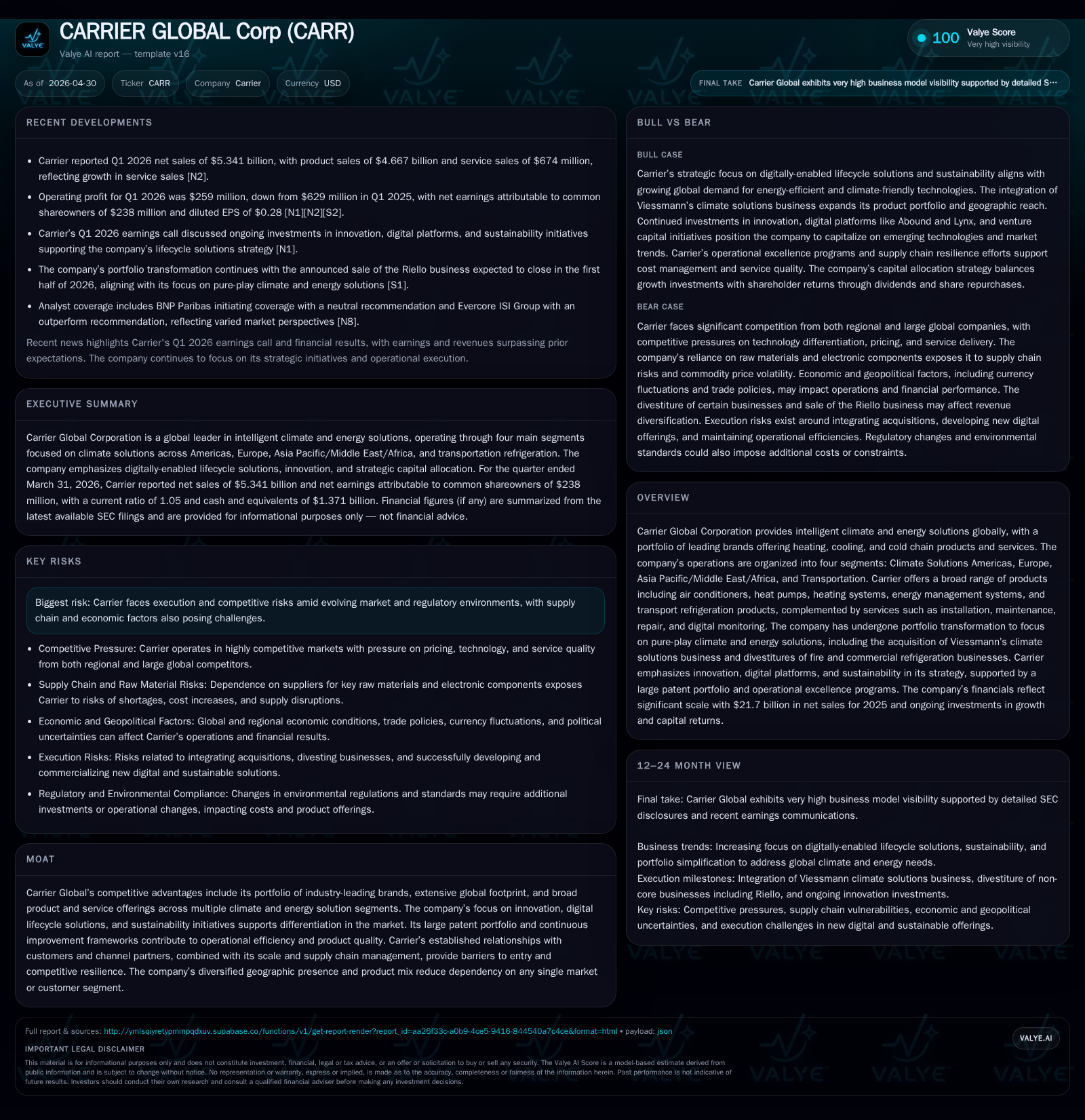
Carrier Global Corporation's Q1 2026 filing reveals a significant $159 million restructuring reserve, highlighting aggressive portfolio reshaping towards pure-play climate and energy solutions. The company realigned its segments into four reportable operating units, emphasizing digital lifecycle offerings to enhance customer retention and operational efficiency. Growth is driven by innovation in HVAC and cold chain products, expanded digital monitoring services, and sustainability trends amid complex competitive and regulatory environments. Financially, Carrier maintains solid liquidity with $1.37 billion in cash, complies with debt covenants on its near $11.4 billion long-term debt, but faces pressure from restructuring costs that temper near-term earnings.
Q1 2026 Operating Update: Restructuring and Segment Performance
Carrier Global’s latest quarterly filing as of March 31, 2026 reveals a material increase in restructuring reserves to $159 million from $102 million at year start [S2]. These reserves support ongoing initiatives aimed at streamlining the operations and focusing resources on core climate solutions and energy management businesses. This near-tripling of restructuring costs versus the prior year’s $56 million signals an accelerated phase of corporate transformation involving workforce realignment and facility consolidations [S2]. Notably, Carrier evaluates its operations across four reportable segments — Climate Solutions Americas (CSA), Europe (CSE), Asia Pacific/Middle East/Africa (CSAME), and Transportation (CST) — reflecting a recent portfolio reshaping after acquisitions like Viessmann’s climate business and divestitures such as Riello [S2][S3]. Segment operating profit replaced operating profit as the key performance metric under ASC 280 guidelines to better reflect resource allocation consistency [S2].
The segment breakdown highlights dynamics across geographies with CSA generating $2.5 billion net sales while CSE contributed $1.3 billion; the smaller CSAME segment pulled in $834 million; Transportation accounted for $713 million [S16]. However, segment operating profits declined from $893 million in Q1 2025 to $644 million in Q1 2026 — largely attributable to the surge in restructuring charges ($108 million vs. $8 million prior year) alongside standard amortization of acquired intangibles [S16]. The elevated restructuring expense represents a deliberate investment phase intended to reposition Carrier as a pure-play climate solutions leader.
Carrier’s Business Model: Intelligent Climate Solutions Across Segments
Carrier builds revenue primarily through sales of heating, ventilation, air conditioning (HVAC), refrigeration equipment, and complementary energy management systems integrated with services including installation, maintenance, repair, system integration audits, and digital monitoring capabilities [S1]. Approximately 72% of net sales are new equipment transactions while recurring parts and service revenues account for about 28%, illustrating a model blending upfront capital goods with sustainable aftermarket income streams [S1]. This recurring revenue aspect improves cash flow visibility over multi-year product lifecycles.
The company has aligned its global operations into four customer-centric segments to address distinct regional market needs efficiently: Americas focusing on residential/commercial HVAC; Europe integrating the Viessmann acquisition’s expanded product suite; Asia Pacific/Middle East/Africa addressing high-growth emerging markets; and Transportation providing cold chain solutions critical for food security logistics [S1][S2]. This structure supports tailored product development while leveraging Carrier’s extensive brand portfolio — including established names such as Toshiba and Automated Logic — aiding penetration across residential, commercial buildings and transport refrigeration ecosystems.
Carrier places considerable emphasis on digital lifecycle solutions that involve IoT-enabled predictive maintenance platforms enabling customers to optimize energy use dynamically over time. This aftermarket service model fosters higher switching costs while differentiating Carrier from lower-technology competitors [S1]. The company also invests in energy management products capable of delivering grid flexibility benefits supporting electrification trends globally.
Competitive Position and Industry Dynamics in Climate Control
Carrier holds a commanding competitive position built on a diverse brand portfolio recognized for technological leadership alongside robust patent protections covering innovations across HVAC design to refrigerant technologies [S1]. Its global footprint spanning mature markets in the Americas/Europe plus growth regions in Asia-Pacific/Middle East/Africa provides resilience against geographic volatility.
Strategic acquisitions such as Viessmann have expanded specialized offerings into sustainable heating systems strengthening product breadth. Meanwhile divestitures like Fire & Security businesses streamline focus towards core climate/energy verticals clarifying capital allocation priorities [S1]. Barriers to entry remain considerable given required R&D intensity coupled with scale economies entrenched through Carrier’s supply chain mastery.
Regulatory environments worldwide increasingly tighten emissions and energy efficiency standards creating both compliance challenges and opportunities via premium pricing for cutting-edge products meeting evolving codes. Competitive pressures persist from regional OEMs aiming at market share gains but Carrier's innovation pipeline enforced by an extensive patent portfolio coupled with digital service layers sustain differentiation power amid commoditizing pressures.
Catalysts Driving Demand: Innovation, Digital Platforms, and Sustainability
Key secular growth drivers for Carrier encompass urbanization fueling global HVAC demand especially in burgeoning economies where modern cooling/heating installations become critical infrastructure [S1]. Electrification policies mandating reduced carbon footprints align well with Carrier’s expanding portfolio of highly efficient heat pumps, energy management systems, and refrigerants with low global warming potentials.
Digitally-enabled lifecycle offerings allow predictive maintenance yielding uptime reliability improvements critical for commercial customers’ operational continuity. Such platforms also stimulate aftermarket part sales contributing double-digit growth opportunities via software subscription or service contracts enhancing customer lock-in effects beyond initial equipment purchase cycles [S1].
Moreover, sustainability commitments – both regulatory-driven and customer-mandated – expand market relevance as industrial players seek lower-carbon building HVAC solutions along with smarter cold chain refrigeration supporting food safety objectives globally. Carrier Energy business initiatives targeting grid flexibility showcase potential new revenue streams enabling utilities to monetize peak load adjustments aligning with decarbonization goals [S1].
Risks and Constraints: Execution, Supply Chain, and Regulatory Environment
Execution risk is elevated during this intensive restructuring phase whereby workforce reductions or facility consolidations could disrupt operational cadence or strategic momentum if not carefully managed [S2]. The integration complexity of recent acquisitions like Viessmann requires sustained managerial bandwidth to realize projected synergies without diluting customer experience.
Supply chain fragility remains a concern amid lingering raw material constraints or geopolitical trade uncertainties despite prior successful mitigation strategies including price increases totaling approximately $200 million to cushion tariff impacts during 2025 [S1]. Future inflation or component shortages could compress margins further if cost pass-through is limited by competitive dynamics.
Regulatory shifts pose ongoing compliance costs especially tightening refrigerant codes or emissions standards requiring product redesigns potentially delaying time-to-market while increasing R&D spend. Competitive intensity particularly within fast-growing Asian markets aims at volume gains occasionally pressuring price realization thus constraining margin expansion opportunities.
Legacy legal risks such as asbestos-related claims exist but have historically been immaterial given insurance coverage alongside ongoing diligent risk assessments [S21]. Cybersecurity threats targeting digital assets or operational technology could also cause reputational damage or operational interruptions if not mitigated effectively.
Monitoring Forward: Key Milestones and Industry Signals to Watch
Critical near-term markers include Q2 updates on restructuring activities regarding pace of cost reductions versus incurred charges that dictate medium-term margin recovery trajectory [N1][N2][S2][S3]. Observing Viessmann business integration performance metrics will illuminate success in expanding European market share aligned with global ambitions.
Tracking new aftermarket service contracts adoption rates especially related to digital predictive maintenance will signal enhanced recurring revenue strength supporting stable cash flows. Market launches of latest sustainability-oriented products targeting electrification mandates will reveal how well Carrier leverages regulatory tailwinds.
Supply chain normalization progress remains vital to sustain shipment volumes without inflationary shocks undermining pricing power. Monitoring regulatory developments internationally regarding refrigerants or building codes will clarify impending cost or timing challenges impacting product roadmaps.
Margin trends will be indicative of execution effectiveness particularly if cost containment offsets inflation headwinds while sustaining innovation investments essential for long-run competitiveness.
Financial Snapshot: Liquidity, Debt Covenants, and Profitability Metrics
Latest financial snapshot
| Metric | Value | Period |
|---|---|---|
| Cash & equivalents | $1371mm | |
| 2026-03-31 | ||
| Current assets | $9.0bn | |
| 2026-03-31 | ||
| Current liabilities | $8.6bn | |
| 2026-03-31 | ||
| Current ratio | 1.05x | |
| 2026-03-31 |
Source: SEC companyfacts cache [F1].
Carrier maintains a tight but stable current ratio around 1.05 reflecting sound working capital management despite rising restructuring charges that elevated accrued liabilities notably within the quarter [F1][S2]. The company was in compliance with the covenants under the agreements governing its outstanding indebtedness as of March 31, 2026 [S2].
Net income was impacted by heightened pre-tax restructuring expenses reducing overall profitability relative to last year’s quarter but these investments aim at longer-term margin accretion through improved productivity frameworks substantiated by continuous improvement practices carrier-wide [S16]. Interest expense rose modestly reflecting incremental debt servicing costs tied to current borrowings but remains covered comfortably by operational cash flows generated from diversified regional portfolios [S2][F1].
Liquidity is fortified by more than $1.3 billion cash-on-hand bolstered by commercial paper programs available alongside the unsecured revolving credit facility ensuring resource availability for both strategic initiatives like acquisitions or bolt-on investments plus opportunistic working capital support during cyclical fluctuations [F1].
Disclaimer: This analysis is provided solely for informational purposes based on publicly available SEC filings and news sources as of April 30, 2026. It does not constitute investment advice or recommendations regarding Carrier Global Corporation securities or any other financial instruments.
Disclaimer: This is research-only, informational analysis and not investment advice. It may include AI-generated interpretation and general industry context. Always verify important details using primary sources.

Comments