
W. P. Carey Accelerates Portfolio Rebalancing and Strengthens Liquidity in Q1 2026
The REIT posted solid rent growth and capital deployment in Q1, balancing acquisitions with disposals while maintaining robust financing flexibility.
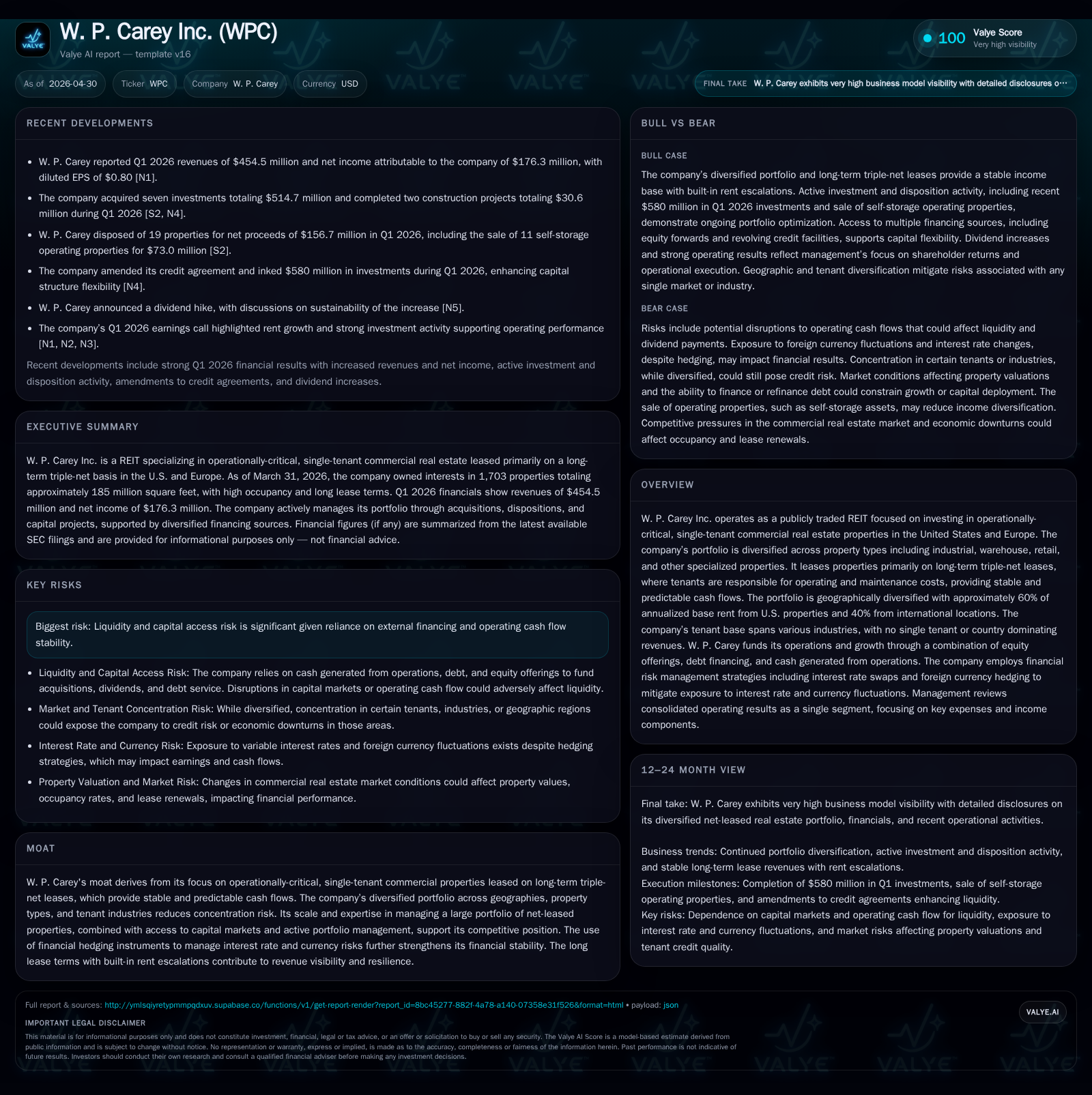
In the first quarter of 2026, W. P. Carey Inc. amplified its activity with $515 million in new real estate investments, complementing 19 property sales generating $157 million in net proceeds. The company sustained steady revenue growth driven by rent escalations and disciplined portfolio management, highlighted by the divestiture of self-storage assets and selective expansion into industrial and healthcare properties internationally and domestically. A strong liquidity position supported by a $1.9 billion credit facility, equity forward issuance, and cash reserves underpins ongoing investment and dividend capacity amid manageable debt maturities.
Recent Operating Update: Q1 2026 Performance Highlights
W. P. Carey's latest 10-Q filing dated April 29, 2026 details a vibrant quarter marked by significant investment activity alongside continued portfolio optimization [S2]. The firm completed seven acquisitions totaling $514.7 million, emphasizing industrial properties in Germany, healthcare facilities in Ohio, and manufacturing assets in North Carolina [S16]. This deployment underscores WPC’s strategic focus on operationally essential assets with durable tenant demand.
On the disposal front, the company sold 19 properties for net proceeds of $156.7 million during Q1, notably liquidating its remaining self-storage operating portfolio ($73 million) as part of a targeted exit from non-core or lower yield segments [S16]. The realized gain on these sales ($54.1 million) reflects disciplined asset selection and timing.
Revenue growth was supported by scheduled rental escalations ingrained in long-term triple-net leases plus contributions from newly acquired assets despite a drag from lower operating property revenues after self-storage disposals [S19]. Net income attributable to WPC rose to $176 million for the quarter versus $126 million prior year.
Liquidity was bolstered via equity forwards issuance with net proceeds of $247 million settled in Q1 and remaining availability under Equity Forwards ($244 million) and ATM Forwards ($410 million) programs providing optionality for capital deployment [S6][S10].
Financing activities included prudent refinancing and repayment moves such as retirement of €500 million senior notes due 2026 while issuing €1 billion senior notes across two tranches maturing in 2031 and 2035 at attractive fixed rates near mid-3% levels [S10][S7]. Interest rate hedging mitigates exposure on floating components.
Business Model Overview
W.P. Carey operates primarily as a publicly traded real estate investment trust focused on net-leased commercial properties—specifically operationally critical single-tenant facilities leased under long-term triple-net agreements [S1]. Tenants bear responsibility for maintenance, insurance, and taxes which translates into enhanced predictability of cash flows for the REIT.
The company's revenue mechanics revolve around collecting annualized base rents subject to contractual escalation clauses providing organic growth over time [S1]. Its diversified tenant base spans industries like manufacturing, logistics, retail, technology data centers, and healthcare without significant concentration risk by tenant or geography (60% US / 40% international division) [S21].
Portfolio additions typically involve acquiring stabilized or build-to-suit assets that meet strict underwriting criteria for tenant creditworthiness and operational necessity. Dispositions are opportunistic to improve yield or reallocate capital towards higher-growth sectors.
Capital markets access is essential to their business model given reliance on external financing sources mixed between fixed-rate senior unsecured notes (~85%), term loans denominated in multiple currencies hedged against currency volatility, revolver borrowings (subject to availability), and equity issuance vehicles including ATM programs.
Industry Structure and Competitive Position
W.P. Carey occupies a specialized niche within the REIT landscape focused on net-leased single-tenant commercial real estate—a sector attractive for its bond-like characteristics but with real asset inflation protection. Competition includes other net-lease REITs like Realty Income and National Retail Properties; however, WPC’s unique mix of global footprint coupled with sector diversification distinguishes it from predominantly U.S.-centric peers.
The company’s moat derives from scale (over $19 billion gross real estate investments), expertise managing complex cross-border portfolios, active capital recycling capabilities, sophisticated risk management through financial derivatives (interest rate swaps and currency hedges), and entrenched tenant relationships securing long lease terms averaging near or above ten years with embedded rent escalators [S1].
Growth Drivers
Capital Recycling & Investment Activity
WPC continues to deploy capital into sectors exhibiting favorable secular trends such as industrial logistics hubs aligned with e-commerce growth; healthcare properties benefiting from demographic aging; and specialized manufacturing facilities that underpin supply chain resilience initiatives globally [S16].[N9]
Construction Pipeline Execution
Two completed construction projects valued at approximately $30 million alongside funded loans for ongoing projects signal expansion beyond acquisitions into value creation via built-to-suit developments [S16],[S2].
International Geographic Expansion
With roughly 40% annualized base rent worldwide—including meaningful stakes in Poland, Italy, Germany, UK, Canada—the company leverages diversified economic environments mitigating localized risks while capturing growth opportunities overseas [S21].
Rent Escalations & Lease Structures
Long-dated triple-net leases embed annual contractual rent bumps which support top-line resilience even through economic cycles. Embedded escalators contribute materially to AFFO growth at steady margins [S19].
Risks & Growth Constraints
Capital Market Dependence & Liquidity
Despite sizeable liquidity buffers (over $2.8 billion combined between cash & equivalents plus undrawn revolver capacity), WPC’s growth hinges heavily on continued access to equity markets and debt capital under favorable terms given regular debt maturities ($353 million remainder of 2026; nearly $600 million due in 2027) [S6][S13]. Any disruptions here could constrain acquisition pacing or dividend policies.
Tenant Credit & Lease Renewals Risk
Tenant financial distress or delays/revisions in lease renewals can impact income stream stability despite diversification. The complexity of international lease management can magnify these risks.
Interest Rate & Currency Volatility Exposure
While using derivatives to hedge floating rates on term loans minimizes interest expense volatility near term horizon through end-2027 or beyond for certain instruments [S7], longer-term exposure post-hedge maturity remains sensitive to macroeconomic shifts affecting borrowing costs.
Regulatory & Environmental Uncertainties
Though not currently material according to filings, evolving environmental regulations or property-specific compliance issues could impose capital or expense burdens alleviated only partially through triple-net structures [S1].
What To Watch Next
- Execution updates on the eleven outstanding Equity Forward shares settlement (~$244 million proceeds expected) will provide insight into capital inflows available for acquisitions or debt reduction.
- Completion progress on committed construction projects over remainder of 2026–27 will clarify the realized value accretion beyond pure acquisition-driven growth.
- Commentary on tenant leasing activity or any material credit events will provide signals regarding income stability moving forward.
- Debt maturity management including refinancing strategies around significant balloon payments due in late 2026–2027.
- Quarterly disclosure updates touching on geographic segment performance may highlight any evolving market dynamics impacting yields or occupancy.
- Dividend policy announcements aligned with AFFO sustainability metrics given current payout levels exceeding $0.93/share per quarter [S19].[N4]
Financial Profile Snapshot (Q1 Ending March 31, 2026)
Latest financial snapshot
| Metric | Value | Period |
|---|---|---|
| Cash & equivalents | $239mm | |
| 2026-03-31 | ||
| Total debt | $8.8bn | |
| 2026-03-31 | ||
| Net debt | $8.5bn | |
| 2026-03-31 |
Source: SEC companyfacts cache [F1].
This conservative leverage structure anchored by predominantly fixed-rate senior notes coupled with ample liquidity provides WPC flexibility to navigate market cycles while pursuing disciplined expansion opportunities.
This analysis relies exclusively on data from W.P. Carey's SEC filings as of April 29, 2026 ([S2], [S3], [S4], et al.), supplemented by validated news transcripts ([N1]–[N10]) and company facts ([F1]). It avoids speculative projections or investment recommendations.
Disclaimer: This is research-only, informational analysis and not investment advice. It may include AI-generated interpretation and general industry context. Always verify important details using primary sources.

Comments