
CIM Real Estate Finance Trust Faces NAV Adjustment Amid Market Pressures
NAV per share cut from $5.22 to $5.14 underscores evolving real estate finance market challenges and validates external management reliance.
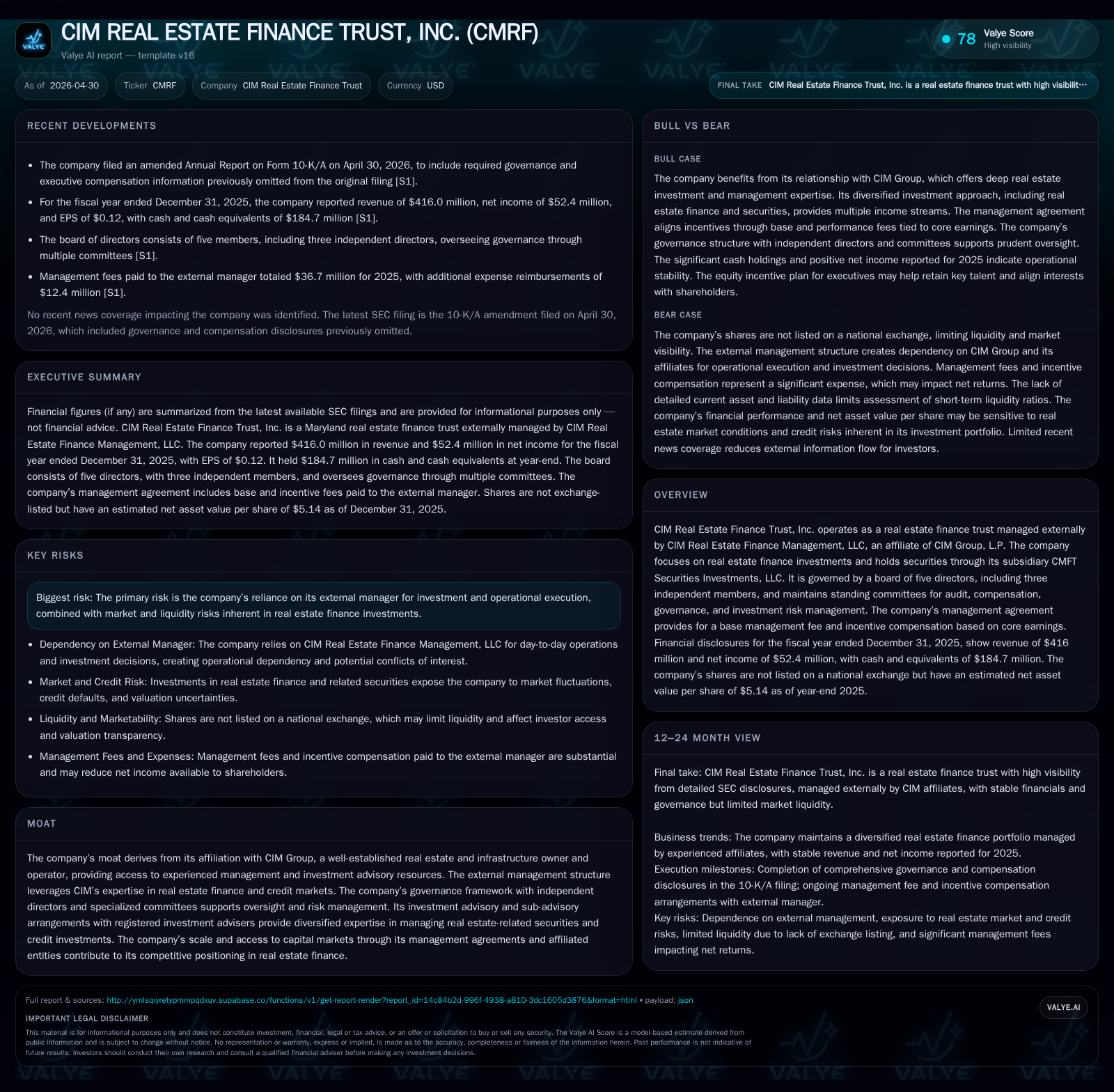
CIM Real Estate Finance Trust has updated its estimated net asset value (NAV) per share downward to $5.14 as of December 31, 2025, reflecting adjustments in its real estate finance portfolio amid shifting economic conditions. The company operates as an externally managed real estate finance trust with a business model centered on credit-related securities managed through affiliated entities. Its governance structure incorporates independent oversight but remains dependent on external managers for investment execution. Market dynamics, including interest rates and tenant credit quality, are key growth and risk drivers influencing CIM’s valuation and operational outlook.
Latest Operating Update: NAV Revision and Market Context
In March 2026, CIM Real Estate Finance Trust’s board approved an estimated net asset value (NAV) per common share of $5.14 as of December 31, 2025, marking a decline from the prior year-end NAV of $5.22 [S3]. This downward adjustment reflects the recalibration of asset valuations within a complex commercial real estate (CRE) finance landscape characterized by evolving interest rates, shifts in supply-demand balances, and tenant financial health variability. The valuation methodology employs third-party review from Kroll which confirmed the reasonableness of company-supplied cash flow projections and assumptions underlying asset-level fair values [S3]. This NAV update serves as both an accounting metric and a tangible indicator of the pressure confronting CRE finance assets due to broader macroeconomic headwinds.
Business Model Deep Dive: External Management and Investment Focus
CIM Real Estate Finance Trust operates as an externally managed REIT specializing in real estate finance investments. Its operations are executed via its wholly owned subsidiary CMFT Securities Investments, LLC, which holds the underlying credit-related securities portfolio [S1]. Management responsibilities reside with CMFT Management under a contract entitling it to base fees calculated at 1.5% per annum of Company equity (with a floor) plus incentive compensation linked to core earnings relative to a hurdle rate [S6].
The company’s revenue profile is thus anchored in fees derived from managed equity capital rather than direct property operations or rent collection. Furthermore, sub-advisory agreements allocate portions of advisory fees to affiliates skilled in corporate credit and other real estate-related securities investment disciplines [S22–S23]. This layered management structure leverages CIM Group’s comprehensive platform expertise while creating complex fee structures that can influence net margins depending on portfolio performance and core earnings growth.
Governance Framework and Management Alignment
Governance provisions emphasize independent oversight despite the externally managed nature of operations. The board consists of five members with three independent directors who chair critical committees including audit (chaired by Howard Silver), compensation (chaired by Brian Kretzmer), governance, and investment risk management [S1][S6][S8].
Board oversight extends to rigorous review of related-party transactions with CIM affiliates and periodic evaluation of the fairness of management fees [S11][S24]. Equity-based awards such as restricted stock units granted to key executives signify attempts to align management incentives with long-term shareholder value creation [S7][S9]. Compliance mechanisms include annual reviews of director independence according to NYSE and NASDAQ standards despite the lack of national exchange listing.
Industry Structure: Competitive Landscape and Market Dynamics
CIM operates within the CRE finance trust sector facing cyclical demand driven by macroeconomic conditions including interest rates volatility, CRE asset supply-demand imbalances, and tenant creditworthiness fluctuations [S3][S1]. Exposure to corporate credit adds complexity with evolving credit spreads affecting underlying asset valuations.
Its affiliation with CIM Group offers a competitive moat through access to extensive capital markets capabilities, diversified real estate expertise across debt and equity classes, and scalable advisory services—elements necessary for navigating an increasingly sophisticated CRE finance market. However, sector-wide challenges such as tightening lending standards or softness in specific property segments remain overhangs.
Growth Drivers: Capital Access and Portfolio Strategy
Growth avenues rely on leveraging CIM’s capital markets access for deploying into accretive credit investments amid improving tenant fundamentals or economic recovery phases [S1][S3]. Expansion through prudent portfolio construction backed by deep market intelligence can underpin core earnings enhancement over time.
Fee income scalability is linked directly to equity base growth; hence maintaining or raising AUM thresholds supported by investor capital inflows or retained earnings is central. Additionally, successful navigation through economic cycles via portfolio quality improvements or active risk management could unlock further incentive compensation accruals for the external manager [S6].
Key Risks and Constraints: External Manager Reliance and Market Sensitivities
A fundamental vulnerability lies in operational reliance on CMFT Management’s execution capabilities—a single-point-of-failure risk tied closely to adherence to investment discipline and responsiveness under volatile credit conditions [S2][S3][S6]. Conflicts inherent in external management arrangements necessitate vigilant independent board oversight.
Market risks pertain chiefly to liquidity constraints within CRE debt markets, potential deterioration in property valuations driven by tenant defaults or rent declines, and broader macroeconomic uncertainties impacting yield curves or funding costs [S2]. Incentive fee non-payment during weak core earnings periods introduces revenue cyclicality that could pressure margins.
What to Watch Next: Valuation Milestones and Operational Execution
Investors should track forthcoming NAV disclosures scheduled annually following year-end reporting, focusing on changes against book values reflective of asset revaluations under fresh market data inputs [S3]. Core earnings trajectory sustained over sequential quarters will provide clarity on fee income stability alongside assessment of any amendments proposed for external management contracts influencing cost structures.
Board deliberations concerning managerial renewal decisions or changes in governance policies aimed at enhancing alignment will also offer insights into strategic direction [S6].
Financial Snapshot: Current Leverage, Liquidity, and Asset Position
Latest financial snapshot
| Metric | Value | Period |
|---|---|---|
| Cash & equivalents | $185mm | |
| 2025-12-31 | ||
| Total debt | $3.1bn | |
| 2025-12-31 | ||
| Net debt | $2.9bn | |
| 2025-12-31 |
Source: SEC companyfacts cache [F1].
As supported by latest filings ([F1],[S2],[S3]), CIM maintains approximately $185 million in cash amidst $3.1 billion total debt resulting in net debt around $2.92 billion. Revenue for 2025 was reported at $416 million with net income totaling approximately $52 million reflecting ongoing operational scale albeit moderated profitability likely impacted by prevailing market spreads [F1]. Such leverage levels are consistent with externally managed REITs engaged primarily in real estate credit investment arenas where steady distributable cash flows underpin coverage ratios.
This analysis synthesizes publicly available regulatory filings up through April 30, 2026. It refrains from forward-looking estimates absent explicit disclosure while contextualizing operational developments within current industry dynamics specific to externally managed real estate finance trusts affiliated with larger integrated platforms like CIM Group.
Disclaimer: This is research-only, informational analysis and not investment advice. It may include AI-generated interpretation and general industry context. Always verify important details using primary sources.

Comments