
SPX Technologies Weighs Tariff Impacts and Geopolitical Risks Amid Ongoing HVAC and Detection Market Growth
Latest quarterly results underscore resilience in core segments despite inflationary pressures and tariff uncertainties.
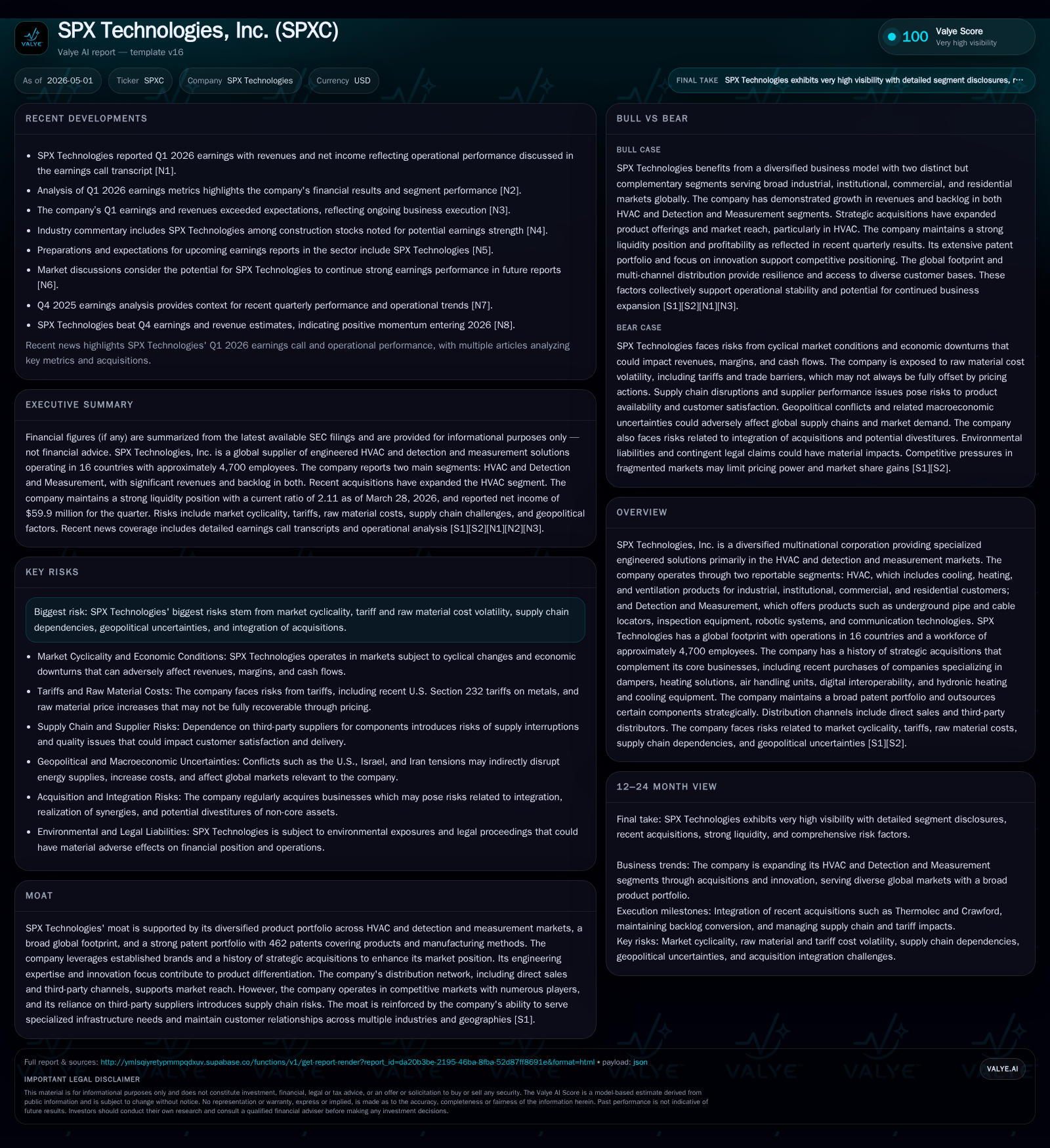
SPX Technologies’ Q1 2026 filing highlights stable operational momentum with cautious commentary on new U.S. tariffs and global geopolitical tensions. The company’s diversified HVAC and detection businesses benefit from strategic acquisitions and innovation but face headwinds from raw material inflation and cyclical demand. Its broad patent portfolio, multinational footprint, and integrated distribution provide competitive advantages, while exposure to supply chain risks and tariff fluctuations remain watchpoints. Growth is expected from infrastructure investments, digital interoperability expansion, and ongoing product line enhancements tied to customer capital expenditures.
Latest Operating Update
SPX Technologies’ first-quarter 2026 Form 10-Q filing dated May 1 confirms steady operational progress, notably maintaining sales momentum despite macroeconomic headwinds [S2]. The company acknowledges ongoing challenges from newly introduced U.S. tariffs effective April 2026 targeting metal imports critical to production inputs — aluminum, steel, copper — which differ in duty basis versus prior tariff regimes. While prior tariffs under IEEPA were largely mitigated through pricing strategies, the latest Section 232 tariffs could exert more significant cost pressures due to their application on full customs value rather than metal content alone [S2].
Additionally, SPX highlighted the indirect impacts of the escalating conflict involving the U.S., Israel, and Iran on global energy costs and supply chains. Though lacking direct regional exposure, these macro disruptions have heightened raw material inflation and logistical uncertainty [S2]. These factors amplify the complexity of managing input costs and customer demand patterns for specialized engineered solutions.
The recent 8-K filing also incorporated a press release detailing strong Q1 earnings that beat market consensus on both revenue and profitability metrics [S3][N3], signaling effective operational execution despite inflationary pressures.
Business Model Overview
SPX Technologies is a multinational engineering company focusing primarily on two segments:
HVAC (Heating, Ventilation, Air Conditioning): This segment provides mechanical systems including dampers, heating elements, air handling units, heat pumps, and related equipment for a spectrum of customers ranging from industrial plants to residential complexes. These highly engineered products are often customized for efficiency requirements in sectors such as healthcare facilities, food processing plants, pharmaceuticals, and educational institutions.
Detection and Measurement: This division develops underground pipe/cable locators, inspection robots, communication technologies tailored to infrastructure maintenance sectors like utilities, telecommunications, transportation systems (e.g., Genfare transit fare technology), aids to navigation (marine lighting), and defense-oriented digital interoperability solutions.
Revenue depends largely on capital investment cycles in these end markets; customers typically commit via project-based contracts or long-term service agreements. SPX's revenue driver mechanics comprise volume increases aligned with new builds or repair projects plus price adjustments reflecting inflation or technological enhancements. Mix benefits arise from growth in higher-margin customized or digital-enabled products replacing commodity offerings.
The company's business model leverages strategic acquisitions to complement organic R&D efforts within both segments. Purchased firms often bring niche technologies or expand geographic reach — e.g., recent HVAC acquisitions added expertise in electric duct heating (Thermolec) or hydronic heat pumps (Sigma & Omega). In Detection & Measurement, acquisitions like Kranze Technology Solutions enhance tactical communications capabilities [S1][S19][S26].
Margins benefit from IP protection with an extensive patent portfolio numbering 462 grants covering product designs and manufacturing methods as of late 2025 [S21]. Coupled with engineering know-how and established brands such as Radiodetection for underground locators or Genfare for transportation tech, SPX maintains defensible product differentiation ambitions.
Industry Structure and Competitive Position
The HVAC market served by SPX is fragmented yet competitive across global players ranging from multinational conglomerates (Carrier/United Technologies) to specialized regional manufacturers. Success factors include product innovation toward energy efficiency standards mandated by governments (e.g., Department of Energy rules) alongside customization capabilities for regulated environments like healthcare or pharma labs.
Detection & Measurement sits at a convergence of infrastructure diagnostics, utility maintenance technology, security/defense communication niches that have grown more complex with digital transformation trends. Competitors vary by sub-market segment but include companies focused on sensor development (industrial IoT), robotics suppliers for inspections in confined spaces, as well as established manufacturers with integrated solutions.
SPX’s global footprint across 16 countries serves to diversify geographical risks while exposing it to multiple regulatory environments—each with distinct compliance requirements ranging from data privacy regulations impacting digital offerings to export controls relevant to defense-related products [S11][S23].
The company faces pressure from lower-cost competitors that may benefit from governmental subsidies or local manufacturing advantages abroad. Maintaining technological leadership via ongoing R&D investment mitigates some margin erosion risk but requires continuous capital deployment [S6][S14].
Growth Drivers
Capital Investment Cycles:
End-customer capital expenditures drive SPX’s order pipelines; infrastructure maintenance programs for utilities or telecom expansions fuel detection product demand. New construction activity bolsters HVAC sales for advanced air quality control systems amid rising health-conscious designs.
Regulatory Environment:
Energy efficiency mandates spur upgrades/replacements in heating/cooling systems favoring sophisticated units with controllability features developed by SPX. Similarly, enhanced safety regulations can drive expanded use of underground pipe locators across municipal infrastructure projects.
Digitalization & Product Innovation:
Integration of smart controls into HVAC units alongside enhanced interoperability tech in detection instruments opens incremental revenue streams beyond core hardware sales. Strategic acquisitions targeting niche digital networking solutions augment this trajectory [S19].
Geographic Expansion:
Growth potential exists by leveraging acquired entities’ regional strengths to expand distribution networks further internationally where infrastructure modernization investments are increasing.
Synergistic M&A Pipeline:
Past mid-sized acquisitions have meaningfully contributed incremental revenues without diluting core operations materially. Continued bolt-on purchases may accelerate platform evolution if integration risks are well-managed.
Risks and Watchpoints
- Tariff Exposure: Newly announced Section 232 tariffs on aluminum/steel/copper pose cost escalation threats; inability to fully pass these costs onto customers may compress margins significantly [S2].
- Geopolitical Uncertainty: Heightened tensions in the Middle East create fueling price volatility for commodities critical across SPX's manufacturing footprint plus potential transport disruption risks.
- Cyclical Demand Sensitivity: Heavy dependence on capital project timing means quarterly revenues can be volatile; weather-related seasonality further influences HVAC segment strength skewed toward later calendar halves [S1].
- Supply Chain Dependencies: Outsourcing components to third parties exposes risk of quality failures or supply interruptions impacting customer satisfaction or causing delays [S21].
- Acquisition Integration: New buys bring execution hurdles surrounding aligning digital systems/security standards plus cultural fit that may distract management focus or inflate costs temporarily [S14][S16].
- Competitive Pressures: Vigorous competition drives pricing challenges requiring continued innovation investments to preserve market share.
- Regulatory Changes: Potential tightening/loosening of industry-specific rules around DOE energy efficiency standards or FAA lighting requirements could unpredictably affect key product demand [S23].
- Labor Market Risks: Shortages in skilled workers combined with collective bargaining dynamics could raise wage costs or disrupt output schedules during contract renewals [S20].
- Cybersecurity Concerns: As SPX expands its digital offerings especially post-acquisition integrations like KTS’s tactical networking solutions potential cybersecurity vulnerabilities must be vigilantly managed to prevent reputational damage.
What to Watch Next
Investors should monitor updates forthcoming in subsequent quarterly earnings releases regarding:
- The extent of tariff pass-through success reflected in margins.
- Order backlog trends especially vis-à-vis large capital project awards across utilities/institutional clients.
- Progress integrating recent acquisitions operationally without dilutive cost impacts.
- Development milestones around digital interoperability products within Detection & Measurement.
- Macro environment shifts including commodity price stabilization or inflationary easing that affects raw material procurement costs.
- Any early signs of geopolitical resolution or escalation that could materially alter supply chain stability.
Financial Profile Snapshot (As of March 28, 2026) [F1]
Latest financial snapshot
| Metric | Value | Period |
|---|---|---|
| Cash & equivalents | $157mm | |
| 2026-03-28 | ||
| Total debt | $644mm | |
| 2026-03-28 | ||
| Net debt | $487mm | |
| 2026-03-28 | ||
| Current assets | $1013mm | |
| 2026-03-28 | ||
| Current liabilities | $481mm | |
| 2026-03-28 | ||
| Current ratio | 2.11x | |
| 2026-03-28 |
Source: SEC companyfacts cache [F1].
The balance sheet exhibits ample liquidity with a healthy current ratio indicating comfortable short-term asset coverage over liabilities. Net debt levels reflect continued leverage consistent with funding acquisition activity alongside working capital needs. Interest rate exposure remains relevant given variable rate borrowings described in previous filings [S4][S17][S18]. Operating income reached $350 million at FY-end 2025 underscoring core profitability trends supporting reinvestment capacity [F1].
Disclaimer: This analysis is based exclusively on information publicly filed with the Securities and Exchange Commission as of the dates cited along with supplemental news sources detailed herein. It does not constitute any form of investment advice or recommendation regarding securities issued by SPX Technologies Inc.
Disclaimer: This is research-only, informational analysis and not investment advice. It may include AI-generated interpretation and general industry context. Always verify important details using primary sources.

Comments