
Civeo Corp Q1 2026: Strengthening Remote Workforce Hospitality in Resource-Rich Regions
Civeo’s Q1 2026 results underscore its durable contract portfolio and operational resilience across mining and energy hubs in Australia and Canada.
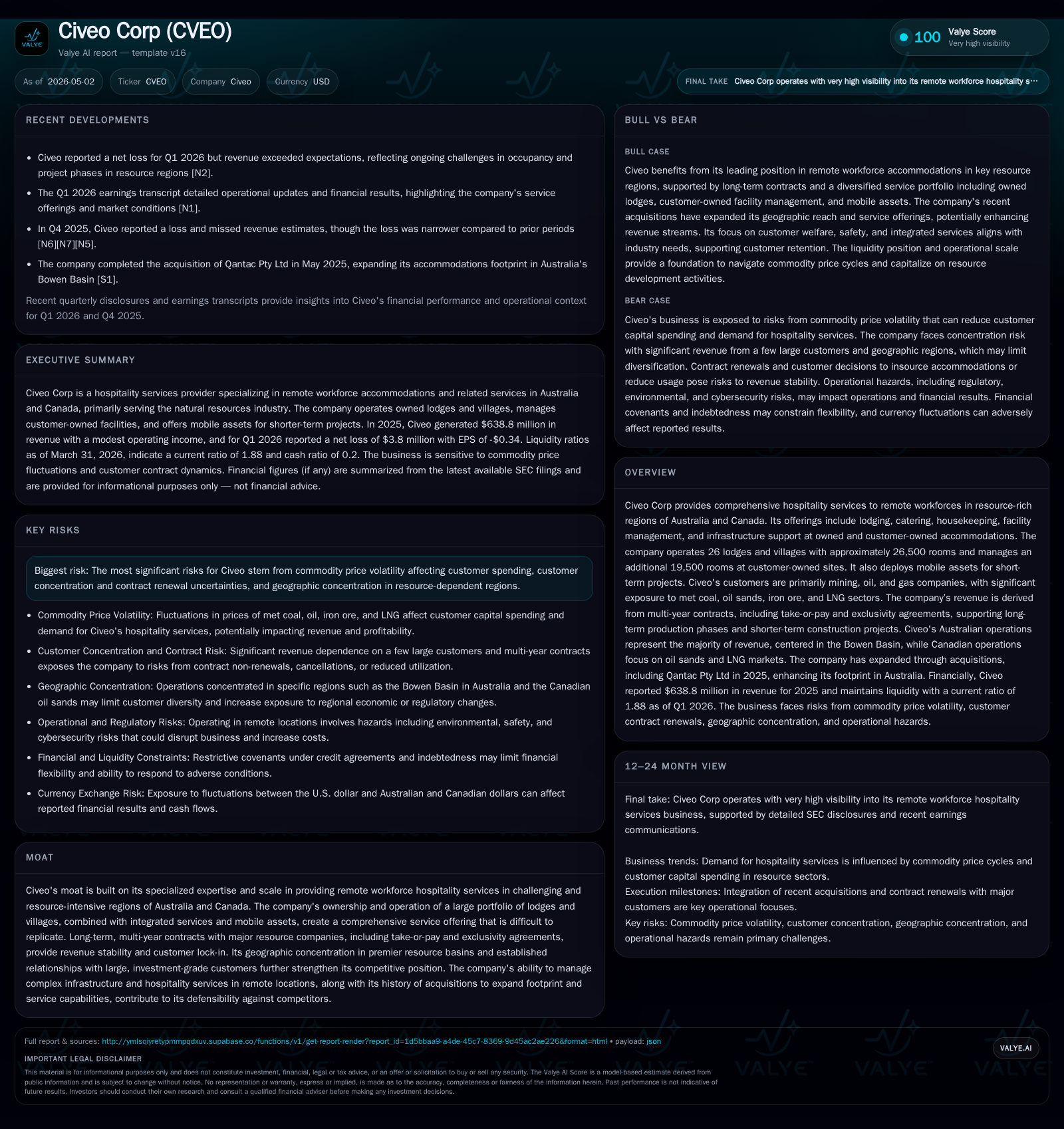
In Q1 2026, Civeo Corp maintained stable revenues driven by multi-year take-or-pay contracts with key resource operators in Australia’s Bowen Basin and Canadian oil sands. The company’s integrated hospitality model, encompassing owned lodges and customer-managed accommodations, continues to underpin revenue predictability despite commodity sector cyclicality. Growth momentum centers on expanding mobile lodging assets and deepening service integration amid evolving customer needs. However, risks persist from commodity price volatility, regional concentration, and contract renewal challenges. The April 2026 credit facility extension supports financial flexibility for operational execution.
Latest Quarterly Operating Highlights and Why They Matter
Civeo Corp’s Q1 2026 results [S2][S3][N1][N2] reaffirm its core business resilience despite challenging market conditions. Revenue remained supported by its portfolio of multi-year take-or-pay contracts predominantly in Australia’s Bowen Basin and the Canadian oil sands region. While the company reported a net loss reflecting ongoing cost pressures and investment in mobile lodging assets, top-line performance beat expectations, signaling stable demand from major resource sector customers.
Notably, Civeo continues to optimize deployment of its owned lodges alongside customer-managed accommodations under integrated service contracts. This strategic balance helps sustain occupancy rates while expanding presence in short-term project segments via mobile lodging units. The recent extension and upsizing of the credit facility through 2030 further supports financial flexibility to navigate sector cyclicality.
These developments are material as they suggest near-term stability underpinned by contractual revenue protections, even as commodity price-linked customer capex remains volatile. Operationally, improving utilization trends at owned facilities combined with growth in catering and housekeeping services contribute positively to margin prospects.
Business Model Overview: Integrated Hospitality for Remote Resource Workforces
Civeo specializes in providing comprehensive hospitality services—lodging, catering, housekeeping, maintenance—primarily to remote workforces engaged in mining, oil sands extraction, met coal production, iron ore mining, and LNG operations across Australia and Canada [S1][S9].
The company’s business model revolves around managing both owned accommodation assets (26 lodges/villages totaling roughly 26,500 rooms) as well as overseeing an additional approximately 19,500 rooms at customer-owned sites under long-term service contracts. This dual approach allows Civeo to offer tailored integrated hospitality solutions while mitigating exposure to asset ownership risks.
Revenues are mainly derived from multi-year contracts that often include take-or-pay clauses assuring minimum payment regardless of facility occupancy levels—critical for cash flow stability—and exclusivity agreements that reduce competition. Customers benefit from outsourcing complex on-site accommodations management to a specialist provider capable of ensuring workforce welfare and operational continuity in logistically challenging environments.
Competitive Position and Industry Dynamics
Civeo’s competitive moat is carved out through expertise managing the intricacies of remote workforce accommodations within resource-rich zones that lack conventional infrastructure [S1][S5][S6]. The company leverages scale advantages from a broad asset base combined with specialized service integration—covering everything from food safety compliance to power generation support—that competitors without such breadth find difficult to replicate.
However, the industry faces notable pressures. Accommodations overcapacity occasionally emerges in mature basins during downturns, pressuring pricing power. Contract negotiations remain sensitive to client cost reduction imperatives inherent to materials extraction sectors experiencing cyclical cost volatility. Furthermore, supply chain complexities tied to remote logistics can constrain rapid scaling or redeployment of assets.
Entry barriers remain significant due to capital intensity (owning/building lodges), contractual relationship depth (multi-year exclusive deals), geographic footprint concentration (Australian Bowen Basin & Canadian oil sands), and regulatory environment familiarity—all disadvantaging new entrants.
Growth Drivers: Contract Portfolio Expansion and Service Innovation
Future growth pivots on several concrete avenues [S2][N1]:
- Contract renewals & expansions: Retaining existing large clientele while negotiating scope uplifts linked with project ramp-ups remains paramount.
- Mobile lodging assets: Increasing deployment of modular accommodation units for ephemeral development or construction phases provides a flexible growth vector less capital-intensive than lodge builds.
- Bundled service offerings: Cross-selling integrated catering and facility management enhances service stickiness and improves margin profiles.
- New resource projects: Early engagement with emerging mining or LNG projects offers potential for securing foundational multi-year contracts before main construction phases start.
These growth levers are tightly coupled with measurable KPIs such as room utilization rates, contract backlog volumes, renewal win ratios, mobile asset fleet growth, and ancillary service uptake metrics.
Risks and Watchpoints: Commodity Cyclicality, Customer Concentration, and Geographic Focus
Civeo’s exposure is shaped materially by macroeconomic influences on its resource sector customers [S5][S6]. Key risks include:
- Commodity price volatility: Downturns depress customer capital expenditures leading to contract terminations or utilization declines impacting revenues despite take-or-pay safeguards.
- Customer concentration: Dependence on a limited set of large mining/oil companies increases credit risk; failure to renew key contracts could materially affect operations.
- Geographic concentration: Heavy focus on Australian Bowen Basin and Alberta oil sands means political/regulatory shifts or environmental events disproportionately affect business continuity.
- Operational risks: Seasonal weather variation affects lodge occupancy; managing transitions between projects requires deft logistics; labor relations expose vulnerability.
- Regulatory/Legal risks: Compliance challenges stemming from foreign jurisdictions with complex worksite standards impose ongoing operational burdens.
Take-or-pay clauses mitigate volume risk but do not insulate entirely against prolonged downturns or abrupt contract cancellations triggered by sector shocks.
Near-Term Catalysts and Monitoring Points
Attention should be focused on the following indicators over the coming quarters [N1][S2]:
- Progress on contract renewals especially for large portfolio customers amid current commodity market conditions.
- Utilization trends at owned lodges signaling demand robustness or deterioration.
- Successful award and mobilization of new contracts requiring mobile lodging deployments indicative of expanding project pipelines.
- Trending operating leverage improvements resulting from optimized service integration increasing profitability margins.
- Customer commentary on capital spending plans that may foreshadow changes in accommodations needs tied to upstream resource development activity.
- Macroeconomic signals around commodity prices affecting visibility into longer-term demand sustainability.
These milestones will shape Civeo's near-term ability to translate its differentiated hospitality platform into consistent cash flows amid volatile external factors.
Financial Snapshot Supporting Operational Analysis
Latest financial snapshot
| Metric | Value | Period |
|---|---|---|
| Cash & equivalents | $16.5mm | |
| 2026-03-31 | ||
| Total debt | $212.3mm | |
| 2026-03-31 | ||
| Net debt | $195.7mm | |
| 2026-03-31 | ||
| Current assets | $152.8mm | |
| 2026-03-31 | ||
| Current liabilities | $81.1mm | |
| 2026-03-31 | ||
| Current ratio | 1.88x | |
| 2026-03-31 |
Source: SEC companyfacts cache [F1].
| Metric | Value (USD) |
|---|---|
| Cash & Equivalents | 16.5 million |
| Total Debt | 212.3 million |
| Net Debt | 195.7 million |
| Current Assets | 152.8 million |
| Current Liabilities | 81.1 million |
| Current Ratio | 1.88 |
As of March 31, 2026 [F1], Civeo maintains $16.5 million in cash against $212.3 million of total debt resulting in net debt near $195.7 million.
The company secured an upsized revolving credit facility totalling $285 million with maturity extended through April 2030 [S18][S22], providing ample headroom for working capital needs or episodic project investments.
Leverage levels remain elevated given the capital-intensive nature of operating remote workforce accommodations but are supported by predictable cash flows embedded in contracted revenue streams with well-known counterparties.
This analysis is drawn exclusively from recent SEC filings including the latest quarterly report dated May 1, 2026 [S2], supporting event filing [S3], prior annual disclosures [S1], related risk factor discussions [S5,S6,S19], recent news transcripts [N1,N2], and companyfacts data [F1]. It reflects Civeo Corp's operational positioning without offering any investment recommendation or price guidance.
Disclaimer: This is research-only, informational analysis and not investment advice. It may include AI-generated interpretation and general industry context. Always verify important details using primary sources.

Comments