
Ryman Hospitality Properties Strengthens Financial Position with $700 Million Senior Notes Issuance
The recent issuance of $700 million senior notes enhances Ryman's liquidity and supports its growth in upscale group-oriented hospitality and entertainment assets.
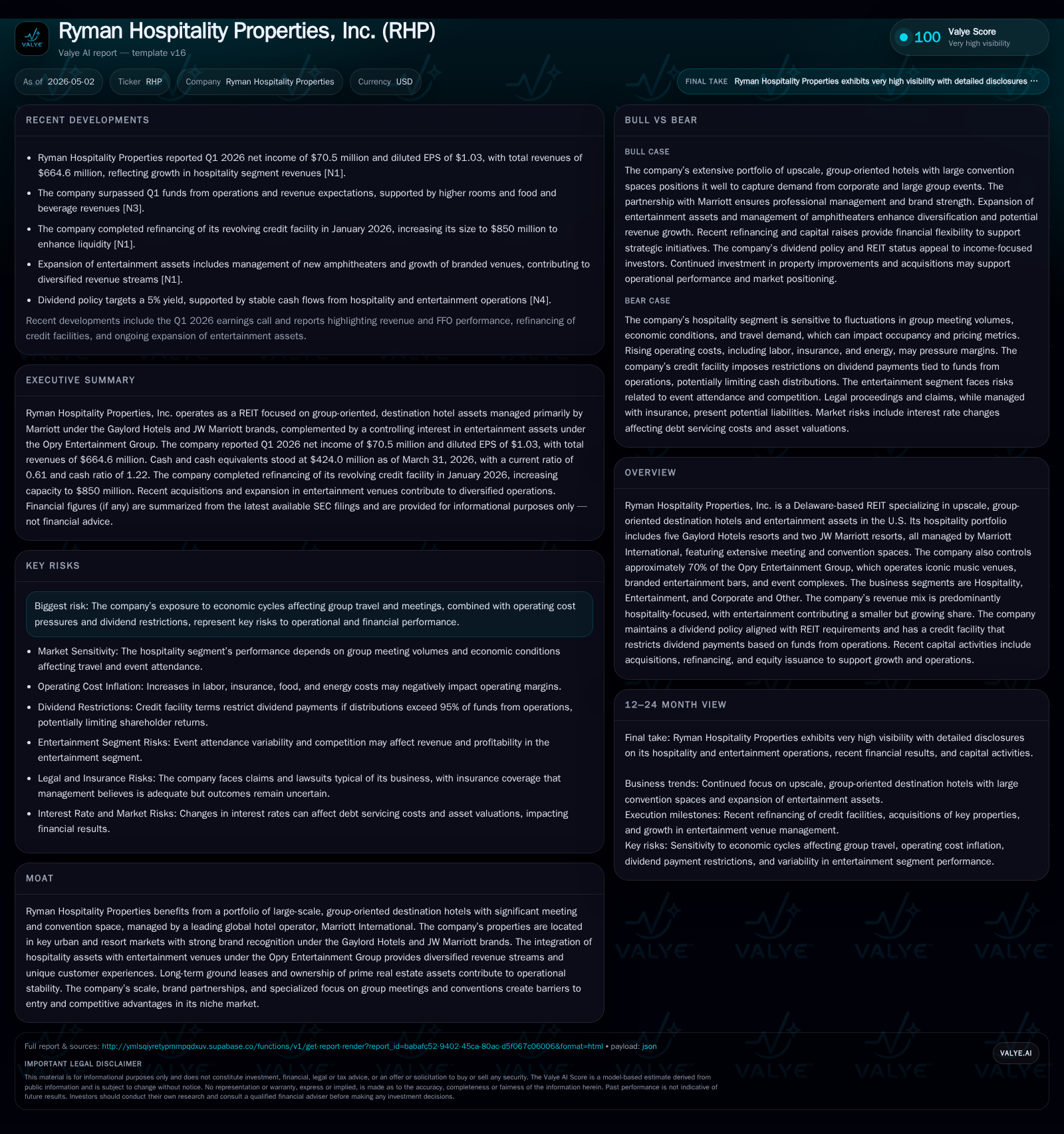
Ryman Hospitality Properties bolstered its capital structure by issuing $700 million of 5.75% senior notes due 2034, improving financing flexibility amid ongoing investments in its upscale hotel portfolio and entertainment venues. The company's core business remains anchored in large-scale, Marriott-managed group-oriented resorts with extensive meeting spaces, complemented by its entertainment segment centered on iconic Nashville music venues. Key growth drivers include rising demand for group meetings, strategic property expansions, and diversified revenue streams from entertainment assets. Risks stem from cyclical demand sensitivity and operational cost pressures, while the company’s credit facilities and covenant structure moderate financial flexibility. Upcoming milestones focus on execution of capital projects and monitoring event booking trends.
Latest Quarterly Operating Update Highlights
Ryman Hospitality Properties filed its latest quarterly report (10-Q) on May 1, 2026, revealing a significant liquidity enhancement via the private placement of $700 million aggregate principal of senior notes due March 2034 at a coupon rate of 5.75% [S2]. This issuance joins the company's existing unsecured senior notes stack and strengthens its capital structure by locking in comparatively attractive fixed-rate financing with a long maturity horizon. Alongside this financing move, Ryman amended its revolving credit facility to increase borrowing capacity from $700 million to $850 million while extending the maturity date to January 28, 2030 [S7]. These capital activities reflect proactive balance sheet management supporting ongoing investment plans and potential strategic initiatives.
Concurrently, new accounting standards update ASU 2024-03 mandates more detailed disaggregation of expense line items on interim and annual bases starting in fiscal year 2026 [S2]. While this does not materially affect reported results yet, it enhances future visibility into specific cost components such as employee compensation and depreciation expenses.
The April 30, 2026 Form 8-K filing included a revision to certain financial guidance metrics reflecting updated assessments of operating conditions through Q1 and anticipated headwinds [S3]. Analysts noted that actual first-quarter performance exceeded expectations for funds from operations (FFO) and revenue driven by strong group demand recovery and successful price realization efforts at core properties [N3].
Business Model: Group-Focused Destination Hospitality and Entertainment
Ryman Hospitality Properties operates as a real estate investment trust (REIT) specializing in premium large-scale group-oriented resorts primarily concentrated in key U.S. urban and resort markets [S1]. The hospitality portfolio consists mainly of five Gaylord Hotel resorts—with room counts ranging from approximately 1,500 to nearly 3,000 rooms each—and two JW Marriott resorts aggregating about 2,000 rooms combined. Each property includes expansive meeting space facilities; for example, Gaylord Opryland alone offers approximately 640,000 square feet dedicated to meetings, exhibits, pre-function areas, and ballrooms [S1]. This scale allows Ryman to serve convention customers requiring sizable contiguous event footprints that few competitors can match.
Day-to-day hotel operations are managed by Marriott International under long-term agreements ensuring brand alignment with global standards and access to Marriott’s distribution network and loyalty clientele—a critical advantage given the specialized nature of group business segments [S1]. Revenue is principally generated from room rentals billed primarily to group customers—typically corporate meetings or industry conventions—augmented by ancillary revenues from food & beverage banquets within event spaces.
Complementing hospitality is the Entertainment segment controlled through Ryman’s ownership (approximately 70%) of the Opry Entertainment Group. This includes landmark music venues like the Grand Ole Opry House and Ryman Auditorium in Nashville plus branded bars such as Ole Red Nashville. These venues diversify income streams into admissions ticketing, retail concessions, food & beverage associated with live events, and event hosting fees generating incremental cash flow not correlated directly with hotel occupancy cycles [S1].
The Corporate & Other segment consists primarily of administrative offices including the company's headquarters building located near Gaylord Opryland.
Competitive Position and Industry Dynamics
Ryman’s competitive moat derives largely from capital-intensive assets tailored for large-scale group functions—a niche difficult to replicate due to high development costs related to contiguous meeting space size combined with premium hotel accommodations. Locations such as Nashville (Gaylord Opryland) benefit from vibrant domestic travel demand hubs with strong draw for convention organizers seeking integrated experiences combining lodging with entertainment options offered through OEG venues. The company also holds robust land positions via fee ownership or long-term ground leases (up to 75 years with renewal options) that underpin operational stability amid market fluctuations [S1].
Marriott’s management role adds another layer of competitive differentiation by delivering consistent service levels recognized globally by corporate planners. Additionally, few competitors can replicate this integration of hospitality with iconic entertainment properties under one corporate umbrella in concentrated geographic regions.
Industry-wise, the demand for meetings-focused hospitality has demonstrated structural resilience particularly post-pandemic as corporations rebalance toward live events over virtual alternatives despite intermittent volatility from economic cycles impacting discretionary budgets. Pricing power appears durable given limited supply additions in large contiguous meeting venues combined with sustained demand growth metrics reported recently by Ryman peers nationally.
Growth Drivers and Expansion Opportunities
Key growth drivers include:
- Post-pandemic meeting demand rebound: Corporations reinstating larger-scale conventions are driving incremental volume gains across room nights booked at Gaylord hotels along with increased banquet spending per event attendee due to inflation-driven food & beverage pricing dynamics [N2][N3].
- Convention space expansion: Planned capital expenditures involve expanding meeting capacity notably at flagship Gaylord Opryland alongside renovations to guestrooms enhancing overall customer experience quality aimed at sustaining higher rate structures [S1][N1].
- Diversification via entertainment venues: Incremental revenue flows from OEG’s iconic venue performances reduce reliance solely on hotel occupancies while enhancing brand affinity among visitors seeking authentic regional experiences within Nashville’s music scene [S1].
- Land development optionality: Ownership or control over adjacent parcels provides potential avenues for future resort expansion or complementary mixed-use projects enhancing site economics beyond core hotel assets [S1].
- Operational improvements leveraging Marriott partnership: Enhanced sales channel effectiveness via Marriott’s global platform enables improved booking cadence especially for international/institutional clients.
These growth efforts tap into entrenched structural preferences favoring face-to-face engagement within highly experiential settings.
Risks and Constraints Impacting Growth Trajectory
Despite strengths, several risks warrant monitoring:
- Cyclical sensitivity: Group travel budgets remain vulnerable during economic downturns or uncertainty periods where corporations delay or downscale events impacting hotel bookings materially.
- Operating cost inflation: Rising labor wages particularly in hospitality sector alongside energy price increases pressure operating margins given fixed nature of many overhead expenses.
- Dividend payout requirements: As a REIT obligated to distribute substantial taxable income portions as dividends limit reinvestment flexibility potentially constraining capital availability for opportunistic growth.
- Interest rate environment: Although recent note issuances lock attractive coupon rates long term (5.75%), any variable rate borrowings remain subject to interest cost volatility affecting net interest expense.
These factors require prudent financial management balancing growth ambitions against cash flow protections.
What to Watch Next: Guidance and Execution Milestones
Stakeholders should closely monitor:
- Quarterly earnings announcements tracking same-store sales trends in occupancy levels and average daily rate (ADR) across flagship properties indicative of sustained pricing power amid evolving macro conditions [N1][S3].
- Updates regarding progress on ongoing capital projects such as meeting space expansions or Category 10 venue constructions which will affect medium-term capacity uplift potential.
- Changes or reaffirmations around dividend policies aligning distribution payments tightly with Funds From Operations (FFO).
- Refinancing activities or credit agreement amendments that could alter borrowing capacity or debt maturities impacting liquidity over horizon beyond next few years.
- Event calendar fill rates especially during peak seasonal periods within Nashville centric properties providing early signals on underlying demand robustness.
Successful navigation through these milestones will validate strategic assumptions supporting valuation frameworks applied by industry participants.
Current Financial Snapshot and Capital Structure Overview
Latest financial snapshot
| Metric | Value | Period |
|---|---|---|
| Cash & equivalents | $424mm | |
| 2026-03-31 | ||
| Total debt | $4.0bn | |
| 2025-12-31 | ||
| Net debt | $3.6bn | |
| 2025-12-31 | ||
| Current ratio | 0.61x | |
| 2026-03-31 |
Source: SEC companyfacts cache [F1].
As of the end of Q1 2026, Ryman maintains liquidity reflected by $424 million cash balances alongside an undrawn but expanded revolving credit facility increased recently from $700 million to $850 million with extended maturity dates out to January 2030 providing financial flexibility entering the current fiscal year cycle [S2][S7].
No covenant defaults were reported as of Q1 end confirming solid compliance posture under current agreements even amidst active debt issuance transactions strengthening long-duration fixed obligations profile reducing near-term refinancing risk exposure further supported by staggered repayment schedules under term loan instruments highlighted previously [S2][S7].
This analysis is based solely on disclosed company SEC filings as well as recent reputable market news sources without offering investment advice or speculative forecast predictions.
Disclaimer: This is research-only, informational analysis and not investment advice. It may include AI-generated interpretation and general industry context. Always verify important details using primary sources.

Comments