
LyondellBasell’s Strategic Asset Rationalization and Cost Discipline Amid Industry Cyclicality
Q1 2026 reflects LyondellBasell’s proactive portfolio pruning and operational adjustments to address cyclical pressures in global chemicals.
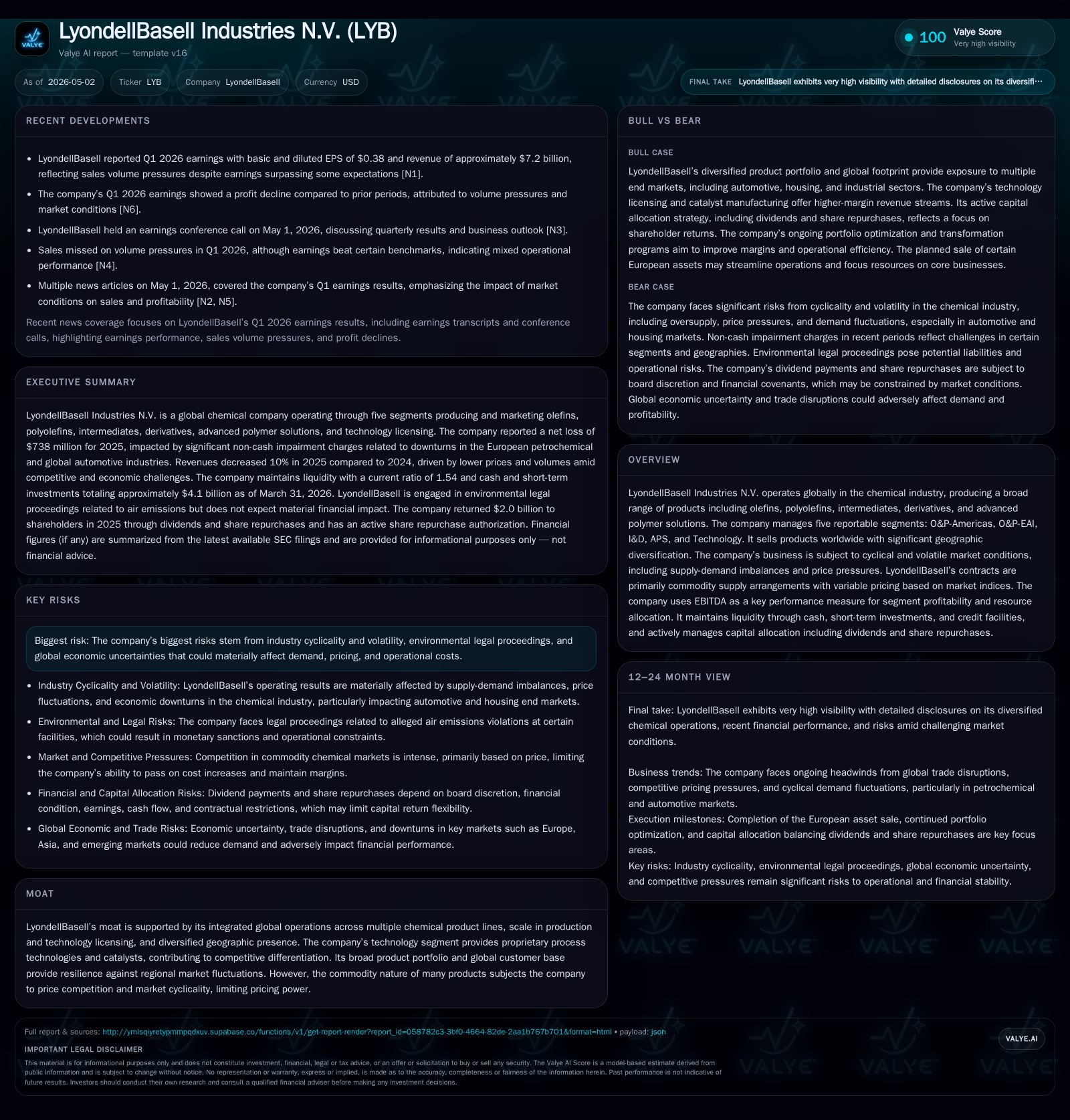
LyondellBasell Industries N.V. reported its first-quarter 2026 results highlighting ongoing challenges from volatile demand in its core polyolefins and olefins markets, which are heavily influenced by global economic conditions. The company completed the divestiture of select European olefins and polyolefins assets, signaling a strategic focus on core markets and capital efficiency. Its broad product portfolio, including proprietary technology licensing, offers resilience despite commodity price pressures. Near-term growth will depend on navigating cyclical headwinds through cash improvement plans and capital discipline while expanding circular economy offerings. Regulatory and environmental compliance remain a watchpoint given sector risks.
Recent Operating Update: Q1 2026 Results and Strategic Asset Sale
LyondellBasell Industries’ first-quarter 2026 filing [S2] disclosed continued headwinds from subdued volume demand across its core olefins and polyolefins segments, particularly reflecting weakness in Europe, Asia, and the Americas due to global economic softness. The company confirmed the completion of a significant divestiture of select European olefins and polyolefins production assets to AEQUITA [S19], executed pursuant to an October 29, 2025 sale agreement. This move fits a broader strategy to sharpen focus on higher-margin or strategically core businesses while managing overall exposure to commodity price cyclicality.
Simultaneously, LYB emphasized progress toward its cash improvement plan initiated in April 2025 [S7]. This plan initially aimed for $600 million annualized savings but surpassed this with $800 million achieved in 2025; it now targets $1.3 billion cumulatively by the end of 2026 through operational efficiencies, capital deferral, and fixed cost reductions.
Business Model: Commodity Production with Technology Differentiation
LyondellBasell operates an integrated chemical manufacturing model with five main reportable segments encompassing Olefins & Polyolefins (O&P) split between Americas and Europe/Africa/India (EAI), Intermediates & Derivatives (I&D), Advanced Polymer Solutions (APS), and Technology [S1]. Its revenue generation hinges primarily on large-scale production and sale of commodity petrochemical products such as ethylene, propylene, polyethylene, polypropylene, intermediates like ethylbenzene, styrene monomer, as well as differentiated polymer solutions.
Revenue streams largely arise from variable-priced supply contracts indexed to commodity market benchmarks. This exposes LYB to considerable volatility in unit sales volumes as well as pricing fluctuations driven by supply-demand imbalances in global petrochemical cycles [S26]. Profitability similarly depends on plant operating rates and securing feedstock at competitive costs.
A key strategic strength lies in LYB's Technology segment, which develops proprietary process technologies and catalysts that it licenses globally. This segment affords incremental margin potential via intellectual property royalties distinct from highly commoditized product sales [S9]. However, intellectual property protection is challenged by the nature of international patent environments.
Industry Structure and Competitive Position
The global chemical industry for olefins and polyolefins is characterized by cyclical capacity expansions leading to intermittent oversupply phases that depress prices and margins [S27]. LyondellBasell's scale confers cost advantages in feedstock procurement, logistics integration, and manufacturing efficiency spread across geographies including the U.S., Europe, Asia Pacific, Mexico, China, Japan, and several European countries [S26].
Competition is intense among major integrated chemical producers with significant emphasis on price given the commodity nature of many products. While differentiated APS products provide some resilience against pure price competition by targeting specialized applications with higher performance requirements, bulk polymers remain vulnerable to variable market pricing.
Recent divestiture activity indicates LYB is streamlining operations geographically in Europe where regulatory complexity and overcapacity have pressured returns [S19]. Its diversified geographic footprint mitigates regional downturns but also exposes it to currency fluctuations and evolving trade policies.
Growth Drivers
Despite near-term industry cyclicality, LYB’s path to growth is underpinned by several structural factors:
- Circular Economy Initiatives: LYB updated its sustainability ambitions aiming to produce/market 800 thousand metric tons per year of recycled or renewable-based polymers by 2030 alongside substantial greenhouse gas (GHG) emission reductions [S1]. This positions LYB favorably amid rising regulatory pressure for sustainability within industrial supply chains.
- Technology Licensing: Continued monetization of proprietary process technologies offers recurring revenue sources less exposed to commodity cycle severity.
- Operational Efficiencies: Execution of cash improvement plans improves margins even when volumes or prices soften short term [S7].
- Geographic Market Dynamics: Emerging markets in Asia Pacific remain a potential growth avenue despite current macroeconomic uncertainty.
- Maintenance Capex Prioritization: Balanced capital allocation focusing on maintenance capex safeguards plant reliability conducive to stable output even during downturns.
Risks / Watchpoints / Growth Constraints
Several risks temper LyondellBasell’s prospects:
- Cyclicality & Volatility: Historical volatility in petrochemicals pricing driven by periodic capacity gluts constrains earnings predictability [S27].
- Price Competition: Limited pricing power due to commoditized products compressed margins during oversupply phases.
- Environmental Compliance Costs: Ongoing exposures from environmental legal proceedings including air emissions suits in Texas state courts [S1], plus expected increases in compliance spending related to evolving climate laws are cost drags [S16].
- Global Economic Uncertainties: Exposure to recessions or dampened industrial activity in key regions such as Europe or China could reduce volumetric demand significantly [S24].
- Regulatory & IP Protection Risks: Challenges defending intellectual property rights internationally can affect Technology segment profitability [S9].
- Debt & Capital Allocation Restrictions: Senior revolving credit facility amendments restrict share repurchases above certain leverage thresholds constraining total shareholder return flexibility [S6], [S16].
What To Watch Next
Key indicators for evaluating LYB's trajectory include:
- Quarterly revenue volume trends particularly in O&P Americas and EAI segments reflecting end-market demand.
- Progress on achieving targeted cash improvements totaling $1.3 billion through cost control initiatives across 2026 [S7].
- EBITDA margin stabilization or improvement signaling effective mitigation of pricing pressures.
- Updates on sustainability KPIs related to recycled polymer output volumes and GHG reductions announced during investor communications.
- Impact assessment from concluded European divestiture on earnings quality going forward.
- Legal developments pertaining to environmental litigation or regulatory enforcement actions that might increase liabilities.
- Debt covenant compliance especially relating to leverage ratios influencing dividend policy or buyback capabilities.
Financial Profile Snapshot (as of March 31, 2026) [F1]
Latest financial snapshot
| Metric | Value | Period |
|---|---|---|
| Cash & equivalents | $2.6bn | |
| 2026-03-31 | ||
| Total debt | $11.2bn | |
| 2026-03-31 | ||
| Net debt | $8.6bn | |
| 2026-03-31 | ||
| Current assets | $11.1bn | |
| 2026-03-31 | ||
| Current liabilities | $7.2bn | |
| 2026-03-31 | ||
| Current ratio | 1.54x | |
| 2026-03-31 |
Source: SEC companyfacts cache [F1].
While LYB maintains a solid liquidity position with positive current ratio comfort of 1.54x despite substantial net debt levels reflective of capital-intensive operations, dividend adjustments earlier in 2026 indicate capital prudence amid earnings variability [S13].
Disclaimer: This analysis is based solely on publicly available SEC filings up through May 2, 2026, alongside corroborated news sources referenced herein. It is provided for informational purposes only without any investment recommendation or advice.
Disclaimer: This is research-only, informational analysis and not investment advice. It may include AI-generated interpretation and general industry context. Always verify important details using primary sources.

Comments