
ReTo Eco-Solutions Expands Supply Chain Control Amid Ongoing Liquidity Challenges
Recent acquisition of Seven Arrows Supply Chain Limited marks a strategic shift for ReTo, highlighting growth ambitions tempered by financial constraints.
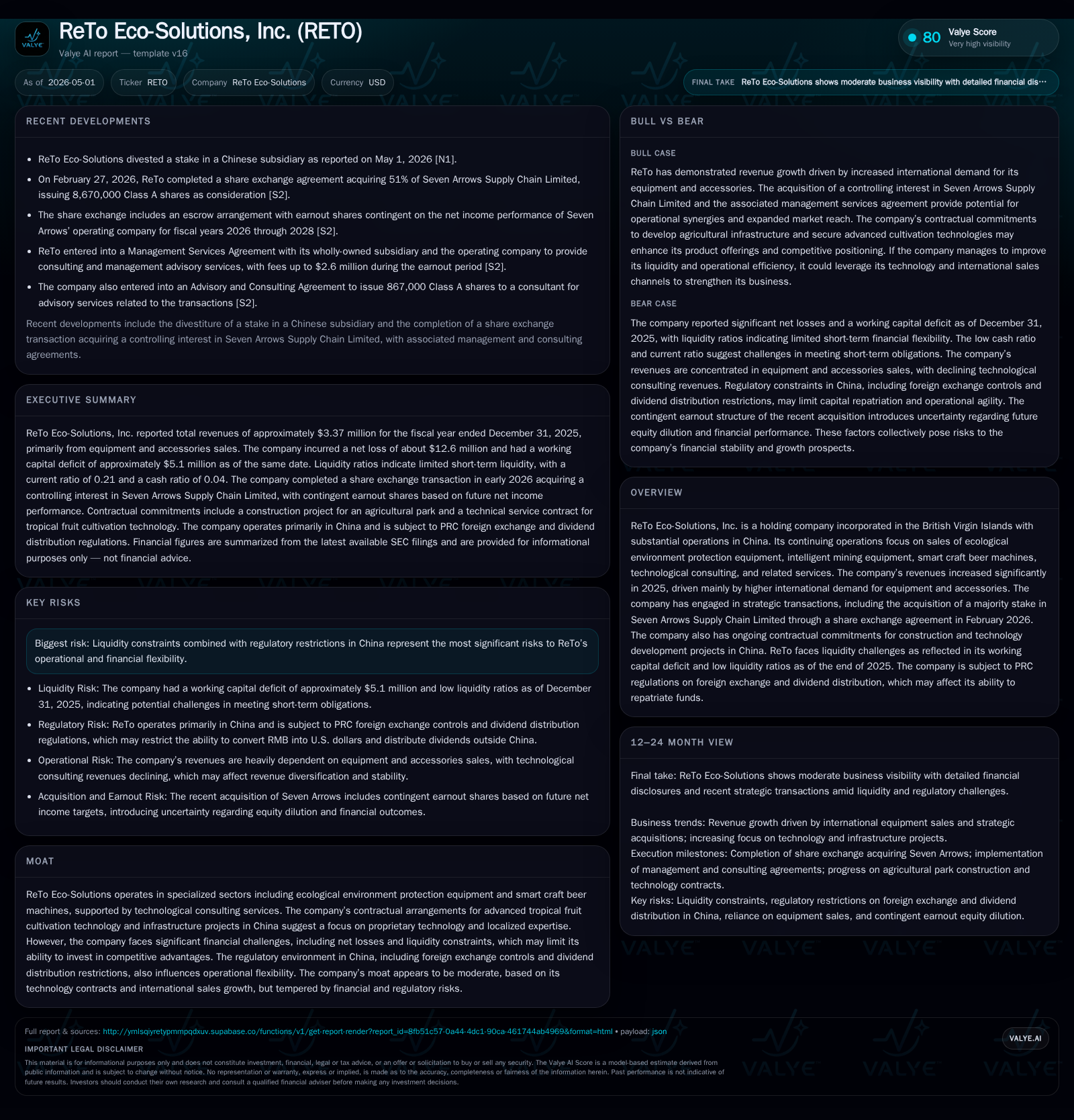
ReTo Eco-Solutions, a British Virgin Islands-based holding company with significant China operations, recently completed a share exchange deal to acquire a majority stake in Seven Arrows Supply Chain Limited. This transaction underscores ReTo's strategic emphasis on strengthening its supply chain and international equipment sales business lines. Despite strong revenue growth driven primarily by overseas demand for ecological protection and intelligent mining equipment, the company faces material liquidity issues with a weak current ratio and significant working capital deficit as of year-end 2025. The operational portfolio is diversified across equipment sales, consulting services, and craft beer machines, but financial and regulatory risks in China limit flexibility and execution capacity.
Recent Operating Update
The latest material development shaping ReTo Eco-Solutions' near-term trajectory is the February 27, 2026 completion of a Share Exchange Agreement under which ReTo acquired a controlling 51% stake in Seven Arrows Supply Chain Limited. The transaction was settled by issuing approximately 8.67 million new Class A shares valued at $1 per share to the seller, who retains escrow shares that vest over three years contingent on net income performance metrics from Seven Arrows' operating company. Escrow shares also serve as indemnification security against post-closing claims [S2]. This acquisition signals a strategic move toward enhancing ReTo's supply chain capabilities and integrating upstream logistics within its core international equipment sales business, which has been the primary revenue driver recently.
Simultaneously, operational disclosure highlights that revenues from continuing operations nearly doubled to $3.37 million in fiscal year 2025 versus $1.83 million in prior year, largely fueled by higher international demand for ecological environment protection equipment and associated accessories sold predominantly to Southeast Asia, Middle East, and African customers (73% of sales) [S1][F1]. However, this volume expansion was accompanied by a sharp rise in cost of goods sold—up more than 100%—limiting gross margin improvement to 35%. Notably, fixed costs such as salaries and depreciation did not increase proportionally despite elevated production activity.
Business Model Analysis
ReTo Eco-Solutions operates primarily as a holding company headquartered in the British Virgin Islands with substantial operations conducted through subsidiaries in China [S1]. Its business model centers on multi-sector ecological technology solutions comprising:
- Sales of Ecological Environment Protection Equipment: These products cater to environmental restoration, pollution control, and sustainable construction needs.
- Intelligent Mining Equipment: Advanced machinery designed to improve mining productivity while adhering to environmental regulations.
- Smart Craft Beer Machines: An unconventional but strategically complementary segment targeting niche consumer beverage markets.
- Technological Consulting Services: Offering technical expertise particularly related to agricultural technology deployments such as tropical fruit cultivation.
Revenue dynamics are heavily dependent on third-party customers buying equipment and accessories internationally (73% of sales), with roughly one-quarter derived domestically within China. Contractual arrangements underpinning the company’s agricultural technology services include long-term commitments like the Facility Agriculture Park construction contract valued at RMB102 million (~$14.5 million), scheduled for completion no later than September 30, 2027 [S6][S12].
Sales contracts typically involve milestone or progress-based payments driving cash flow timing sensitivity; prices contain variable components linked to raw material cost fluctuations (steel and cement), enabling partial pass-through but exposing margins to commodity volatility without formal hedging programs [S13]. The acquisition of Seven Arrows should increase control over supply chain quality and costs given rising logistics complexity for international equipment delivery.
Industry Structure and Competitive Position
ReTo occupies a specialized niche intersecting environmental tech manufacturing with intelligent mining solutions—a sector characterized by moderate competition from both domestic Chinese manufacturers and global suppliers seeking market penetration through technology differentiation or price competitiveness. While its smart craft beer machine business diverges from core operations, it represents an attempt at diversification aligned with emerging lifestyle-tech convergence trends.
The Chinese market integration presents both opportunity due to governmental emphasis on ecological sustainability initiatives and risk owing to complex regulatory frameworks governing foreign investment structures, exchange controls on currency conversion impacting dividend repatriation rights, and reserve requirements limiting profit distributions abroad [S8].
ReTo’s competitive moat is moderate: proprietary technology licenses for tropical fruit cultivation techniques granted under multiyear service contracts provide localized expertise hard for new entrants to replicate quickly. Additionally, recent strategic acquisitions signal intent to vertically consolidate key parts of its value chain such as supply chain logistics via Seven Arrows acquisition. These moves enhance barriers against pure commodity competitors but have yet to translate into consistent profitability owing to lingering operational inefficiencies and capital constraints.
Growth Drivers
Key growth vectors for ReTo include:
- International Demand Expansion: Scaling sales of ecological environment protection equipment primarily across fast-developing Southeast Asian markets plus Middle East and Africa where environmental regulation improvements fuel demand for advanced solutions.
- Contracted Infrastructure Projects: Execution of facility agriculture parks integrating advanced cultivation technologies positioned for multi-year revenue streams tied to construction milestones scheduled through late 2027 [S12].
- Technological Service Contracts: Licensing agreements with companies like Beijing Haoyu Runze Technology Group limit competition through patents covering tropical fruit varieties cultivation methods including passion fruit and dragon fruit as well as Australian finger lime [S6].
- Supply Chain Integration: The recent majority stake acquisition in Seven Arrows Supply Chain Limited aims at strengthening logistical efficiency end-to-end—from procurement through delivery—potentially improving cost control amid increasing raw materials costs.
- Product Portfolio Diversification: Continued development of smart craft beer machines diversifies revenue sources into more consumer-oriented segments potentially buffering cyclical downturns.
Each driver is measurable through growing bookings backlog from international customers noted in filings alongside construction progress payment schedules verifying revenue recognition visibility.
Risks and Constraints
Despite promising top-line growth prospects anchored by technological licensing and international sales momentum, several headwinds temper outlook:
- Liquidity Shortfall: With cash & equivalents at merely $250K compared against $6.4 million current liabilities (current ratio ~0.21), ReTo faces severe short-term funding gaps necessitating reliance on bank borrowings or related-party loans absent committed equity injections [F1][S9].
- Large Net Losses: Operating loss exceeded $11.6 million fueled partly by impairments exceeding $8.7 million (including goodwill) impacting equity cushions very materially [F1][S1], restricting reinvestment capacity.
- Regulatory Barriers: PRC foreign exchange control regulations restrict free movement of RMB outflows limiting dividend payability to overseas shareholders; statutory reserve requirements further reduce distributable profits limiting capital return flexibility [S8].
- Commodity Price Volatility: Lack of hedging exposes gross margins particularly during periods of elevated steel or cement pricing which constitutes important input costs for manufacturing [S13].
- Dependence on Contract Execution Timeliness: Infrastructure project delivery delays or customer payment postponements could impair liquidity formation given milestone-based payment structures.
- Escrow Shares Terms: Earnout conditions attached to newly acquired Seven Arrows shares introduce contingent liabilities reducing near-term capitalization certainty [S2].
These elements collectively heighten execution risk demanding close monitoring whether financing avenues materialize under acceptable terms following losses accumulated.
What to Watch Next
Critical upcoming indicators include:
- Progress updates on Facility Agriculture Park construction including milestone completions triggering contractual payments scheduled through Q3 2027.
- Quarterly revenue growth rates specifically international equipment sales signaling sustained order momentum beyond one-off gains recorded in FY2025.
- Operating cost leverage improvements especially managing SG&A expenses that remained elevated relative to revenues despite scale-up observed last fiscal year.
- Status disclosures regarding liquidity enhancement efforts including potential new equity financing rounds or refinancing bank borrowings on improved terms.
- Development outcomes related to integration synergies from Seven Arrows ownership along with any earnout vesting announcements which could affect share count dilution dynamics.
- Management commentary addressing regulatory impacts pertaining to cross-border capital movements amidst evolving PRC foreign exchange policies.
Together these form key milestones defining if ReTo can transition from top-line growth into sustainable profitability while navigating its complex operating environment.
Financial Profile Summary
Latest financial snapshot
| Metric | Value | Period |
|---|---|---|
| Cash & equivalents | $250008 | |
| 2025-12-31 | ||
| Current assets | $1319578 | |
| 2025-12-31 | ||
| Current liabilities | $6mm | |
| 2025-12-31 | ||
| Current ratio | 0.21x | |
| 2025-12-31 |
Source: SEC companyfacts cache [F1].
Based on latest full-year data ending December 31, 2025:
- Latest debt metrics dated end-2022; no updated debt figures available currently indicate likely leverage level; † Net debt calculated as total debt minus cash & equivalents.[F1]
Losses stem mainly from high operating expenses including non-cash impairment charges totaling nearly three quarters of operating losses reported.[S1]
Trading off aggressive investment scale-up with constrained liquidity resources explains ongoing strained capital structure requiring close attention going forward.[S9]
This analysis is based exclusively on publicly filed documents through SEC forms including the latest quarterly Form 6-K filed March 4 and annual Form 20-F filed May 1 for fiscal year ended December 31 and does not constitute investment advice or recommendations.
Disclaimer: This is research-only, informational analysis and not investment advice. It may include AI-generated interpretation and general industry context. Always verify important details using primary sources.

Comments